

This English version was translated from the Chinese original with AI assistance. The Chinese text is authoritative.
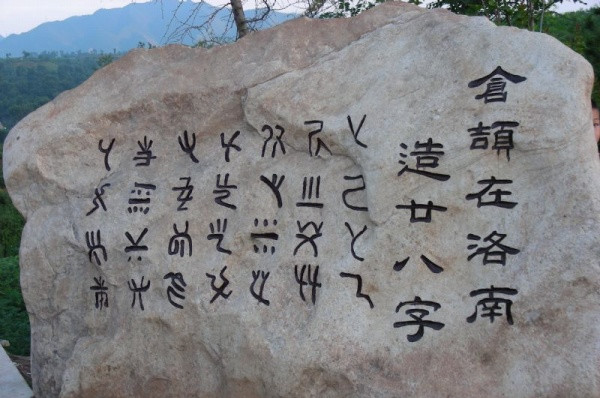
That Chinese characters originated with Cangjie’s creation of writing is a historical fact clearly recorded in Chinese texts, yet in modern times it has been greatly challenged. The earliest written records of “Cangjie creating characters” that can be seen today are texts from the Warring States period. The Xunzi, “Dispelling Obsession,” says: “Many have been fond of writing, but Cangjie alone has been handed down, because he was single-minded.” The Han Feizi, “The Five Vermin,” says: “When Cangjie of old created writing, what encircles itself he called ‘private’ (私), and what turns its back on the private he called ‘public’ (公).” The Lüshi Chunqiu, “The Ruler’s Keeping,” also records: “Xi Zhong made carts, Cangjie made writing, Houji made farming, Gao Yao made punishments, Kunwu made pottery, and Gun of Xia made city walls; what these six men made was fitting.” The Huainanzi, “The Basic Warp,” records: “When Cangjie of old created writing, heaven rained millet and ghosts wept at night.”
Cangjie, also written 苍颉, had the compound surname Hougang and the title Lord Shihuang (the Sovereign Historian); he was the court historian of the Yellow Emperor, Xuanyuan, and later generations revered him as the “Sage of Character Creation.” He lived around the 26th century BC, some four to five thousand years ago. Because early written records are lacking, the historical stories of Cangjie creating characters are now treated as myth. Legends and relics of Cangjie’s creation of characters are found in many places along the middle and lower reaches of the Yellow River.
In Shiguan Village, 35 li northwest of the county seat of Baishui County in today’s Shaanxi, there are Cangjie’s tomb and Cangjie’s temple. Historians believe Cangjie was born and buried here. Philologists also believe Baishui was the birthplace of Cangjie’s creation of characters, because the character 泉 (quán, “spring”), as in “source spring” (源泉), splits apart into 白 (bái, “white”) and 水 (shuǐ, “water”) — Baishui.
In Dong’er Village in Linfen, Shanxi — today’s Xizhao Village in Yaomiao Town — it is said that from the Han and Tang dynasties on, a shrine to Cangjie, called the “Holy Shrine of Cangjie,” always stood in the village, and sacrifices were held there every spring. The shrine had more than 400 rooms; of its two wings, one was the Chongwen Guild Hall and the other the Peiying Charitable Estate, and the local and provincial examinations were held there. In the Qing dynasty, after the shrine burned down, a three-room shrine was rebuilt. In the 49th year of the Qianlong reign (1784), Li Zaorong of Hejian, magistrate of Linfen County, built a stele pavilion beside the Cangjie shrine, and the stele bore five large incised characters in regular script: “Place where Cangjie created characters.” The shrine has since been destroyed, and the stele is kept in the Temple of Yao. The Gazetteer of Pingyang Prefecture records: “In high antiquity Cangjie was the ancient historian of the Yellow Emperor. He was born with four eyes and had virtue. He saw a numinous tortoise bearing a chart, with blue-green writing on a red shell, and thereupon fathomed the changes of heaven and earth. Looking up, he observed the round and curving changes of the Kui constellation; looking down, he examined the patterns on tortoise shells, birds’ feathers, mountains and rivers; pointing with his palm, he created writing. When writing was complete, heaven rained millet, ghosts wept at night, and dragons went into hiding. Today south of the city there is a stele marking Cangjie’s home village.”
