

This English version was translated from the Chinese original with AI assistance. The Chinese text is authoritative.
(Reposted from Zhengjian.org)
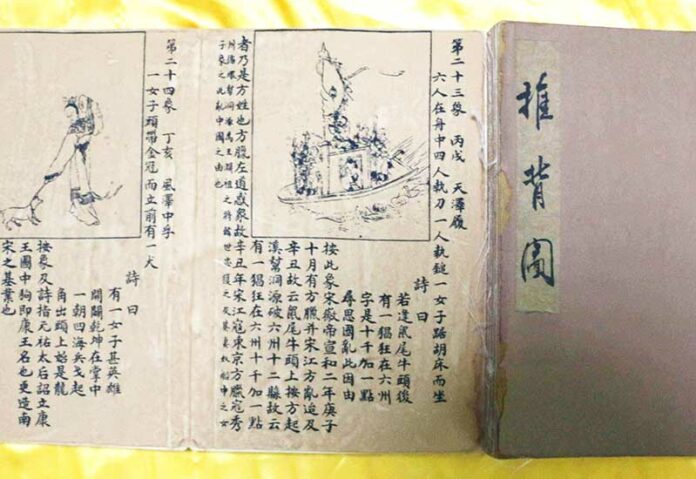
The remarkable book Tui Bei Tu (“Back-Pushing Chart”) was written by Li Chunfeng of the Tang dynasty on the orders of Emperor Taizong of Tang; it foretells the destined rise and fall of the realm. Over the ages there have been many interpretations and commentaries in the world, with endless wonder.
Li Chunfeng’s Tui Bei Tu is recorded in many documents of the Song dynasty, and the book is also listed in the “Treatise on Literature” of the History of Song.
Some also say that the Tui Bei Tu was written jointly by Li Chunfeng and Yuan Tiangang. Many versions have come down to the present, a mixture of the genuine and the fake.
Among them, the version of the Tui Bei Tu annotated by Jin Shengtan uses its words with hidden mechanisms; its riddles are divinely ingenious, its writing brilliant and profound, its drawings simple and unworldly, and its meaning far-reaching. Verified by history from the Tang and Song to the Republic, it is true and not false, every image miraculously fulfilled, and it is recognized as the genuine article. It also holds the breadth, depth and unfathomable mystery of traditional culture.
The other versions of the Tui Bei Tu, by contrast, have crude and cluttered drawings, clumsy wording and an even more confused order, and their prophecies cannot all be verified. They are clearly all altered fakes, deliberately used to confuse people.
The Tui Bei Tu annotated by Jin Shengtan was included by a recluse in the book Seven Chinese Prophecies in the fourth year of the Republic (1915), printed and published, and spread throughout the world. Over more than a hundred years, many people have studied the Tui Bei Tu and deciphered several images concerning modern times, such as the First World War and the Japanese invasion of China. Especially in recent years, some perceptive people have interpreted the twenty-odd images after the Republic, and several of their readings are quite insightful and have been borne out. Bit by bit they have probed and seen, finding faint traces. But none of them has truly, comprehensively and systematically deciphered Li Chunfeng’s prophecy; the divine thought behind those pictures has not yet been revealed. And some take the words at face value, do not grasp the overall changes in the nation’s fortunes, and guess and judge wildly.
Because the times have changed, the miraculous depth of the classical language has been distorted and has declined; with the shallow, frivolous idiom of modern times it is very hard to understand the profound mysteries of classical divinely imparted culture. Let alone a prophecy as deep and secret as the Tui Bei Tu, so profound as to seem almost absurd, which makes one feel as if facing an unreadable wordless book from heaven.
In fact, the Tui Bei Tu is indeed a book from heaven; its pictures describe heaven’s numbers. Here I cast a stone to attract jade: I will systematically decipher the true meaning of this divine work, Li Chunfeng’s Tui Bei Tu, briefly probing its profound and divine flavor, so that the true and complete face of the Tui Bei Tu can now be seen — so that at this time of the final catastrophe, when the winds and clouds gather, people may know heaven and respond to destiny, and the book may serve its true purpose of enlightenment, not failing the great pains and compassionate intent of the sages who passed it on.
Prophecy is an exposition of the mechanism of the Way of Heaven, an expression of the transmission of the messages and arrangements of heaven’s will. It should be said that true prophecies of sages are also a kind, a part, of the great classics of the Dao. The Biejing of the Zhouyi was compiled into a classic afterwards by stringing together divinations that had been cast. Prophecies of sages, however, are enlightenment from heaven’s will given in advance; the Tui Bei Tu in particular can be called an illustrated Book of Changes. The unity of heaven and humanity is not an empty phrase but something real. The true meaning of life and living always lies in knowing heaven and acting in accord with it; this is the very essence of the divinely imparted civilization of traditional Chinese culture. Heaven has its law and earth has its way; through prophecy one can not only comprehend the fortunes of the age and the will of heaven, but also look back through it at the mechanism of the Way of Heaven and confirm the principles of the great Dao in the classics. Cultivating oneself and governing the world are both contained in it.
However, the Jin version of the Tui Bei Tu, that is, the Tui Bei Tu annotated by Jin Shengtan, is also a version whose order has been scrambled. To decipher the Tui Bei Tu, one must first restore the order, and only after restoring it explain it in detail. Please read on carefully.
Deciphering and correctly ordering three key, hard-to-solve images
The order of the Tui Bei Tu has been scrambled; the last twenty-odd images in particular are in disarray, leaving people at a loss, not knowing what they mean, sighing helplessly at the pictures.
Folk legend has it that from the end of the Tang through the Five Dynasties to the early Song, the Tui Bei Tu circulated widely and people vied to read it. Emperor Taizu of Song, Zhao Kuangyin (some say Emperor Taizong of Song, Zhao Guangyi), to prevent the Tui Bei Tu from stirring up strife on all sides, unrest in the Song and chaos in the realm, ordered the order of the Tui Bei Tu to be scrambled and then let it circulate confusedly among the people, so that people could hardly tell the true from the false — banning it without banning it.
Is this just hearsay passed by word of mouth among the people, or did it really happen?
Yue Ke, grandson of Yue Fei and son of Yue Lin, records the following in volume one of his Tingshi: Li Chunfeng of the Tang wrote the Tui Bei Tu. In the chaos of the Five Dynasties, kings and lords rose up, and people harbored ambitions, so the study of it flourished all the more. As for the prophecy of “closed mouth, drawn bow,” the house of Wu-Yue even used it to name all their sons, not knowing that it foretold the glory of the founding mandate of Emperor Zhaowu. The signs of the Song’s rise and receipt of the mandate were especially clear. When the founding emperor took the throne, he first issued an edict banning prophetic books, fearing they would mislead the people’s minds and multiply punishments. But the chart had been circulating for several hundred years, and many people kept copies; it could no longer be gathered in, and the officials were troubled. One day Zhao, Prince of Han, reported a case from Kaifeng, saying that the offenders were so many they could not all be executed. The emperor said: “There is no need to ban it further; we should simply confuse it.” So he ordered the old version taken, and apart from the parts already fulfilled, all the rest were jumbled in order and written out mixed up, a hundred copies in all, to circulate alongside the existing ones. Thereupon those who passed it on were confused about the order and did not know which was wrong; and those who still had copies, finding them no longer fulfilled, also threw them away and did not keep them.
Put simply, this passage says: Li Chunfeng of the Tang wrote the book Tui Bei Tu. At the end of the Tang and in the Five Dynasties, when rival heroes contended for the realm, the fashion for studying the Tui Bei Tu was very strong. Although the Song was the orthodox dynasty mandated by heaven, the Song emperor worried that the wide circulation of the Tui Bei Tu would unsettle people’s minds, and at first issued an edict to ban the book completely. But the book had been circulating for several hundred years, many people kept copies, and the court found it hard to suppress. So he thought of another trick: he ordered the original order of the book scrambled and then printed and distributed. Mixing true and false, the aim was to pass off the false as the true and confuse people’s understanding of what was genuine in the Tui Bei Tu, thereby banning it without banning it.
In this way the original face of the Tui Bei Tu was completely changed. From this we can know for certain that the Tui Bei Tu has been out of order since the early Song.
So how can the original order be restored? The method most commonly used is to decipher it with the Eight Trigrams of the Book of Changes, comparing them with events that have occurred, since the Tui Bei Tu has hexagram images. The study of the Eight Trigrams is broad, profound and incomparably subtle, and in principle it should be able to decipher it; yet despite great efforts, people have not truly restored the order and deciphered it. It can be said they went in the opposite direction, with little effect.
Why is this so? Because although the Eight Trigrams of the Book of Changes are incomparably subtle and profound on many levels, not everyone who studies them can fully understand them. Especially in the present age, the essence of traditional culture has been damaged beyond recognition and has declined greatly; what people know is only some superficial and fragmentary cultural features. The Eight Trigrams are not merely, as they appear on the surface, a flat sequence of eight trigram images arranged and deduced back and forth; hidden within them is an even more profound “mysterious order.” The changes of the Eight Trigrams are three-dimensional. It is like looking up at the starry sky: what you see is the projection of the stars onto a curved surface, in disarray; but in reality the stars in the sky are large and small, far and near, arranged in a three-dimensional, mysterious order, not on one plane. Nor is it three-dimensional in a single space; it involves changes across many space-times — in ancient terms, the comings and goings of many layers of heaven.
To fully understand the Eight Trigrams of the Book of Changes, you must learn those “mysterious orders,” “traversing” back and forth — the three-dimensional Eight Trigrams. But such lost arts are very hard to find today.
Put this way, it seems the scrambled order cannot be restored, which is discouraging.
But is there really no hope?
Yet I have, by another method, astonishingly found the original order of the Tui Bei Tu!!
I cannot yet “traverse the Eight Trigrams,” so I dare not use the hexagram images to find the order; if I did, I would lose the truth, distort the depth, make the civilization shallower and lose sincerity. I deciphered it using the reasoning of Sherlock Holmes’s detective work combined with the classical divine meanings of Chinese culture. Just as wonderful, just as astonishing! Truly it can be said: “Where hills and streams end and there seems no road, beyond dark willows and bright flowers lies another village!”
Below I decipher the Tui Bei Tu and restore its order at the same time.
“The one who tied the bell must untie it”: since the problem lies with the Song emperors, I begin with the Song. The Song scrambled the order, and after the scrambling it must have been especially favorable to the Song. Starting from this line of thought, I studied the Song images in detail and compared them with those later on, and found the flaw!
Look at Image 52 of the Jin version of the Tui Bei Tu:
Yimao; Qian below, Kun above; Tai (Peace)

The prophecy says:
A comet suddenly appears; it bodes ill for the northeast.
Walking alone, where is he going? He gazes toward that happy land.
The verse says:
A point of the Chanqiang comet appears in the east; Wu and Chu still have an emperor.
The guest who comes from outside the gate will not last long; heaven and earth are remade at Jiao and Kang.
Explanation:
The figure in the picture of this image is clearly an emperor, in the same dress as in the several Song images. So does it belong to the Song? How did it come to be placed at the back?
First look at the line “heaven and earth are remade at Jiao and Kang,” which is crucial. “Heaven and earth are remade” means a change of dynasty, while the two characters 角 (Jiao) and 亢 (Kang) are subtle and have puzzled many people for a long time. Jiao and Kang are the first and second of the seven lunar mansions of the Azure Dragon of the East among the twenty-eight mansions, so people naturally delved into the arrangement of the mansions, splitting hairs to explain the time of the next arrangement, but their explanations missed the point. Here 角 is taken to mean “first,” and “first” is 元 (yuán). 亢 is taken to mean rising up. Together they say: the change of dynasty lies in the rise of the Yuan dynasty.
Next look at the line “Walking alone, where is he going?” (踽踽何之). It is a character riddle: 踽踽 gives the character 走 (“walk”), and 何之 gives the character 肖; together they make the character 趙 (Zhao, the Song imperial surname).
From the above three points — Song dress, the character 趙, and the change of dynasty lying in the rise of the Yuan — we can conclude that this is an image of the Song.
So what Song event is it? Careful deciphering reveals that this image foretells the fortunes of the state at the end of the Northern Song — the affairs of Emperor Huizong of Song.
“Walking alone, where is he going? He gazes toward that happy land”: these two lines correspond to the emperor walking under the sun in the picture. They refer to Emperor Huizong of Song going against heaven alone, caring all his life only for his own hobbies — calligraphy, painting and other arts — losing his ambition in trifles and neglecting the emperor’s duty of governing the state and securing the realm. As a result treacherous ministers held power in the great Song, the court was in disorder, the common people suffered, the nation’s fortunes declined day by day, and heroes were pushed aside and suppressed — especially the chivalrous heroes driven to Mount Liang, who had no way to serve their country.
“A comet suddenly appears; it bodes ill for the northeast”: these two lines correspond to the sun at the top of the picture, referring to the Jin state quietly rising in the northeast. The great Song failed to perceive its wolfish ambitions, which led to the Northern Song later being destroyed by the Jin. The sun is also called the “golden crow” (金乌), and 金乌 suggests 金乌珠 (Jin Wuzhu), again hinting that the man who led the Jin invasion of the Song was “Jin Wuzhu” (Wanyan Wuzhu).
“A point of the Chanqiang comet appears in the east; Wu and Chu still have an emperor”: this means that although the Jin, the comet of the Northern Song, would destroy the Northern Song, the Song’s realm would not be entirely lost; south of the Yangtze there would still be half the country.
“The guest who comes from outside the gate will not last long; heaven and earth are remade at Jiao and Kang”: this says that the Jin, coming from outside the northeastern gate, would also not last long; after the rise of the great Yuan it would in turn be destroyed by the Yuan, which then destroyed the Southern Song and unified the Central Plains.
Furthermore, the line “heaven and earth are remade at Jiao and Kang” hides another key secret: in “remade” (再造), 造 (zào) sounds like 趙 (Zhào). Jiao and Kang also mean the Star of Longevity; the Star of Longevity is an auspicious person (吉人), which is the character riddle 佶 (jí). Together they make 趙佶 (Zhao Ji).
Zhao Ji was the name of Emperor Huizong of Song.
The setup here, with one line serving many purposes and one picture serving many purposes — wonderful!
This foretold Emperor Huizong of Song and the final fortunes of the Song after him, yet this image was moved to the back and became Image 52. Deciphering this image is extremely important; it is the key to restoring the order!!
Because once this image is understood, one also understands the Song emperor’s thinking in scrambling the order — knowing by what reasoning and how the Song emperor scrambled it, the original order can be restored!
This image is clearly an omen of the Song’s decline, and it was moved to the back. Evidently the intention was to move everything that looked like a prophecy of the Song’s decline, as well as everything to do with war and fighting, to the back, and then scramble the order to deceive people, so that the great Song would enjoy peace and its “realm be forever secure.” What a well-calculated scheme!
Thus there must be much to be read in how the Song images were arranged after the scrambling!
There is also Image 48 of the Jin version:
Xinhai; Li below, Qian above; Tongren (Fellowship)

The prophecy says:
Between mao and wu, its image is Li (parting).
Eight oxen pull and move; harmonious and bright.
The verse says:
Water and fire in accord, the people are blessed; holding a golden halberd, he does not kill the rebels.
Within fifty years, a general-minister; green, green grass grows out from the fields.
Explanation:
Judging by the picture and text, a fight between a dragon and a snake is used to signify a struggle between two sides: one side is “eight oxen pull and move,” meaning brave and powerful; the other is “harmonious and bright” (雍雍熙熙), meaning noble and civilized.
“Between mao and wu, its image is Li”: this both indicates that the dragon and snake fight a war of separation, and hints at the time of the event — in the fourth and fifth months.
This image has the line “Within fifty years, a general-minister,” a clear point in time; if the starting point of the fifty years is found, this image is deciphered. Look at the next line.
“Green, green grass grows out from the fields” — this line is the most crucial. “Green, green grass” (青青草) hints by sound at “the Qing dynasty” (清朝).
Once the Qing dynasty emerges, it becomes perfectly clear. From the founding of the Later Jin to the early years of Kangxi was about fifty years, and at that time there was a powerful minister, Oboi. Combined with the earlier hints, we know that this image prophesies Kangxi’s removal of Oboi — indeed a major event in the nation’s fortunes.
“Water and fire in accord, the people are blessed; holding a golden halberd, he does not kill the rebels”: water and fire in accord (Ji Ji) is the balance of yin and yang, which has the meaning of 康 (kāng, “well-being”), and 熙 has the meaning of auspiciousness; the whole line is the character riddle “康熙” (Kangxi). It corresponds to the heavenly dragon in the picture and refers to Kangxi as ruler adopting a conciliatory and tolerant strategy of governance, promoting Han culture and treating the people well, so that the Manchus and Han turned from fighting like fire and water to accommodating each other, no longer meeting each other in arms, and for a time the realm was in great order. Therefore later generations called him an emperor unique through the ages.
Yet knowing that this image concerns the removal of Oboi, the line “green, green grass grows out from the fields” takes on a deeper meaning: it corresponds to the long snake in the grass in the picture, that is, Oboi in the court — no good sort, of improper origin. All people in the world each have their own origin and destiny: some are ordinary reincarnations; some are true dragons descending to the mortal world, gods and Buddhas coming down to earth, such as King Wen of Zhou, Yue Fei, Kangxi and Emperor Taizong of Tang. And some are demons mixing in the world to bring calamity to the realm, such as Qin Hui, Huang Chao, Zhang Xianzhong, Wei Zhongxian, Li Yuanji and Yang Guang, and there are whole gangs and crowds of them. That is to say, the goodness or wickedness of people in the world is not measured by any temporary position or power; those in high positions are often demon kings and monsters come into the world — do not be deceived by power. How can one tell? A life has its broad outline; looking at the broad outline and taking history as a mirror, one can tell the loyal from the treacherous, the good from the evil, and by the historical nature of what they did one can verify their falsity or truth, their height or lowness, depth or shallowness.
Here Li Chunfeng is not only prophesying but also teaching principles — the principles of the Way of Heaven.
This image, because it carries the meaning of struggle, was also scrambled to the back.
There is also Image 57 of the Jin version:
Gengshen; Dui below, Dui above; Dui (Joy)

The prophecy says:
When things reach their extreme they reverse; use poison to counter poison.
A boy three feet tall, and the barbarians of the four quarters submit in awe.
The verse says:
Kan and Li overcome each other, revealing heaven’s bounds; heaven sends this man to quell the killing.
Who would believe a rare talent was born in Wu-Yue? From then on, across the oceans, armies and fleets are laid to rest.
Explanation:
“Heaven sends this man to quell the killing”: heaven arranges for this boy to quell the flames of war and the killing. So who is this boy?
In the picture the boy splashes water to put out a fire, signifying “扬物” (yángwù, “tossing things”), which sounds like “洋务” (yángwù, “Western affairs”).
“When things reach their extreme they reverse”: signifying the back-and-forth movement (运动) of things. Combined with the picture’s meaning, this is the “Westernization Movement” (洋务运动).
“Kan and Li overcome each other, revealing heaven’s bounds”: Kan is southern fire and Li is northern water; northern water fits the boy in the picture tossing water to put out fire, meaning “北扬” (běiyáng, “tossing north”), which sounds like “北洋” (Běiyáng). Matched with the armies and fleets across the oceans in the next line, this is the “Beiyang Fleet.”
“The barbarians of the four quarters submit in awe”: 詟 (zhé) is dragon 龍 plus speech 言 — the meaning of 鸿章 (Hongzhang).
Putting the above points together, it becomes clear that the boy in the picture refers to Li Hongzhang. This image foretells Li Hongzhang’s Westernization Movement and the founding of the Beiyang Fleet. The strategy of “learning the barbarians’ superior skills to control the barbarians” made the world powers that wanted to compete with the Great Qing submit in awe for a time, and once again quelled the conflicts and wars of the late Qing.
“Who would believe a rare talent was born in Wu-Yue?”: this indicates that Li Hongzhang was from Anhui. So why use a boy to signify Li Hongzhang? Because Li Hongzhang was also named Li Zhangtong, and 童 (tóng, “boy”) sounds like 铜 (tóng).
“A boy three feet tall”: “three feet” can also mean the zhongtang (central hanging scroll) in calligraphy and painting, and Li Hongzhang was also known as Li Zhongtang (Grand Secretary Li); here again it is indicated that this boy means Li Zhongtang.
In the late Qing, Li Hongzhang can be said to have made an enormous contribution, influencing the fortunes of the late Qing for more than thirty years. Yet even he could not save the Great Qing from its fated decline. What Li Hongzhang salvaged was more a clear and correct understanding of Eastern and Western civilizations.
Yet this image, too, because it carries the meaning of war, was moved to the back by the Song emperor.
From the deciphering of the above three images, one can see the Song emperor’s thinking in scrambling the order: move whatever concerned the Song’s decline, and whatever concerned war and fighting, to the back, and then jumble the order. Then find one image of sweeping away a host of demons and move it to the beginning to proclaim the legitimacy of the dynasty; in this way the great Song could be free of worry and enjoy the realm for a thousand years.
By doing the opposite, we can restore the order: move Image 52 of the Jin version back to the Song, correctly as Image 20, Emperor Huizong of Song. Move Image 48 of the Jin version back to the Qing, correctly as Image 35, the removal of Oboi. Move Image 57 back to the Qing, correctly as Image 38, Li Hongzhang.
What remains are the twenty images from the Republic onward; decipher them carefully and restore their order, and thus the Tui Bei Tu is deciphered.
Below is a comparison between the order I arrived at in deciphering and restoring the Tui Bei Tu and the order of the Jin version.
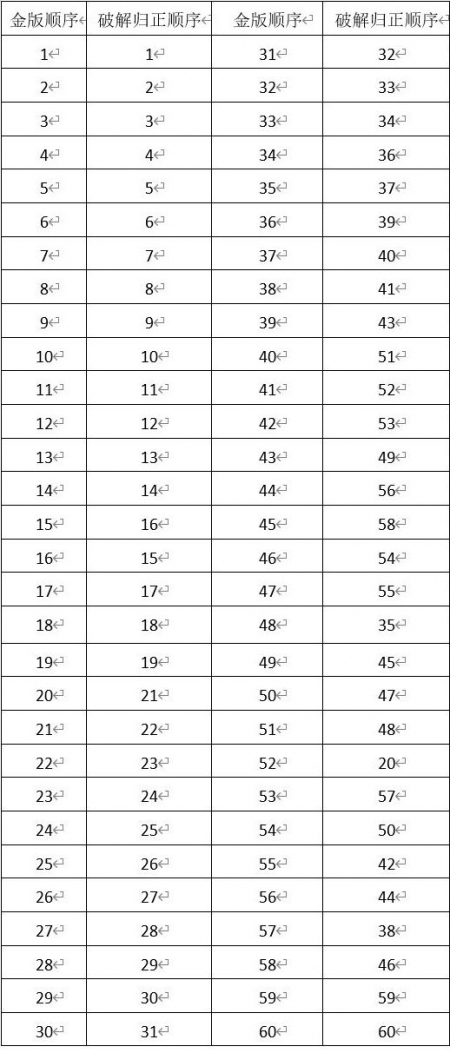
In the course of deciphering the Tui Bei Tu, I was deeply moved. Li Chunfeng used the form, sound and meaning of Chinese characters, the names and images of the hexagrams, the pictures, symbolism, allusion and other techniques, combining them back and forth, setting riddles in interlocking rings like three rings around the moon, with the utmost subtlety. With a few dots and strokes of outline, one sees the spiritual contours of the great events of heavenly signs and national fortunes, yet the subtleties are endless. It truly displays consummate skill, stirring the soul — indeed a divine work.
While deciphering it, I also discovered that the Tui Bei Tu holds yet another hidden world: a series of time codes!! By sorting out these time codes, one can likewise restore the original order.
Since a man like Li Chunfeng could foretell heavenly signs and the great events of the fortunes of successive dynasties, he surely also knew that the Tui Bei Tu would be scrambled and circulated, as well as the features of the present age and the final outcome. Therefore, quietly and miraculously, he hid a series of time codes, waiting for the order to be restored later, for heaven’s secrets to be deciphered, and for the divine intent to save people.
The general meaning of the sixty images of the Tui Bei Tu in restored order is as follows:
Image 1: The principle and course of the cycles of the Way of Heaven
Image 2: The fortunes of the great Tang — twenty-one emperors
Image 3: Wu Zetian
Image 4: Recovering the Tang for the house of Li
Image 5: The Mawei incident and Consort Yang
Image 6: Emperor Suzong takes the throne
Image 7: The Tibetans invade the Central Plains
Image 8: Li Xilie brings calamity to the great Tang
Image 9: Huang Chao’s rebellion
Image 10: Zhu Wen usurps the Tang
Image 11: The death of Emperor Zhuangzong of the Later Tang
Image 12: Shi Jingtang cedes Youzhou
Image 13: Guo Wei of the Later Zhou
Image 14: Chai Rong and the destiny of the Five Dynasties
Image 15: The founding of the Song dynasty
Image 16: The Yang family generals — Yang Liulang
Image 17: The Treaty of Chanyuan
Image 18: Swapping the crown prince for a civet cat
Image 19: Wang Anshi’s reforms
Image 20: Foretelling Emperor Huizong of Song and the fortunes of the Song
Image 21: The Water Margin of Mount Liang
Image 22: The Jingkang humiliation
Image 23: Zhao Gou and Qin Hui harm Yue Fei
Image 24: Jia Sidao and Wen Tianxiang
Image 25: The fall of the Southern Song
Image 26: The fortunes of the Yuan dynasty
Image 27: The fall of the Yuan dynasty
Image 28: The founding of the Ming dynasty
Image 29: The Prince of Yan seizes the throne
Image 30: The rule of Renzong and Xuanzong
Image 31: The Tumu crisis
Image 32: The chaos of Wei Zhongxian
Image 33: Li Chuang destroys the Ming
Image 34: The founding of the Qing dynasty, with eleven emperors
Image 35: Kangxi removes Oboi
Image 36: The Taiping Rebellion
Image 37: Britain and France invade China; Xianfeng flees
Image 38: Li Hongzhang and the Beiyang Fleet
Image 39: Cixi and the Boxers
Image 40: The Republic of China and Yuan Shikai
Image 41: The First World War
Image 42 Foretelling Chiang Chung-cheng (Chiang Kai-shek)
Image 43 The Japanese invasion of China
Image 44 The Second World War
Image 45 The civil war and the founding of the United Nations
Image 46 The Communist state
Image 47 The Great Leap Forward and the Cultural Revolution
Image 48 Generalissimo Chiang, Soong Mei-ling and the fortunes of Taiwan
Image 49 The student movement of 1989
Image 50 Mainland China amid the collapse of the Soviet Union
Image 51 Falun Dafa begins to be spread
Image 52 Jiang Zemin persecutes Falun Gong
Image 53 Shen Yun
Image 54 Fighting tigers, and foretelling the final arrest of Jiang
Image 55 The road to the vindication of Falun Gong
Image 56 The Chinese sage
Image 57 The disintegration of the CCP
Image 58 The nuclear weapons question
Image 59 The great dissolution of the catastrophe and the Fa rectifying the human world
Image 60 The true meaning of the Tui Bei Tu
Deciphering Images 42, 43 and 44
The first forty-one images in restored order are explained briefly, summed up in a word. The key is to decipher in detail the last nineteen images, from Image 42 to Image 60 — the prophecies of the nation’s fortunes from the Republic to the present — especially the earth-shaking fortunes of the last few years. I believe readers will find it exhilarating and astonishing, and may even look up to the sky with a long sigh, close the book and fall into deep thought.
This is not me being conceited, ignorant and shallow, intoxicated with myself and showing off. I have truly discovered an earth-shaking secret!
Bringing out what others have not, seeing what others have not seen, I will take you with me step by step into the wonderful realm, to appreciate the sages’ consummate, divinely imparted skill with words in their three-rings-around-the-moon riddles, to appreciate the vast will of heaven that the world has searched for so painfully, to appreciate unprecedented wonders of life, and to gain deep insight into the changes of today’s world, magnificent and splendid yet fraught with crisis.
Image 42
Wuwu; Qian below, Kan above; Xu (Waiting/Need)
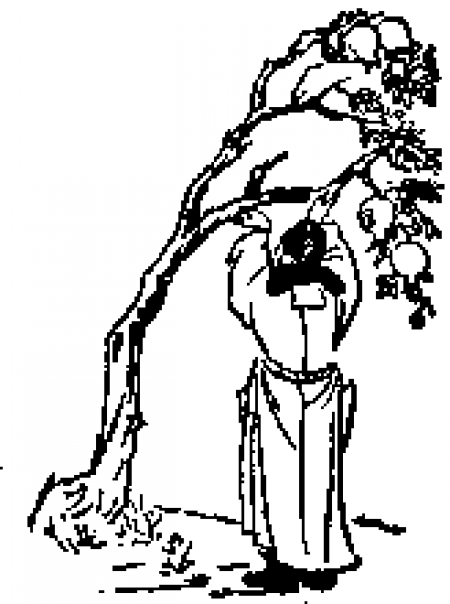
The prophecy says:
Fear gives rise to vigilance (戒); nothing far is not reached (无远勿届).
A woman by the water, bowing herself to the sun.
The verse says:
Coveting the sacred vessel is in the end of no use; cautious and careful, there are many loyal ministers.
Turning danger into safety, integrity and righteousness are seen; the rivers and mountains were not necessarily given away by me.
Brief explanation: this image foretells Chiang Chung-cheng (Chiang Kai-shek).
First look at the picture: a tree is weighed down and tilted by four fruits, and a man stands upright (中正) supporting it, alluding to the two characters 中正 (Zhongzheng). The 戒 (jiè) in “fear gives rise to vigilance” takes the homophone 介 (jiè). The four fruits in the picture are pomegranates (石榴), containing the character 石 (shí); together they make 介石 (Jieshi, i.e. Kai-shek). The big tree in the picture stands for the Republic of China, and also for the Chinese nation and China; the four fruits refer to Yuan Shikai’s subordinates who, after his death, held real power and territory and split into regional warlords. Warlords across the country fought for power and profit, bringing the great tree of the Republic to the brink of toppling and perishing.
“A woman by the water”: this means “Ningbo” (宁波), indicating that the man in the picture is connected with Ningbo, and Chiang Kai-shek was indeed from Ningbo.
In “bowing himself to the sun,” “to the sun” (对日) means the blue sky facing the white sun, referring to the Republic’s national flag, the “Blue Sky, White Sun flag,” as well as to heaven. The line means that the man in the picture is a man of the Republic, following heaven and receiving its mandate, revering heaven.
“Nothing far is not reached” (无远勿届): Chiang Kai-shek was the fourth-term (届) president. From the founding of the Republic of China to Chiang Kai-shek there were some seven or eight so-called presidents, but three or four of them were provisional acting presidents, premiers or chairmen; strictly speaking there were only three formal presidents — Li Yuanhong, Xu Shichang and Cao Kun — and none of them held office for long, only a year or two or three or four. “Nothing far” (无远) says their terms were short, and also means after Yuan Shikai. “勿届” means that this period was rather chaotic and hard to count in formal terms; “勿届” also means the fourth term, borrowing the four strokes of the character 勿.
Yet the pomegranate (石榴, shíliú) holds another hint: it sounds like “sixteen” (十六, shíliù). What does this mean? Chiang Chung-cheng was elected fourth president of the Republic after he took charge of government in 1928 — which was the sixteenth year of the Republic.
“Fear gives rise to vigilance”: Chiang Chung-cheng was benevolent and righteous all his life, revered heaven, earth and the gods, was strict with himself, cultivated himself and examined himself daily, and put the nation and the common people first.
Chiang Kai-shek was a very heavy stroke in the history of the Republic of China, bearing on the rise and fall of the nation’s fortunes and influencing China for more than half a century. So what did Chiang Kai-shek do? In the mainland, because his achievements have been deliberately erased and the facts smeared, people do not know what the real Chiang Chung-cheng was like. Chiang Chung-cheng had seven great achievements for the Chinese nation; examine them carefully and it becomes clear.
“Coveting the sacred vessel is in the end of no use; cautious and careful, there are many loyal ministers”: this refers to the powerful warlords symbolized by the four fruits in the picture, who fought for power and profit and all wanted to ascend the throne, but since the mandate of heaven was not theirs and their hearts were mostly narrow and partial, in the end they could not get their wish, because there were truly loyal ministers and righteous men who kept the nation in mind and the common people foremost, maneuvering with care. Not until Chiang Chung-cheng defeated the warlords and unified China was China once again turned from danger to safety. Throughout, Chiang Kai-shek’s loyal and steadfast integrity toward the nation and the people could be seen.
The name of this image is Xu (“need”), also hinting that China at this time needed such a man to rescue it from the crisis of the moment.
“The rivers and mountains were not necessarily given away by me”: this line indicates in advance that Chiang Kai-shek’s later loss of the mainland was not his fault; there was an inside story. This was also a great calamity for the Chinese nation. Later, the truth of history will surface, and then people will reach their own fair judgment.
Image 43
Renyin; Zhen below, Gen above; Yi (Nourishment)
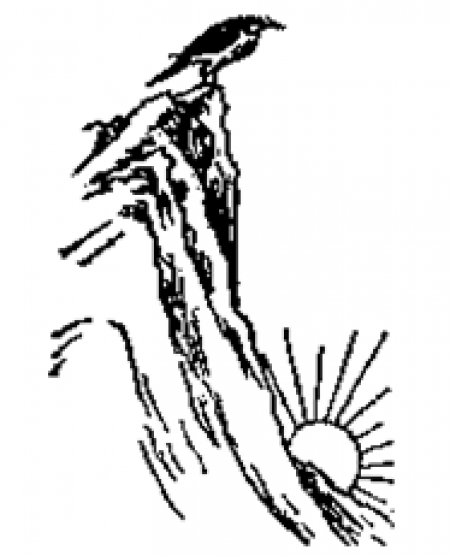
The prophecy says:
A bird without feet; a moon over the mountain.
The rising sun first ascends; all the people weep.
The verse says:
In the middle of the twelve months the qi is not in harmony; on the southern hill there is a sparrow, on the northern hill a net.
One morning the golden rooster is heard to crow; the great sea is deep and dark, the sun has already passed.
Brief explanation: this image foretells the Japanese invasion of China.
The bird on the mountain in the picture is a riddle for the character 岛 (dǎo, “island”: 鸟 “bird” without its feet, over 山 “mountain”); together with the sun, it means the island nation of Japan.
“The rising sun first ascends; all the people weep”: this describes the enormous disaster and devastation the Japanese invasion brought upon the Chinese nation, suffering beyond words.
“In the middle of the twelve months the qi is not in harmony”: this indicates the time of Japan’s full-scale invasion of China. The middle of the twelve months means the seventh day of the seventh month — the July 7th Incident.
“On the southern hill there is a sparrow, on the northern hill a net”: the sparrow stands for the jingwei bird, referring to Wang Jingwei’s puppet government. The net (罗, luó) refers to Aisin-Gioro (爱新觉罗), that is, Puyi’s Manchukuo of that time. The line says the situation was complex and critical, the nation’s fortunes hard, and opportunists rose one after another.
“One morning the golden rooster is heard to crow; the great sea is deep and dark, the sun has already passed”: the golden rooster refers to the Year of the Rooster, that is, 1945, the Year of the Rooster, when Japan surrendered.
Image 44
Jiwei; Kun below, Kan above; Bi (Holding Together)

The prophecy says:
What flies is not a bird; what dives is not a fish.
War lies not in soldiers; it is a game of creation.
The verse says:
Ten thousand li of seas and borders all smoke and cloud; up to the heavens and down to the springs.
Golden Mother and Wooden Lord work illusions; before halberds even clash, disaster reaches the sky.
Brief explanation: this image prophesies the Second World War.
The Second World War was even more brutal and larger in scale, and changed the shape of the whole world. Why, then, was it placed at the back? Because the Song scrambling moved everything to do with war to the back.
Yet the Second World War took place almost at the same time as the Japanese invasion of China in the previous image; why was it not foretold together with the previous image? Looking over the whole Tui Bei Tu, all of it prophesies the rise and fall of the fortunes of the Central State, that is, the rise and fall of the dynasties of the Chinese nation. The Japanese invasion of China bore on China’s fortunes and was of great significance, so it deserved an image of its own. The Second World War was unprecedented in scale and changed the shape of the whole world, also of great significance; China was in it too, as part of the Second World War, and this great upheaval also held within it the next change in China’s fortunes; so it was given an image of its own. Because both images are extraordinarily significant yet distinct, they are prophesied separately.
“What flies is not a bird; what dives is not a fish.” These two lines correspond to the bird in the sky and the fish in the water in the picture, referring to the weapons and equipment of the new era of the Second World War: airplanes, submarines and the like.
“War lies not in soldiers; it is a game of creation.” This says that such a great war is not brought about by human strength but by changes in heaven’s numbers; in the unseen, the gods have their own arrangements. Demonic forces play tricks and madmen are ignorant; if they recklessly flaunt their strength, they can only reap what they sow and create sin in vain.
“Ten thousand li of seas and borders all smoke and cloud; up to the heavens and down to the springs”: these two lines describe the unprecedented scale and vast reach of the war.
Most crucial is that the two men in the picture are breathing fire from their mouths, which is very interesting. Many people cannot explain what it means; but these two men breathing fire signify the two characters “二赤” (two reds) or “二叱” (two shouts), which sound like “二次” (èrcì, “second”). Once this is understood, one knows that this image prophesies the Second World War. Wonderful!
The most hidden are the last two lines: “Golden Mother and Wooden Lord work illusions; before halberds even clash, disaster reaches the sky.”
“Before halberds even clash, disaster reaches the sky” — on the surface this line seems close in meaning to the two lines above, as if referring to modern warfare, nothing special. “Golden Mother and Wooden Lord work illusions” — at first glance one hardly knows what on earth this line is saying; it looks like a character riddle, yet the words don’t make sense.
Yet these two lines in fact hide a deep meaning, with endless subtlety. They not only reveal the secret of this image but also foreshadow several later images. These two lines reveal and prophesy that “a certain person” in the country, at the moment of national peril, played tricks to grow powerful, rising in an extremely disgraceful way. What he did caused endless harm, with disaster reaching the sky.
Why do I say this? I will not elaborate at length here; I will reveal and decipher it together when we come to Image 47, where the disaster reaches the sky — it will be more meaningful then.
