

This English version was translated from the Chinese original with AI assistance. The Chinese text is authoritative.
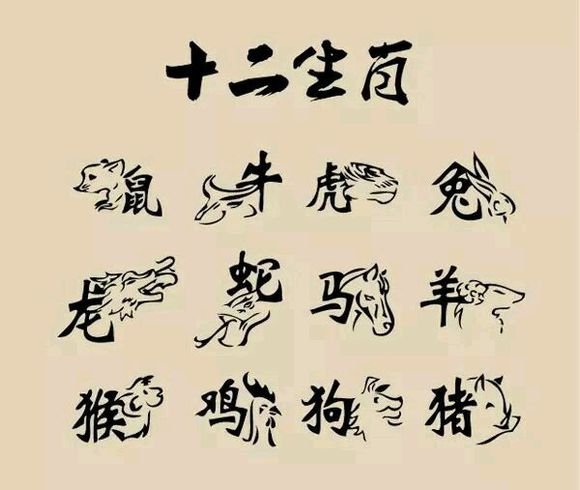
The twelve zodiac animals (生肖), also called 属相, are the twelve animals that China pairs with the twelve Earthly Branches to mark the year of a person’s birth: the rat, ox, tiger, rabbit, dragon, snake, horse, goat, monkey, rooster, dog and pig. As a long-standing symbol of folk culture, the zodiac has inspired, through the ages, a great body of poems, Spring Festival couplets, paintings, calligraphy and folk handicrafts depicting the animals and their symbolic meanings. Besides China, many countries issue zodiac stamps during the Spring Festival to express their good wishes for the Chinese New Year. As for the order of the twelve animals, there are all sorts of folk tales — for example, that when the Yellow Emperor Xuanyuan wanted to choose twelve animals as palace guards, the cat asked the rat to sign it up, the rat forgot, the cat was not chosen, and from then on the cat and the rat became enemies… and so on. But these are not true. The real order of the twelve zodiac animals involves a great deal of learning.
The ancients explained the pairing of the Earthly Branches with the zodiac animals from the standpoint of the twelve double-hours of day and night. Later, inspired by the twelve double-hours, they devised the order of the twelve zodiac animals.
子时 (zǐ hour): midnight, also called 子夜 or 中夜; the first of the twelve double-hours (23:00 to 01:00 Beijing time).
From 11 at night to 1 in the morning is the zǐ hour, exactly when rats are most active in the deep quiet of the night; hence “zǐ rat.”
丑时 (chǒu hour): cockcrow, also called 荒鸡; the second of the twelve double-hours (01:00 to 03:00 Beijing time).
From 1 to 3 in the morning is the chǒu hour. Oxen are used to grazing at night, and farmers often got up in the dead of night and lit a lamp to feed them; hence “chǒu ox.”
寅时 (yín hour): dawn, also called 黎明, 早晨, 日旦 and so on; the time when night gives way to day (03:00 to 05:00 Beijing time).
From 3 to 5 in the morning is the yín hour. At this time the tiger, which hides by day and roams by night, is at its fiercest, and the ancients often heard tigers roaring then; hence “yín tiger.”
卯时 (mǎo hour): sunrise, also called 日始, 破晓, 旭日 and so on; the time when the sun has just shown its face and is slowly rising (05:00 to 07:00 Beijing time).
From 5 to 7 in the morning is the mǎo hour. As day breaks, rabbits leave their burrows and like to eat grass still wet with dew; hence “mǎo rabbit.”
辰时 (chén hour): mealtime, also called 早食 and so on; the time of the ancients’ “morning meal,” that is, breakfast time (07:00 to 09:00 Beijing time).
From 7 to 9 in the morning is the chén hour. Fog tends to form at this time, and legend has it that dragons love to ride the clouds and mist; it is also when the sun is rising in the east, ever higher; hence “chén dragon.”
巳时 (sì hour): 隅中, also called 日禺 and so on; the time approaching noon is called 隅中 (09:00 to 11:00 Beijing time).
From 9 to 11 in the morning is the sì hour. The heavy fog has lifted and the sun shines brightly, and snakes come out of their holes to look for food; hence “sì snake.”
午时 (wǔ hour): midday, also called 日正, 中午 and so on (11:00 to 13:00 Beijing time).
From 11 in the morning to 1 in the afternoon is the wǔ hour. In ancient times wild horses had not yet been tamed by humans, and at the wǔ hour they would run about everywhere neighing; hence “wǔ horse.”
未时 (wèi hour): 日昳, also called 日跌, 日央 and so on; the sun declining toward the west is called 日跌 (13:00 to 15:00 Beijing time).
From 1 to 3 in the afternoon is the wèi hour. Some places call this time “sheep go out to the slopes,” meaning it is a good time to graze sheep; hence “wèi goat.”
申时 (shēn hour): 哺时, also called 日铺, 夕食 and so on (15:00 to 17:00 Beijing time).
From 3 to 5 in the afternoon is the shēn hour. The sun has moved to the west, and monkeys like to cry out at this time; hence “shēn monkey.”
酉时 (yǒu hour): sunset, also called 日落, 日沉, 傍晚; meaning the time when the sun goes down behind the mountains (17:00 to 19:00 Beijing time).
From 5 to 7 in the evening is the yǒu hour. The sun has set, and chickens circle in front of their coops; hence “yǒu rooster.”
戌时 (xū hour): dusk, also called 日夕, 日暮, 日晚 and so on. At this time the sun has already set and the sky is about to grow dark but is not yet dark; heaven and earth are dim and yellow and all things are hazy, hence it is called 黄昏 (“yellow dimness”) (19:00 to 21:00 Beijing time).
From 7 to 9 in the evening is the xū hour. Having toiled all day, people bolt their doors and get ready to rest. The dog lies before the door on guard, and at the slightest sound it barks loudly; hence “xū dog.”
亥时 (hài hour): 人定, also called 定昏 and so on: by this time the night is deep, and people have stopped their activities and gone to rest and sleep. 人定 means people are still (21:00 to 23:00 Beijing time).
From 9 to 11 at night is the hài hour. In the deep quiet of the night one can hear pigs rooting at the trough; hence “hài pig.”
In addition, according to the Chinese belief in yin and yang, the twelve animals are divided into two groups, yin and yang, and an animal’s yin or yang is determined by whether the number of its toes is odd or even.
An animal generally has the same number of toes on its front, hind, left and right feet, but the rat alone has four toes on the front feet and five on the hind feet — odd and even in one body. Since rarity makes a thing precious, it naturally ranks first. After it come the ox, four toes (even); the tiger, five toes (odd); the rabbit, four toes (even); the dragon, five toes (odd); the snake, no toes (counted as even); the horse, one toe (odd); the goat, four toes (even); the monkey, five toes (odd); the rooster, four toes (even); the dog, five toes (odd); and the pig, four toes (even). This view was held by Hong Xun of the Song dynasty. The Ming scholar Lang Ying classified it further on this basis; in his Qixiu Leigao (Seven Revisions Manuscript), under “The Twelve Zodiac Animals,” he states that “the Earthly Branches are below,” so yin and yang should be distinguished by the number of toes. The rat has four claws on its front feet, an even number, which is yin, and five on its hind feet, an odd number, which is yang. The first half of the zǐ hour belongs to the yin of the previous night and the second half to the yang of the new day, so the rat is just right to symbolize 子. The ox, goat and pig have cloven hooves, the rooster has four claws, the rabbit has a split lip and four claws, and the snake has a forked tongue; these six all correspond to even numbers and belong to yin, occupying six of the Earthly Branches. The tiger has five claws, the monkey and dog also have five, and the horse’s hoof is round and undivided; these six are all odd and belong to yang, and together with the yang rat they occupy the other six Earthly Branches.
So why are there no cat and no elephant among the twelve zodiac animals?
The legend that the cat asked the rat to sign it up, the rat forgot, the cat was not chosen and from then on became the rat’s enemy, and the story that the elephant came to sign up but was chased off by the rat crawling into its trunk, are tales imposed by later people. In fact, neither the cat nor the elephant is native to China. The cat came to the Han lands, it seems, from India together with Buddhism; some say in the Han dynasty, some say it came with the Tang monk Xuanzang. In any case, by then China’s twelve zodiac animals were already settled, so it is quite natural that neither the cat nor the elephant is among the “immortal ranks.”
