

This English version was translated from the Chinese original with AI assistance. The Chinese text is authoritative.
Most of China’s classical masterpieces share one feature: different people reading them come away with entirely different meanings. Take Journey to the West: some read it as a novel of gods and monsters, others as a book about spiritual practice. Wu Cheng’en writes at the opening: “If you wish to know the work of creation and the cosmic cycles, you must read the Journey to the West, the tale of release from calamity.” That is: if you want to know the true meaning of life, you must read Journey to the West! The article below gives a fine interpretation of these two lines.
Some say that when one day you truly understand Journey to the West, you will understand the true meaning of all the suffering in the world, and the true meaning of life as a whole.
Some believe Journey to the West should rank first among the Four Great Classical Novels, and that it is the greatest book on success in the world.
It seems to be a story of fighting demons, but it is really a book on success that tells people how to overcome the demons of the heart.
Through the myth of the journey to the West to fetch the scriptures, Wu Cheng’en leads us on life’s road to keep overcoming ourselves and defeating the demons of the heart, finally obtaining the true scriptures and fulfilling our lives.
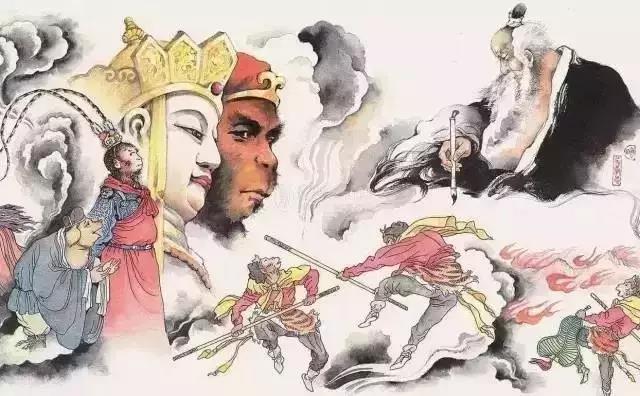
In Journey to the West, the five travellers — Sun Wukong, the Tang monk, Zhu Bajie, Sha Heshang (Sandy) and the White Dragon Horse — are really just one person.
Sun Wukong is a person’s heart-mind, the Tang monk is the body, Zhu Bajie is desire, Sha Heshang is one’s original nature, and the White Dragon Horse is willpower.
Sun Wukong is the disciple of Patriarch Subodhi of the Slanting Moon cave; “slanting moon and three stars” is the character 心 (xīn, “heart”). Isn’t the slanting moon that hook stroke? Aren’t the three stars those three dots?
So Sun Wukong is the disciple of the heart, and is the heart itself.
This restless, agitated heart shuttles freely between heaven and hell, good and evil.
The Shurangama Sutra says the heart has seventy-two aspects, and so Wukong has seventy-two transformations.
The hearts of worldly people are very changeable, transforming seventy-two times in an instant.
The golden-hooped staff weighs thirteen thousand five hundred jin, and the Yellow Emperor’s Classic of Eighty-One Difficulties says “a person breathes thirteen thousand five hundred breaths in a day and night,” so the golden-hooped staff is qi (vital breath).
What can reach up to the thirty-three heavens and down to the eighteen levels of hell, so great it can touch the sky, so small it is like an embroidery needle?
It is a person’s magnanimity (气度).
Refining the heart makes the mind’s eye bright and luminous, so the Eight Trigrams furnace not only failed to burn Sun Wukong to death but refined in him the fiery golden eyes.
Wukong’s eyes became bright, symbolizing that the mind’s eye had become bright.
Sun Wukong’s single somersault covers one hundred and eight thousand li, yet he cannot escape from the palm of the Tathagata Buddha.
The Five Phases Mountain crushing Wukong symbolizes the metal, wood, water, fire and earth of the secular world pressing down powerfully on that heart that could rise to heaven and enter the earth.
The Five Phases Mountain also symbolizes the Buddhist “greed, anger, delusion, pride and doubt.”
The Buddha said these five words sum up all of people’s conduct and thoughts.
Even Sun Wukong still could not escape these five words.
The Sun Wukong who wreaked havoc in heaven was precisely trapped by these five poisons.
In reality, how many Buddhist disciples, thinking they have gained some enlightenment, painstakingly cultivate “precepts, concentration and wisdom,” yet in the end still do not leave “greed, anger and delusion” behind, only because they do not understand the nature of “greed, anger and delusion.”
Beyond the Five Phases Mountain is the Mountain of Two Frontiers; past this mountain, that once restless heart finally leaps out of the Three Realms.
Sun Wukong’s single somersault covers one hundred and eight thousand li, exactly the distance to Vulture Peak (灵山, the Spirit Mountain). What does this mean?
It means: however far Vulture Peak is, a single thought of the heart reaches it! Good and evil lie in a single thought; one thought can make a Buddha, and one thought can make a demon.
The master and disciples fighting demons on the road to the West really refers to a person removing the demons of the heart on life’s road; fetching the scriptures is a process of cultivating the heart.

The true Vulture Peak is in our hearts.
This is exactly what Sun Wukong often says to the Tang monk:
“As long as you see your true nature and your will is accomplished, wherever every thought turns back, there is Vulture Peak.”
And when the Tang monk first set out on the journey, the Crow’s Nest Chan Master passed on to him the Heart Sutra and told him: “Do not seek the Buddha far off at Vulture Peak; Vulture Peak is only in your own heart.”
But the Tang monk did not understand what it meant; only at last, upon arriving at Vulture Peak, after Sun Wukong awakened him, did he understand.
Because one can only understand by relying on the heart to awaken oneself; and by that time all the demons of the heart had been removed, so he attained understanding.
The “True Words for Settling the Heart,” the tightening-band spell, can settle and restrain the heart, making the heart hurt again and again.
Once Wukong was subdued, that heart of seventy-two transformations was set right.
As soon as he set out, Sun Wukong killed six robbers. In the original novel, the names of the six robbers are:
“Eye-sees-joy, Ear-hears-anger, Nose-smells-love, Tongue-tastes-thought, Body-bears-sorrow, Mind-sees-desire” — these are the six roots (six senses).
Sun Wukong killed the six roots, showing that the purification of the six roots is the basis of fetching the scriptures.
The White Dragon Horse is willpower. At first a person’s will is like a wild horse; only once the goal ahead is fixed can one obtain the true scriptures with single-minded concentration.
Subduing the little white dragon achieves the unity of heart and intent; as long as heart and intent are one and the aspiration is firm, there is no West that cannot be reached.
Later Bajie and Sha Seng were taken on, and the most perfect team — “body, heart, desire, nature and intent” — was formed.
On the road to the West, Wukong often draws a circle on the ground before going off to beg for food; this is the boundary the heart sets for the person, but the person’s body (the Tang monk) is always led away by desire (Zhu Bajie).
So the person (the master and disciples) easily leaves the boundary (the drawn circle) set by the inner heart (Wukong), and once outside the boundary meets all kinds of demons of the heart (monsters).
The heart (Wukong) leads the person (the master and disciples) ever forward; Wukong subduing demons along the way means the heart subduing the demons of the heart.
Every monster on the road to the West has a meaning.
All the monsters are metaphors, all illusory transformations of the demons of the heart.
What each monster represents is one of the things in the world that entangle people — each is a person’s own demon of the heart.
The process of fetching the scriptures from the West is the process of a person removing the demons of the heart.
The master and disciples continually removing monsters on the road to the scriptures refers to a person continually defeating the demons of the heart on life’s road.
For example, the Black Bear Demon is a demon of the heart: Wukong’s anger led him to fan the fire that burned the Guanyin Chan Monastery, and so a demon of the heart arose that obstructed his becoming a Buddha — and so the Black Bear Demon came.
The Bull Demon King is also a transformation of Wukong’s demon of the heart; Red Boy, the Bull Demon King and the Flaming Mountains are all flames in the heart.
The Bull Demon King and Wukong are sworn brothers and evenly matched, so losing one’s temper is fighting against oneself.
The Flaming Mountains were formed because Sun Wukong, in his early years, kicked down a fire brick; the great fire of the Flaming Mountains was set by Wukong to vent his spleen after he escaped the Eight Trigrams furnace, and in the end it burned him.
The ordeal of the Flaming Mountains arose from Sun Wukong’s early heart of stubborn emptiness, hence “the Bull King was originally a transformation of the mind-monkey,” and one must “break through stubborn emptiness to behold the face of the Buddha”; here Sun Wukong cut away his heart of stubborn emptiness.
Red Boy symbolizes the fire of hatred: a person who lives in hatred will in the end only burn his own heart (Red Boy burned Wukong).
Moreover, Red Boy also symbolizes the “newborn child” (赤子), and we must preserve the heart of a newborn child.
“The great man is one who does not lose the heart of a newborn child.” On life’s road, preserve the heart of a newborn child, do not let it be burned up by your own “samadhi true fire,” and keep that childlike heart (the child was protected by the Bodhisattva).
The Yellow Wind Demon can blow a samadhi divine wind; he represents the general mood of society, which can make the human heart (Wukong) lose its way.
The three guises of the White Bone Demon represent a person’s feeling, love and desire; the heart kills them all, showing that on life’s road we must keep our feeling, love and desire under control and not let them become obstacles to our progress.
Moreover, the White Bone Demon also symbolizes a human-skin mask; the mask (the White Bone Demon) can draw out people’s instinctive desires, so Zhu Bajie begins to sow discord; it makes people lose their own inner heart, so the Tang monk drives Sun Wukong away.
People are always bewitched by the world’s many beautiful appearances.
Money (the Golden Horn King and the Silver Horn King) can bind and seal up the human heart so that it can hardly escape.
The author likens this truth to the Golden Horn King and Silver Horn King binding Sun Wukong with the golden rope and sealing him up in the purple-gold gourd.
Later, at the Lesser Thunderclap Monastery, the Yellow-Browed Demon impersonating the Buddha sealed Sun Wukong up in golden cymbals; the golden cymbals, a magic treasure, also symbolize money — money can trap the heart.
The seven spider spirits represent the seven emotions and six desires; the seven emotions and six desires are like a web spun by a spider, which can trap people.
Worldly people give rise to feelings through thought (思, sī, a pun on 丝, sī, “silk thread”) and are entangled by threads of feeling. The centipede spirit has a thousand eyes on its body, a symbol of the various material desires the human eye sees.
The scorpion spirit represents feminine beauty; beauty hooks people like a scorpion, so none of the master and disciples could withstand her.
In the episode of the true and false Monkey King, a Wukong sincerely devoted to the Buddha defeats a Wukong not sincerely devoted to the Buddha; it is really two of one’s own wills fighting each other — two hearts in one person.
The book states very clearly that this ordeal arose from the demons of the heart of the master and his three disciples.
Sun Wukong’s “heart of wild arrogance,” the Tang monk’s “heart benighted to the Way” that cannot tell true from false, Zhu Bajie’s and Sha Seng’s “heart of jealousy” in refusing to plead for him, and the “heart of suspicion” between master and disciples and among the brother disciples.
Once a “second heart” arises, the second heart must be removed; only by dispelling the second heart and being single-hearted can one succeed! So the false Sun Wukong was killed, and only then could the master and disciples continue on their way.
In the Kingdom of Bhiksu, the deer spirit wants to eat the hearts of a thousand children, symbolizing “many hearts.”
Sun Wukong transforms into a false Tang monk, meaning that at this point the Tang monk and Wukong merge into one; he cuts open his own belly and a heap of hearts rolls out, also symbolizing “many hearts.”
We often say “a deer is butting in the heart” (心头鹿撞, i.e. one’s heart is pounding). When a person has a “second heart,” calamity arises — how much more so with many hearts. Once this deer spirit is subdued, there is no deer butting in the heart, “many hearts” become “one heart,” and only single-heartedness leads to success.
The three brother disciples liked to play teacher: in Yuhua Prefecture they took the king’s three sons as disciples and taught them martial arts.
Liking to play teacher and not being humble, they stirred up a whole den of lion spirits. 狮 (shī, “lion”) is 师 (shī, “teacher”).
The Nine-Spirit Primal Sage is one of the most formidable monsters on the road to the West, a nine-headed lion who could capture Sun Wukong by trickery.
The nine-headed lion symbolizes the “nine considerations.” Confucius said: “The noble person has nine things he considers.”
If a person achieves the nine considerations, he can become a sage — nine considerations make a sage, hence the name Nine-Spirit Primal Sage.
For a person, overcoming all one’s habitual tendencies and eliminating the demonic obstacles is to behold Vulture Peak.
In the end the heart (Sun Wukong) is made the Victorious Fighting Buddha: whatever we do, as long as we know how to restrain our inner heart, we can ultimately succeed.
The body (the Tang monk) is made the Buddha of Sandalwood Merit: to be a person, heart and body must be one before one can obtain the true scriptures.
Desire (Zhu Bajie) is made the Cleanser of the Altars: desire cannot be given up entirely, so in the end he is only made an envoy.
Original nature (Sha Heshang) is made the Golden-Bodied Arhat, because original nature is precious as gold.
Willpower (the White Dragon Horse) is made a Heavenly Dragon of the Eight Classes, a protector of the Dharma: we must guard our intentions at all times, so it is made a protector.
As for the absurd and strange events that take place in the book’s many and varied kingdoms, they are biting satires on the society of the time.
Lion-Camel City is a huge kingdom of demons, and also a huge reflection of a dark age.
The reason the Buddha finally gave the master and disciples wordless scriptures is that the wordless scriptures are the true scriptures.
The 经 (jīng, “scripture”) of the wordless scriptures means 经历 (“experience”). The “experience” along this road is the more important “scripture,” far surpassing any words.
If a person, having experienced everything in the world, can still keep a true heart, then even without reaching the West, he has long since become a Buddha in his heart.
Firm and unwavering, it is likened to diamond (vajra); since the heart has become diamond, the vajra band on the head of the heart (Wukong’s head) need no longer exist.
Among the Buddha’s scriptures, this is exactly the Diamond Sutra.
The same person reading the same passage at different times will understand it differently.
Take Journey to the West: the same person reading it in his teens and in his thirties will understand it completely differently.
Read it again twenty years later, and the understanding will be different again.
Sadly, very few people truly understand Journey to the West
