

This English version was translated from the Chinese original with AI assistance. The Chinese text is authoritative.
The wind of the Tang dynasty blew fine moments and lovely scenery into pages full of misty clouds; the rain of the Song soaked the hearts of countless wanderers. These two great ages of poetry produced innumerable works that astonish and delight — astonishing in their free and unrestrained imagination, delightful in their flourishing, splendid diction. Of course, this glory belongs to the outstanding creativity of the poets, who could chew and swallow the hardships of time and the toil of life, and then pour them out as pools of precious ink.
This kind of “wonder” is a dazzling one, something that bursts forth as inspiration wells up, and most poets have had such experiences. But there is another kind of wonder, the wonder of the strange: unlike ordinary poetry, it does not follow the mainstream rules of composition, but delivers a powerful shock through unexpected means; it is commonly called a “wondrous poem” (奇诗). Today I bring you the most wondrous poem of all time.
A pity, perhaps, that the author of this most wondrous poem of all time was not a person of the Tang or Song, but a frail woman of the Former Qin in the Sixteen Kingdoms period, named Su Hui. Su Hui did not have Cao Zhi’s extraordinary talent of composing a poem in seven steps, nor Li He’s ghostly genius for the strange and original, nor Li Bai’s masterly hand that turned the decayed into the miraculous; all she had was a great deal of time. And this wondrous poem could only have been written by spending a great deal of time.
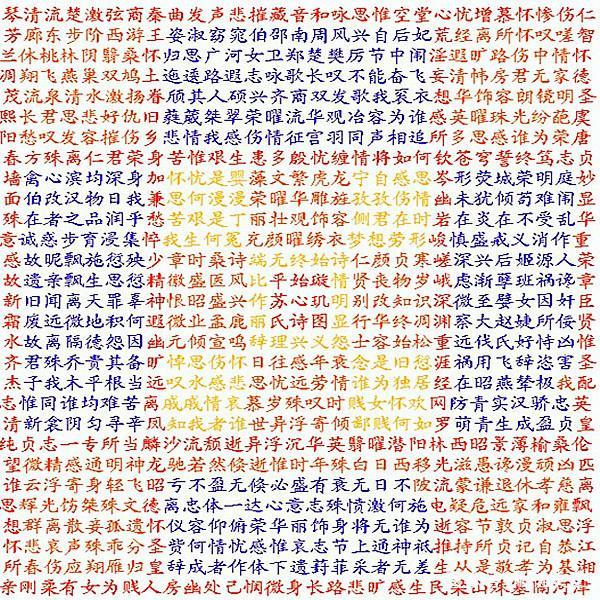
The poem has 840 characters in 29 rows and 29 columns, so it is 29 characters both across and down; because the three characters 璇玑图 (“Xuanji Tu,” the Armillary Sphere Chart) stand at the very centre, it got this name. It is a wondrous poem because at first glance you cannot make head or tail of it, but on reading again you slap the table in amazement! Let me roughly explain how to read it: poems can be formed horizontally, vertically and diagonally; lines can be formed reading forwards, backwards, alternately and around corners; and the number of characters per line is not fixed — three, four, five, six or seven characters are all possible! That is to say, take any part of it, ponder it carefully, and you can read out hundreds or thousands of poems.
What? Hundreds or thousands? That’s right — there really are that many!
Wu Zetian once commented on the Xuanji Tu: “The five colours set one another off, eight inches across and down, with more than two hundred poems inscribed, totalling over eight hundred words; across and down, forwards and back, all form verses.” So in the early Tang, people had read out only some two hundred poems. But by the Ming dynasty this figure had become 7,958 — nearly eight thousand poems could be deciphered! After the Ming, with further readings by scholars, the number of poems has in fact long since exceeded eight thousand.
Creating such a work is no easy matter. Not only must every character be placed in a reasonable position, but all kinds of possibilities must be weighed, and every element that makes up a poem must be tested one by one; if a few characters were just thrown together at random, it would be meaningless. One has to say that the effort Su Hui put into this poem is admirable. So why did she spare no cost to create such a wondrous poem? Behind the breathtaking work lies a sad story.
Su Hui’s husband was Dou Tao, a general of the Former Qin. Because he disobeyed military orders, he was banished to the region of the shifting sands, where he met the singing girl Zhao Yangtai and took her as his concubine. Dou Tao had wanted to take both his wife and concubine with him to his new post, but Su Hui, angry about the concubine, refused to go, so Dou Tao could only take Zhao Yangtai with him. As time went by, Su Hui, keeping to her empty room alone, inevitably felt lonely and empty inside, and began writing poems to dispel her feelings. She arranged all the poems she had written into the Xuanji Tu, hiding her heart’s voice between the lines, and then sent the chart to her husband.
When Dou Tao received the Xuanji Tu, he savoured it carefully, was deeply won over by Su Hui’s literary talent and moved by her devotion, and immediately sent people to bring Su Hui to him. These eight hundred-odd characters look simple, yet they conceal enormous mysteries; not only are the words heartfelt, the story too is deeply moving. Of course, to fully make out all those eight thousand-odd poems would probably be hard for one person to achieve in a lifetime — but if you really did it, it would surely be a great thing to be proud of.
