

This English version was translated from the Chinese original with AI assistance. The Chinese text is authoritative.
By Ziwei
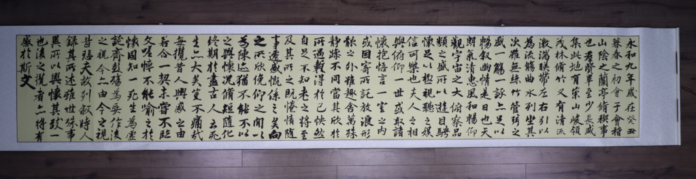
When I first studied the Lanting Preface (Preface to the Orchid Pavilion Poems) as a youth, I took great delight in copying it. My heart imitated and my hand pursued it, but although I captured perhaps two or three tenths of its form, in the end I never grasped its spirit. Later, after practising the Great Law (Dafa) and seeing Shen Yun’s Lanting, I happened to gain a little insight.
As I gaze upon the Sage of Calligraphy’s preface, I am joyful as though rising over the Eastern Sea, and in the vast distance it seems the gods are descending to earth. Gathering splendour and condensing jade-green, leading with truth to be seen. I hear the elegant music of the worthies of the Wei and Jin floating wine cups along the winding stream; I know Shaoyi (Wang Xizhi) cleansing his breast and clarifying his heart between waking and dream, a clear breeze issuing from his sleeves and the bright moon entering his embrace. The sky is clear and the air fresh, a gentle breeze flows soft and smooth — the vastness of the universe in full; letting the eyes roam and the heart gallop, seeing to the utmost the abundance of all kinds of things. Embracing all within one room, he grasps, looking down, the free abandon beyond bodily form. His dots fall like boulders tumbling from a high peak, shaking the ranks; his horizontal strokes open like battle clouds a thousand li long, unfurling and rolling out at leisure. Though looking down and up at life and death he does not fully explain, yet, responding to the mandate of the Creator, he opened a calligraphic style for a thousand ages and for all time. The sun rises bright and clear like the ringing of a great bell; waxing and waning, cloud and shine, the dynasties change like the monthly tides of the moon. Pursuing the profound and wondrous philosophy of the ancients, yet never daring to act rashly, he left later ages a mystery that spurs people today to seek its source.
Truly the Lanting stands alone from ancient times to today, invigorating the world of calligraphy in China for a thousand years — yet who knew that at the end, on the Shen Yun stage, the Lanting would be seen again: the Great Law saving and delivering, and a good disciple dancing with a fan (a fan, 扇, sounding like goodness, 善)! Ah! The appraisal of the Sage Emperor (Taizong of Tang) suddenly rings in my ears: “Perfectly good and perfectly beautiful, a phoenix’s pearls and a coiling dragon” — truly so!
For a thousand years later generations have prized the traces of his work, yet made light of his character — indifferent to worldly things, returning to the true and turning toward the Dao — and of his perfectly good and beautiful, vibrant calligraphic style. This is the fundamental reason for us later generations to explore! Living in a chaotic age yet bound by destiny to the factors of righteousness — this too may be the Dao of reading and writing!
