

This English version was translated from the Chinese original with AI assistance. The Chinese text is authoritative.
His writing is like tai chi push-hands: he always yields to the very end, absorbs his opponent’s force, and then borrows that force to strike back with even greater power…
Do you know who, in 1953, beat the favorite, Hemingway, to win the Nobel Prize in Literature? The answer is Churchill. Yes, that great British military leader Churchill (Winstonr-Churchill, 1874–1965), who led the Allies to victory in the Second World War and was, like a British bulldog, “unbeatable and never giving in.”
In fact, readers need not be surprised: Churchill really was a great writer. In his lifetime he wrote 45 books, almost every one of which was a sensational bestseller and received glowing reviews. The Times once wrote: “Few people in the 20th century earned more in royalties than Churchill.”
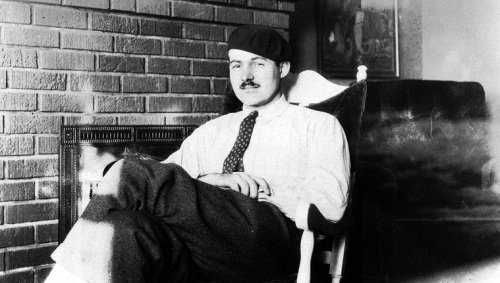
Hemingway was an internationally famous man of letters. (Image source: Wikipedia)
In the film Darkest Hour, there is a scene in which Churchill’s wife Clementine says: “We’re broke.”
In fact, Churchill came from declining aristocracy and his wife from a wealthy family; the household’s expenses were considerable and money was always tight. Only after publishing The Second World War memoirs, which won him the Nobel Prize in Literature, did Churchill truly escape financial difficulty. So when the Cambridge professor Peter Clarke wrote in Mr. Churchill’s Profession that “politics was only Churchill’s second profession,” it was no exaggeration.
Although Churchill spent most of his life in politics, at heart he was absolutely a literary type. In his lifetime he created 570 paintings and two sculptures, but what he loved most was words. He once said that what he would most like to do in the next life was “converse with the writer Oscar Wilde”; he also said, with exaggeration: “I would rather lose India than lose Shakespeare.”
However busy he was, Churchill’s mind was always on writing. His first job after graduating from the Royal Military College, Sandhurst, at 21 was not to take up a gun but to take up a pen and go to Cuba to report on the Cuban revolution from the front line. Later, Churchill was stationed in southern India with his cavalry regiment, still working part-time as a war correspondent, and completed his first book, The Story of the Malakand Field Force.
Anyone who has written a book knows that wanting to write is one thing, but completing it on schedule amid a busy life brings physical and mental pressure that outsiders cannot understand. No wonder Churchill described the process of writing a book this way: “Writing a book is an adventure. To begin with, it is a toy and an amusement. Then it becomes a mistress, and then it becomes a master, and then it becomes a tyrant. The last phase is that just as you are about to be reconciled to your servitude, you kill the monster, and fling him out to the public.”
Writing requires good habits; it is nothing like the Churchill of the film, drinking himself tipsy at any hour. For example, even after Churchill became prime minister he still had a strong urge to write and often wrote at night and in the morning. He also recorded matters large and small in writing at all times, keeping a vast number of notes, memos, letters and wartime materials for later use in writing his memoirs of the Second World War.
Churchill was a true magician of words. The Mayor of London, Johnson, once said: “Churchill commanded an English vocabulary even larger than Shakespeare’s and Dickens’s combined.” According to lexicographers’ counts, the Latin Bible uses more than 5,400 words, Shakespeare commanded about 24,000, while Churchill could use 90,000, many times more than other writers.

Lightning bugs in a jar-soft focus diffusion through glass, enhanced with photoshop
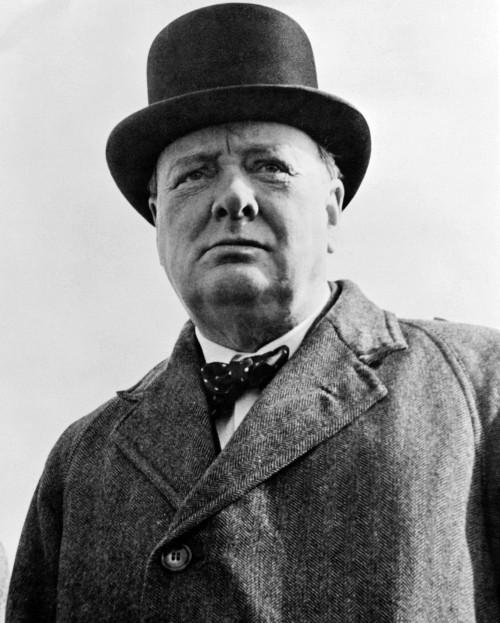
Churchill’s writing has the power to “find life in a desperate situation,” hacking out a path with a great axe. (Image source: Wikipedia)
Churchill’s writing has the power to “find life in a desperate situation.” Just when it seems there is no way forward, suddenly, between heaven and earth, there is only Churchill, splitting open the path with the great axe of his words, as in “I have no road, but I know the direction to go forward,” “Courage is going from failure to failure without losing enthusiasm,” or “We persevere not because we are strong enough, but because we have no other choice.”
Former US President John F. Kennedy put it well: “In the dark days and darker nights when England stood alone, he mobilized the English language and sent it into battle.”
The title of the film Darkest Hour is actually a pun, because 1940 was not only the darkest hour in British history but also the darkest hour in Churchill’s heart. Churchill had a history of depression. His father, though a cabinet minister, died of syphilis at 42; his mother was a socialite who squandered the family fortune; and Churchill did poorly at school, taking the exam three times before getting into the Royal Military College.
Churchill had every reason to despair of life, yet paradoxically he was the one who gave hope through his words when all of Europe had lost hope. His writing is like tai chi push-hands: he always yields to the very end, absorbs his opponent’s force, and then borrows that force to strike back with even greater power.
For example, at the end of the Second World War, the party Churchill represented suffered a heavy defeat in the election and he lost the premiership. Stalin said to Churchill: “Churchill, you won the war, yet the people voted you out. Look at me: who would dare vote me out!” Churchill answered, neither humble nor arrogant: “I fought the war precisely to defend the people’s right to vote me out.” He was mocking Soviet Russia as a country without human rights.
The British playwright George Bernard Shaw disliked Churchill, so he sent him two tickets with a note: “Enclosed are two tickets to the first night of my new play; bring a friend, if you have one.” Churchill did not fight back against the taunt but simply hit back with the force of the taunt itself: “Cannot possibly attend first night; will attend second, if there is one.”
Churchill’s rhetorical technique is first to admit defeat, then to give defeat a height, and then to stand on it and look down on the world like a king. (Image source: Adobe stock)
He has another famous saying: “We are all worms, but I do believe that I am a glow-worm.” Churchill’s rhetorical technique is first to admit defeat (I am a worm too), then to give defeat a height, and finally to stand on that height and look down on the world like a king (a worm that shines).
For example, when others criticized democracy for its inefficiency, he would not argue with you and would even concede your point, but he would bypass the battlefield you had opened (the question of efficiency) to strike at you. He replied: “Democracy is the worst form of government, except for all the others that have been tried.” He lets you know that however you attack him, the system you want to promote is a fake.
In this world, everyone always complains that “these are rotten times” or “I’ve been put in the wrong place.” Churchill admits these complaints are right, then in the third sentence lands a thoroughly satisfying heavy punch: “People are always pushed into the wrong position at the wrong time to do the right thing.” How good is that! Churchill admits that everything is wrong, but wakes you up: you yourself must not be wrong! To do the right thing in the wrong time and place is what makes a true hero.
We too can learn from that British bulldog and extract fiercely optimistic, vigorous lines from an extremely pessimistic world. Come, let’s practice Churchill’s tai chi rhetoric of “absorb first, then strike”!
============================
〈Exercise〉(the first six are famous Churchill quotations)
1. What you have lost will always be ______ more than what you hold in your hands.
A) be B) never be
2. If you are going through hell, ______!
A) keep going B) you are in dire straits
3. Success is _______ without losing enthusiasm.
A) stopping failing B) going from failure to failure
4. _______ what you like; learn to like what you are doing.
A) Go and do B) Don’t try to do
5. When I look back on all these worries, I remember the story of the old man who said on his deathbed that he had had a lot of trouble in his life, most of which _______.
A) had all happened B) had never happened
6. A) I am willing to devote my whole life, including blood, toil, tears and sweat.
B) I have nothing to offer but blood, toil, tears and sweat.
7. Yes, yesterday you met with the greatest tragedy in the world, __________________
8. We are sure to fail, _____________________
9. The joint entrance exam is the worst system, _____________________
10. Reading takes a great deal of time, _______________
Answers: BABBBB
Suggested answers:
7. but only by seizing today can there be a comedy tomorrow.
8. but we can choose to fail gloriously.
9. but it is the fairest system.
10. but it is the only way to learn to read.
This article is excerpted from the book [Write! Cracking the Mind Map of Creative Genius]
