

This English version was translated from the Chinese original with AI assistance. The Chinese text is authoritative.
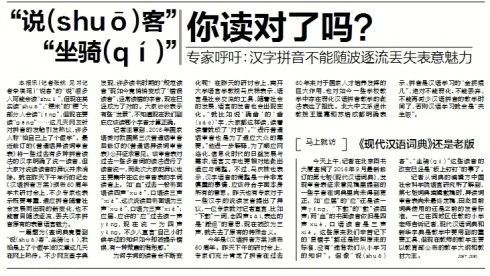
“I left home young and return old; my local accent unchanged, my temple hair grown thin (衰, shuāi).”
“Far up the cold mountain the stone path slants (斜, xié); where white clouds rise there are homes.”
“A horseman (骑, qí) raising red dust, and the imperial consort smiles; no one knows it is lychees arriving.”
…
Note: in these poems 衰 was originally read cuī, 斜 was originally read xiá, and 骑 was originally read jì. Because many people misread them, the pinyin has now been changed. The readings given in new editions of textbooks are now 衰 (shuāi), 斜 (xié) and 骑 (qí).
The author: “The rhymes this old man worked so hard to craft finally became immortal lines, and they’ve just been changed like that?”
There are quite a few similar cases, such as:
The 说 of “说客” (lobbyist) was originally read “shuì,” but is now prescribed as “shuō”; likewise 说 (shuō) 服 (persuade);
The 粳 of “粳米” (japonica rice) was originally read “jīng,” but should now be read “gěng”;
…
In recent days, netizens’ posts about pinyin have sparked heated discussion, with many saying they “fear they went to a fake school.”
Many netizens looked up dictionaries and found that many of the “standard pronunciations” from their school days have quietly become “wrong pronunciations,” while readings they often got wrong have now become correct…
Everyone said they felt somewhat “dazed,” not knowing which pronunciation we should now use to be correct.
Below, let’s look at the characters whose pronunciations people have discovered were changed.
For example, when saying goodbye, we often say “拜拜” (bái bái, “bye-bye”). For 拜, the 5th edition of the Contemporary Chinese Dictionary gives the reading bài; the 6th edition adds the reading bái.
确凿 (què záo, “conclusive”): original reading 确凿 (zuò). Later changed to follow popular usage: 确凿 (záo).
荨 (qián) 麻疹 (urticaria) was changed to 荨 (xún) 麻疹.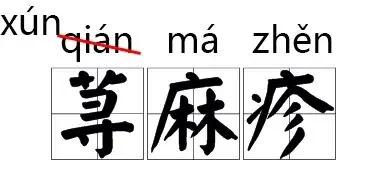
“呆板” (rigid) was originally read ái bǎn, but later, out of respect for popular habit, from 1987 its reading was changed to dāi bǎn.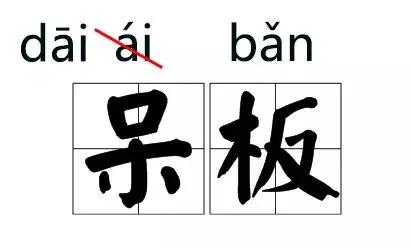
铁骑 (tiě jì, “armored cavalry”) is the ancient pronunciation. The character 骑 was read qí in verb-like senses, as in 骑兵 (cavalry), and jì in all similar noun senses: 轻骑, 车骑, 骠骑.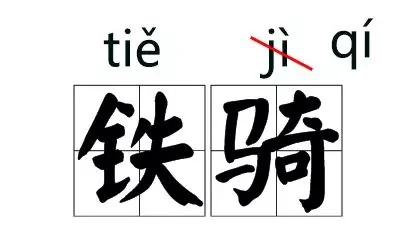
However, today it is read qí in all cases, and the reading jì has been abolished. In the new edition of the Xinhua Dictionary, this character has only one reading, qí. (Old readings “jì” and “jí”; from 2005 “jì” and “jí” were uniformly abolished in favor of “qí”; see the 11th edition of the Xinhua Dictionary.)
There’s nothing to be done; we have to keep up with the times and cannot hold on to the old, or else we are wrong. This is the case with “呆板” and “确凿” mentioned above. Another example is 斜, anciently read xiá, now uniformly read xié.
The pinyin for “说服” (persuade) is “shuō fú,” not “shuì fú.” See the entry (p. 1225) in the Contemporary Chinese Dictionary (compiled by the Dictionary Editing Office of the Institute of Linguistics, Chinese Academy of Social Sciences, published by the Commercial Press, 6th edition).
The character 说 has four readings.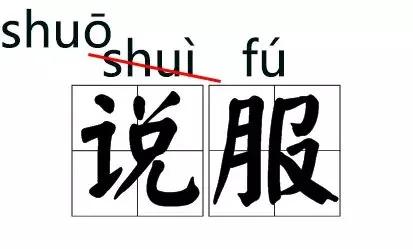
First, “shuō,” with the main meanings:
1. to explain, to interpret; 2. to tell, to speak; 3. views, doctrines (as a noun, as in “学说” theory, “歪理邪说” fallacies and heresies), and so on.
Second, “shuì,” meaning to persuade others to follow oneself, as in “游说” (to lobby).
Third, “yuè,” as a loan for 悦 (pleased).
Fourth, “tuō,” as a loan for 脱 (to shed). The third and fourth readings are now very rare in modern Chinese.
谁 (who): “谁 means 何 (what). It takes 言 as its form and 隹 as its sound; its reading is 示隹切.” Wuyin Jiyun: 是为切; Yupian: 是推切. Derived from the historical phonological system, the correct reading should be “shuéi,” written in simplified form as “shuí.”
Because it is hard to pronounce, the medial is easily lost in dialects, and it mostly turned into “shéi.” With this reverse influence, the standard reading followed popular usage, so dictionaries include both, and today’s dictionaries mostly give “shéi” first, with “shuí” as an alternative.
“Shuí” is the reading pronunciation, used mostly on formal occasions and in highly emotional poetry recitals; “shéi” is the colloquial pronunciation, more everyday, used mostly in film and television programs and in daily life.
唯 (wěi) 唯 (wěi) 诺诺 (meek and submissive) was changed to 唯 (wéi) 唯 (wéi) 诺诺.
靡 (uniformly read mí): in the phrase “靡靡之音” (decadent music) it was once read mǐ.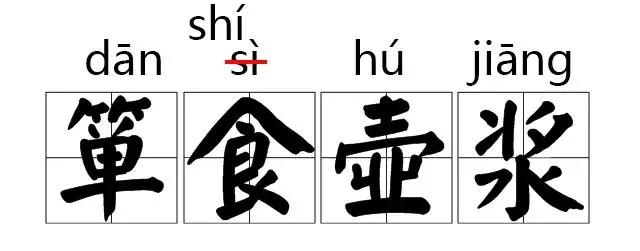
箪食壶浆 (food in baskets and drink in pots): the 5th edition of the Contemporary Chinese Dictionary gives dān sì hú jiāng; the 6th edition gives dān shí hú jiāng.
Examples like these are too numerous to list.
橙: uniformly read chéng; chén (橙子, orange) abolished;
从: uniformly read cóng; cōng (从容, calm) abolished;
脊: uniformly read jǐ; jí (脊梁, backbone) abolished;
迹: uniformly read jì; jī (事迹, deeds) abolished;
绩: uniformly read jì; jī (成绩, results) abolished;
框: uniformly read kuàng; kuāng (门框, door frame) abolished;
拎: uniformly read līn; līng (拎东西, carry things) abolished;
澎: uniformly read péng; pēng (澎湃, surging) abolished;
绕: uniformly read rào; ráo (回绕, wind around) abolished;
往: uniformly read wǎng; wàng (往前走, walk forward) abolished;
寻: uniformly read xún; xín (寻思, ponder) abolished;
荫: uniformly read yìn; yīn abolished;
咱: uniformly read zán; zá (咱们, we) abolished;
作: read zuō in “作坊 (workshop), 洗衣作 (laundry), 豆腐作 (tofu shop), 小器作 (small woodware shop),” and zuò everywhere else; that is, zuó (作料, seasoning) is abolished, as is zuō in some words (作弄 tease, 作揖 bow with clasped hands, 作死 court death, 自作自受 reap what one sows).
After reading all this, all those pronunciations our Chinese teachers corrected feel like tears in vain!
Spare a thought for our dear ones studying dubbing and broadcasting: almost every year the pronunciations of a few characters change.
Why do the pronunciations of characters and words keep changing?
Ma Qingzhu, professor of linguistics at Nankai University, said that language is a tool of social communication, and as society develops, the pronunciation of language will also change.
“Take for example 凿 (záo) in ‘确凿’: everyone read it this way, and through reading it this way it became ‘correct.'” “Reviewing the pronunciations of Putonghua is also meant to meet the needs of the public.”
He further explained that, to keep pace with the growing development and demands of the age of networks and information, language and writing must also adapt and adjust accordingly.
But Ma Qingzhu also said that adjusting the pronunciation of Chinese characters is a very serious matter and should accord with all the meanings of the characters themselves.
Wang Lijia, retired professor in the Department of Chinese at Peking University, said this is because all Chinese character sounds express meaning; every character sound expresses a meaning.
Some experts have also raised objections to the uniform readings of certain characters. For example, in the word “下载” (download), 载 read in the fourth tone, zài, expresses the meaning of “transport”; it has now been changed to the third tone, losing its original special meaning.
We learned from the dictionary’s editor, the Institute of Linguistics of the Chinese Academy of Social Sciences, that when editing of the seventh edition closed, the table for reviewing the pronunciation of words with variant readings had not yet been finalized. Therefore the dictionary still uses the previous pronunciation standards.
A primary school teacher in Xicheng District told reporters that the Contemporary Chinese Dictionary and the Xinhua Dictionary are important tools used in teaching, but teachers now teach mainly according to the syllabi and textbooks issued by the Ministry of Education.
Xunzi said: “Names have no intrinsic appropriateness; they are fixed by agreement. What is established by agreement and custom is called appropriate; what differs from the agreement is called inappropriate.”
Language is the same. As a tool of communication, changes made according to established custom seem to make communication between people more convenient.
But some people also feel: if changes are made according to established custom, what is the point of our learning the correct pronunciation of Chinese characters?
