

This English version was translated from the Chinese original with AI assistance. The Chinese text is authoritative.
Li Xutong
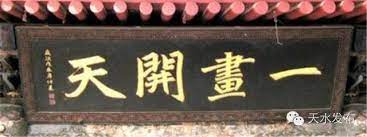
Day 1: With One Stroke, Heaven Is Opened
This idiom comes from the poem “Reading the Yi” by Lu You of the Song dynasty. Tradition holds that when Fuxi drew the Eight Trigrams, he began with the first of the three strokes of the Qian trigram; Qian is heaven, hence “with one stroke (一画, also written 一划), heaven is opened.” Cangjie’s creation of characters was divinely imparted and bestowed by heaven, handed down in an unbroken line for five thousand years, unfathomably wondrous. Yet the Great Dao is supremely simple and easy: the ancient masters who made the characters looked up to observe the phenomena of heaven and looked down to examine the patterns of the earth, and the characters they made secretly accord with the ultimate principles of heaven and earth and the Dao of the Book of Changes (Yijing). So when learning Chinese characters, one should likewise start from the principles of heaven and earth; following them naturally, one can grasp the essence of Chinese characters.
The Dao gives birth to one, one gives birth to two, two gives birth to three, and three gives birth to the ten thousand things.
In the pitch-black chaos without light, Pangu opened heaven and earth with “one” stroke of his axe. With the “one” of this single stroke, there was the “two” of “heaven and earth.” The stroke in the middle plus heaven above and earth below made three (axe, heaven, earth). This stroke of the axe is also the Dao, so it is also “the Dao, heaven, earth.” With this process of the Dao opening heaven and earth out of chaos, there was a basic process for creating all things: the Dao created heaven, earth and the ten thousand things, which can also be seen as the law of heaven, earth and all things. First there are heaven and earth; heaven and earth unite and give birth to the ten thousand things. With this process, all things can be created.
With the ten thousand things, there is “four” (the Dao, heaven, earth, the ten thousand things). Thus there are one, two, three and four. Buddhism teaches that everything has four stages: “formation, abiding, decay and extinction.” One is formation, two is abiding, three is decay, four is extinction.
“一” (yī, “one”) sounds the same as 易 (yì, “change”), 义 (yì, “righteousness”), 乙 (yǐ, “second”), 亿 (yì, “hundred million”), 衣 (yī, “clothing”) and 意 (yì, “intent”). 易 expresses the meaning of the Dao’s changes; only with such change can “one” be revealed. For people, the inner Dao, when manifested, is 义, righteousness; in ancient China great emphasis was placed on being loyal and righteous in one’s conduct. 乙 shows that “one” ranks second. 亿 shows that only with one can there be hundreds of millions. 衣 is a person’s outer adornment, what is manifested and shown outwardly; “one” is also the manifestation of the Dao, hence 一 and 衣 sound the same.
“二” (èr, “two”) means the same as 两 (liǎng, “two”), and 两 sounds the same as 量 (liàng, “quantity”), 亮 (liàng, “bright”), 梁 (liáng, “beam”), 良 (liáng, “good”) and 粮 (liáng, “grain”). The Dao giving birth to one is a qualitative change; one giving birth to two is a quantitative change. In terms of the four stages of things, “formation, abiding, decay and extinction,” it is the stage of “abiding,” a stage of quantitative change. Likewise, 亮, 梁, 良 and 粮 can all be seen as different aspects of abiding. A bright state is abiding; the existence of a great beam is an expression of abiding; a good state is abiding; and grain is the condition for survival, which is also abiding.
“三” (sān, “three”) corresponds to “decay”; 三 has the same sound as 散 (sàn, “scatter”), in a different tone. When things scatter, they decay.
“四” (sì, “four”) corresponds to “extinction”; 四 has the same sound as 死 (sǐ, “death”); when one dies, one is naturally extinguished.
Putonghua has four tones, usually called the four tones: yinping (the first tone), marked with “ˉ”, as in bā; yangping, the second tone, marked with “ˊ”, as in bá; shangsheng (the third tone), marked with “ˇ”, as in bǎ; qusheng (the fourth tone), marked with “ˋ”, as in bà. The first tone is “formation” (entering, birth), the second tone is “abiding” (rising, quantitative change), the third tone is “decay” (turning, breaking down, bending), and the fourth tone is “extinction” (departing, going).
The Book of Changes says: “In change there is the Supreme Ultimate, which gives birth to the Two Modes. The Two Modes give birth to the Four Images, and the Four Images give birth to the Eight Trigrams.” When characters are constructed using the principles of the Book of Changes, there are two aspects: the abstract expression of the character, its appearance (form), and the object the character expresses, its meaning (intent); form can give birth to intent, and intent can give birth to form. Further, form can be divided into the form of form, the figure, and the intent of form, the structure of the character; intent can be divided into the intent of intent, the essence, and the form of intent, the concept.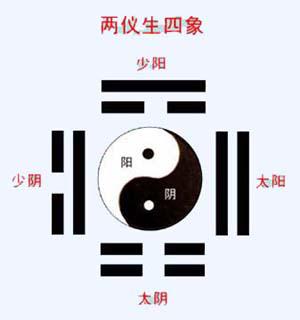
Figure: greater yang; structure of the character: lesser yang; essence: greater yin; concept: lesser yin.
If there is a cycle in which greater yin gives birth to lesser yin, lesser yin to lesser yang, lesser yang to greater yang, and greater yang to greater yin, then essence gives birth to concept, concept to the structure of the character, the structure to the figure of the character, and the figure to the essence. In such a cyclical process, people simultaneously come to know a thing’s form (figure), its nature (attributes and so on), the concept representing the thing, and the structure of the character representing the thing.
As described above, there is an inner connection among the sound, form and meaning of Chinese characters. Once this connection is grasped, Chinese becomes lively and vivid, easy to learn and easy to remember. Sever this connection, and Chinese becomes hard to learn, hard to remember and exceedingly abstruse.
