

This English version was translated from the Chinese original with AI assistance. The Chinese text is authoritative.
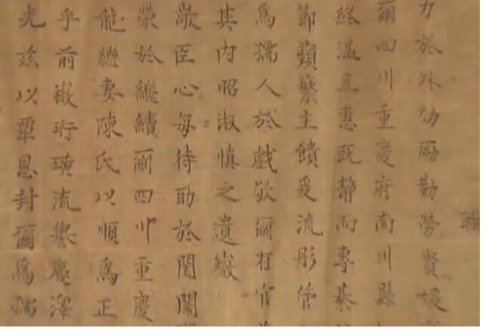
An imperial edict issued during the Kangxi reign and treasured by a farming family in Linxi County, Hebei Province, was recently made public, attracting the attention of many archaeological experts and history enthusiasts. The regular-script calligraphy on the edict, with brushwork so forceful it seems to pierce the paper, amazed everyone.
According to mainland Chinese media, this edict was issued on the twenty-fourth day of the ninth month of the twenty-third year of Kangxi (1684 CE) to Wu Chenglong, then magistrate of Nanchuan County in Chongqing Prefecture, Sichuan, and to his late wife née Liu and his second wife née Chen.
In the edict, phrases such as “elegantly skilled in talent and ability” and “not forgetting the duty to care for and nurture the people” praise Wu Chenglong’s competence and his compassion for the people’s sufferings. The edict also commends the fine household management and tradition of his two wives; Wu Chenglong and his two wives were granted the titles “Gentleman for Civil Service” (Wenlinlang) and “Lady of Rank” (Ruren) respectively.
According to the Genealogy of the Wu Clan, the Wu family was a prominent local clan in the Qing dynasty, with six members over four generations serving as officials in the early and middle Qing. Because Wu Chenglong was an upright official, he was later promoted to posts such as subprefect of Puan Department and vice director in the Ministry of Justice.
Although this edict has weathered more than 300 years, it is basically well preserved. It is made of jacquard brocade with an overall background of interlaced cloud patterns; it is 1.2 metres long and 0.31 metres wide, and is written in both Chinese and Manchu. The Chinese part of the main text is written in regular script, 19 lines with 325 characters in total; the Manchu part totals 23 lines.
After the edict was made public, it attracted the attention of many archaeological experts and history enthusiasts. Some comments praised it: “This brush calligraphy is simply superb.” Others sighed: “The traditional-character regular script of the edict is like a work of craftsmanship; just looking at it you feel a powerful aura of majesty and dare not be presumptuous.”
The contemporary poet and writer Liu Shahe once pointed out: “Every traditional character can prove its own existence, while no simplified character can prove the reason for its existence.”
