

This English version was translated from the Chinese original with AI assistance. The Chinese text is authoritative.
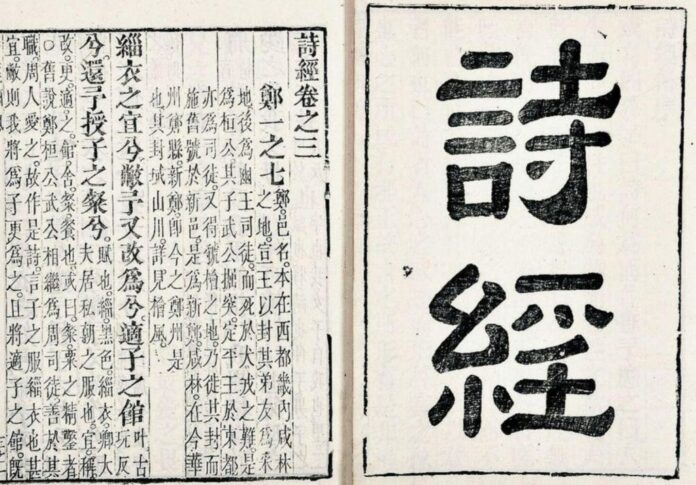
The Book of Songs (Shijing) contains the most beautiful poems among China’s ancient books. Here are excerpted its 20 most beautiful lines, with vernacular renderings, to share with readers.
一、手如柔荑,肤如凝脂,领如蝤蛴,齿如瓠犀,螓首蛾眉。巧笑倩兮,美目盼兮。 — 1. Her hands like soft young shoots, her skin like congealed lard, her neck like a tree grub, her teeth like melon seeds, a cicada’s brow and moth-feeler eyebrows. Oh, her artful smile with its dimples! Oh, her lovely eyes, black and white!
Her slender fingers are like tender shoots, her fair skin like congealed cream, her lovely neck like a white grub, her teeth white and even like gourd seeds, her forehead square and her eyebrows finely curved. A faint smile shows charming dimples; her beautiful eyes glance about, sparkling.
--Book of Songs, Airs of Wei, “The Stately Lady”
二、知我者,谓我心忧;不知我者,谓我何求。悠悠苍天,此何人哉? — 2. Those who know me say my heart is grieved; those who don’t know me ask what I am seeking. O distant azure heaven, who has brought this about?
Those who know me say my heart is sad; those who don’t say I am after something. O heaven high above, who has driven me from my home!
--Book of Songs, Airs of Wang, “The Millet Droops”
三、风雨如晦,鸡鸣不已。既见君子,云胡不喜? — 3. Wind and rain, and all is dark as night; the cocks crow without ceasing. Now that I have seen my lord, how can I not rejoice?
Wind and rain without end, the sky dim and grey; the cock heralds the dawn, crowing on and on. At last I see my husband return; how could my heart not be glad?
--Book of Songs, Airs of Zheng, “Wind and Rain”
四、青青子衿,悠悠我心。 — 4. Blue, blue is your collar; long, long is my longing.
The fine young man with the blue collar: my heart longs for him without end.
--Book of Songs, Airs of Zheng, “Your Collar”
五、有匪君子,如切如磋,如琢如磨。 — 5. There is our elegant gentleman, as if cut and filed, as if carved and polished.
The cultured and graceful gentleman is like ivory that has been cut and filed, like fine jade that has been carved and polished.
--Book of Songs, Airs of Wei, “The Banks of the Qi”
六、“死生契阔”,与子成说。执子之手,与子偕老。 — 6. “In death or life, together or apart,” so I vowed with you. I hold your hand, to grow old together with you.
“In life and in death we shall never part”: we keep our vow in our hearts. I once held your hand tight, to be with you until we are old.
--Book of Songs, Airs of Bei, “Beating the Drum”
七、投我以木瓜,报之以琼琚。匪报也,永以为好也。 — 7. She threw me a quince, I repaid her with a jade pendant. Not as repayment, but to be forever bound in love.
She gave me a quince, I repaid her with a jade pendant. Not merely as repayment, but to show that I will love her forever.
--Book of Songs, Airs of Wei, “The Quince”
八、我心匪石,不可转也。我心匪席,不可卷也。 — 8. My heart is not a stone; it cannot be turned. My heart is not a mat; it cannot be rolled up.
My heart is not a stone that can be moved at will. My heart is not a straw mat that can be rolled up at will.
--Book of Songs, Airs of Bei, “The Cypress Boat”
九、相鼠有齿,人而无止。人而无止,不死何俟? — 9. Look at the rat: it has teeth; a man, yet without restraint! A man without restraint: why does he not die, what is he waiting for?
Look at the rat, it still has teeth; a person whose conduct has no restraint. If a person has no restraint, what is he waiting for, why not die?
--Book of Songs, Airs of Yong, “Look at the Rat”
十、视民不恌,君子是则是效。 — 10. He shows the people no meanness; the gentlemen take him as their model and imitate him.
Showing people generosity and not frivolity, he is a fine model for gentlemen to learn from.
--Book of Songs, Lesser Odes, “The Deer Cry”
十一、妻子好合,如鼓瑟琴。兄弟既翕,和乐且湛。 — 11. Wife and children in loving harmony, like the playing of the se and qin. Brothers in accord, joyful and happy.
The husband leads, the wife follows, and she is good to him; like the se and qin playing in harmony, together until old age. The brothers’ feelings are harmonious too, and the whole family gathers in happiness.
--Book of Songs, Lesser Odes, “The Cherry Tree”
十二、月出皎兮,佼人僚兮。 — 12. The moon comes out so bright; the lovely one so fair.
The bright moon rises shining into the sky; the beauty is charming, her figure light and graceful.
--Book of Songs, Airs of Chen, “The Moon Comes Out”
十三、他山之石,可以攻玉。 — 13. Stones from other hills can serve to work jade.
On the hills of other lands there are hard stones that can likewise be used to carve jade.
--Book of Songs, Lesser Odes, “The Crane Cries”
十四、今夕何夕,见此良人? — 14. What night is this night, that I see this good man?
What night can this be, that I get to meet such a good man?
--Book of Songs, Airs of Tang, “Bound Fast”
十五、有美一人,清扬婉兮。 — 15. There is a beautiful one, with clear brows and lovely eyes.
A beautiful woman walks along the road, with fine brows and clear eyes, lovely and radiant.
--Book of Songs, Airs of Zheng, “In the Wilds There Is Creeping Grass”
十六、如月之恒,如日之升。 — 16. Like the moon in its constancy, like the sun in its rising.
You are like the bright moon constant in the sky, like the sun rising in the east.
--Book of Songs, Lesser Odes, “Heaven Protects”
十七、关关雎鸠,在河之洲。窈窕淑女,君子好逑。 — 17. “Guan guan” cry the ospreys on the islet in the river. The lovely and virtuous maiden is a fine match for the gentleman.
The ospreys calling “guan guan” to each other perch on a sandbar in the river. The beautiful, virtuous girl is truly a good match for a gentleman.
--Book of Songs, Airs of Zhou and the South, “The Ospreys”
十八、日居月诸,照临下土。 — 18. O sun, O moon, shining down upon the earth below.
The sun and moon send forth their rays, their light illuminating the whole earth.
--Book of Songs, Airs of Bei, “Sun and Moon”
十九、巧笑倩兮,美目盼兮。 — 19. Oh, her artful smile with its dimples! Oh, her lovely eyes, black and white!
A faint smile shows charming dimples; her beautiful eyes glance about, sparkling.
--Book of Songs, Airs of Wei, “The Stately Lady”
二十、鸿雁于飞,肃肃其羽。 — 20. The wild geese are flying, su su go their wings.
The wild geese fly off into the distance, their spread wings rustling.
--Book of Songs, Lesser Odes, “The Wild Geese”
