

This English version was translated from the Chinese original with AI assistance. The Chinese text is authoritative.
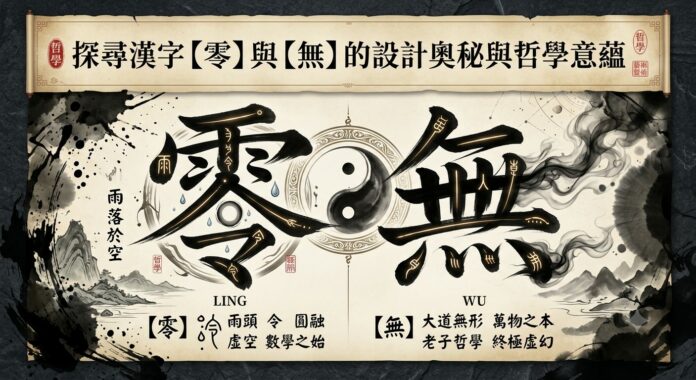
——Exploring the Design Mysteries and Philosophical Meaning of the Characters 零 (Zero) and 无 (Nothing)
Introduction: being and non-being give rise to each other; heaven and earth seen within a square inch
In the vast universe of Chinese characters, the two characters 【零】 (líng, “zero”) and 【无】 (wú, “nothing”) both seem to point to the image of “vacancy” or “not having.” Yet their design concepts, paths of evolution and the cultural content they carry are like two gates opening onto different worlds, each profound and unique. One sprouted from a concrete natural phenomenon and finally took its place in the field of numbers; the other was born of ancient philosophical speculation and became a foundational concept of Chinese civilization. This article uses the character-formation theory of the New Six Scripts to explore the design mysteries and philosophical wisdom hidden behind these two characters, which look similar but are in fact quite different.
【零】: from light rain to the empty place in numbers (common reading)
The origin of the character 【零】 has no direct connection with the number “0” as we understand it today. Its ancient form was 【霝】; in oracle-bone script it looks like fine raindrops falling from the sky, and its original meaning was “light rain” or “scattered rain.” The Shuowen Jiezi explains it as “slow rain,” vividly depicting raindrops falling scattered. In terms of form, 【零】 is a typical phono-semantic character, with the 【雨】 (yǔ, “rain”) top component expressing meaning and 【令】 (lìng) as the phonetic component. Over its long history, the meaning of 【零】 gradually extended to scattered, fragmentary, withered and fading, as in “fallen and scattered, crushed into mud and dust.” Only in modern times, with the introduction of the Western mathematical system, was the character 【零】 borrowed and established as the symbol for the number “0,” completing its semantic leap from a natural phenomenon to an abstract mathematical concept. This is a unique case of cultural exchange and functional borrowing, showing the great inclusiveness and adaptability of Chinese characters.
【零】: microscopic order within the Two Modes of form and meaning (design reading)
Viewed through the Two Modes of form and meaning of the New Six Scripts, the design of 【零】 is by no means accidental. In the rationale of character formation, its radical 【雨】 refers not only to the water of nature but also symbolizes the “virtue of water”: supremely soft and supremely good, nourishing things silently, as well as the most fundamental principle of the universe, “Truthfulness, Compassion, Forbearance.” Water can wash all things clean and can also nourish life; its nature is diffuse and formless, yet it is everywhere. The character 【令】 carries the meaning of “command, rule, order,” and can also mean “minute, subtle.” Therefore the design of 【零】 reveals precisely a kind of “microscopic order” or “truth within scattering.” It is not true “nothing,” but a state that is extremely subtle and scattered everywhere, yet exists in accordance with the fundamental laws of the universe (the virtue of water; Truthfulness, Compassion, Forbearance). Just as in cultivation culture the principles of the great Dao manifest in all things, even the most minute “scattered” places contain higher-dimensional order and laws. This is the “character rotor” shown by the mutual generation of form and meaning in 【零】: within the apparent “emptiness” is reflected a subtle “principle of existence.”
【无】: philosophical origin and the realm of non-existence (common reading)
Unlike the concrete origin of 【零】, the character 【无】 carried profound philosophical meaning from the very beginning. Scholars interpret its oracle-bone and bronze-script form 【無】 differently: some think it depicts a person dancing with feathers in hand, performing a shamanic prayer, symbolizing a state of communicating with the divine and transcending material limits; others take it to depict flames burnt out, with nothing left. Whatever exactly it depicts, its core points to the concept of “not having, not existing, emptiness.” In pre-Qin philosophy, 【无】 was further raised to the level of ontology. The Daodejing says at its very beginning, “The nameless is the beginning of heaven and earth,” regarding 【无】 as the origin of heaven, earth and all things, the initial state of the “Dao.” It is not “nothing at all,” but the infinite potential of “everything is possible,” the foundation from which “being” arises. This “non-being” transcends sensory experience; it is a profound philosophical concept full of tension.
【无】: the ultimate Taiji of rationale generating form (design reading)
In the New Six Scripts’ system of the Four Images of rationale, form, sound and intent, the character 【无】 is the supreme embodiment of “rationale generating form.” The “rationale” it carries is the ultimate noumenon at the beginning of cosmic creation, when all things had not yet taken form. If the original character 【無】 is taken in the sense of “a person dancing with feathers,” then the 【人】 figure symbolizes the cultivator’s search for and penetration of the origin of the great Dao, and the 【羽】 (yǔ, “feather”) can be seen as a medium for communicating with higher-dimensional spaces. This suggests that “non-being” is not emptiness, but an ineffable “being” of a higher dimension. If it is taken in the sense of “flames burnt out,” then the extinguishing of 【火】 (light, wisdom) does not mean extinction, but a return to a purer, more primordial state of energy. In the Two Modes of form and meaning, 【无】 is the Taiji state of supreme yin and supreme yang, the chaos in which forms are not yet differentiated and all things not yet born. With its abstract form, it directly reflects the formlessness and imagelessness, the beginninglessness and endlessness of the “Dao”; it is the highest abstraction and distillation of the laws of the universe at the level of writing. It reminds us that true “emptiness” is not void, but the origin that holds infinite vitality.
The cultural interweaving and philosophical divergence of 【零】 and 【无】
Although 【零】 and 【无】 are both related to the concept of “emptiness,” their cultural positions and philosophical depth are entirely different. 【零】 starts from a concrete natural phenomenon (raindrops, scattering) and finally represents an “empty place” or “minuteness” at the quantified, discrete level; its meaning points to the “non-being” within “being,” a relative vacancy. It is concerned with the subtleties of the material world and the order embodied in fine details. 【无】, by contrast, points directly to the noumenon and origin of the universe; it is the “non-being” above “being,” an absolute, transcendent state of “non-existence,” the starting point from which all things arise. It is concerned with metaphysical philosophical speculation, the mystery of cosmic creation. One microscopic and one macroscopic, one concrete and one abstract, together they build the Chinese nation’s unique understanding of the philosophical categories of “emptiness” and “being,” showing the infinite possibilities of Chinese characters in carrying cultural and philosophical thought.
Conclusion: the profound wisdom in the design of Chinese characters
By exploring the design mysteries and cultural content of the two characters 【零】 and 【无】, we gain a glimpse of the profound wisdom contained behind the system of Chinese characters. They are not simple piles of symbols, but carry the sages’ deep insight into nature, life and the laws of the universe. Whether the microscopic order revealed by 【零】 or the philosophy of origins reflected by 【无】, both embody the unique charm of the “mutual generation of form and meaning” in Chinese characters. They are an important part of the genes of Chinese culture, continually inspiring us to reflect on the dialectical relationship between “being” and “non-being,” “existence” and “non-existence,” and on the formless and eternal “rationale” behind all things.
