

This English version was translated from the Chinese original with AI assistance. The Chinese text is authoritative.
From the small one sees the great. A little chopstick is both insignificant and indispensable. In it are embodied most of the characteristics of traditional Chinese culture.
First, a chopstick is round at one end and square at the other. The round end symbolizes heaven and the square end symbolizes earth, corresponding to “heaven is round and earth is square”;
this is the Chinese understanding of the basic principles of the world;
and the square end is on top while the round end is below and touches the food directly, representing “food is heaven to the people.”
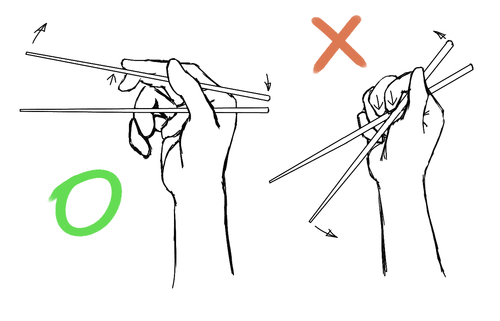
Second, when holding chopsticks, the thumb and index finger are above, the ring finger and little finger below, and the middle finger in the middle: this is the image of the Three Powers, heaven, earth and humanity, and it is the Chinese understanding of the relationship between humanity and the world;
next, the Chinese follow the ideas of the Supreme Ultimate (Taiji) and of yin and yang.
The Supreme Ultimate is one, yin and yang are two;
one divides into two, which represents that all things are made up of two opposing sides;
two combine into one; this union of yin and yang also signifies a perfect result;
The Chinese value combining two into one. For example, Eastern and Western civilization both originated in myth. Later, in the West, humans and gods parted ways: for doing things one relied on science, for being a person one relied on religion. In China, by contrast, everything is joined together: He Xiangu, Iron-Crutch Li, Lü Dongbin, Sun Wukong and Zhu Bajie, these immortals are also people;
for the Chinese, ideals and reality, soul and body, are likewise united as one;
so someone in a restaurant who calls to the waiter “bring a pair of chopsticks” is surely Chinese; someone who says “bring two chopsticks” is surely a foreigner.
The Zhou Yi (Book of Changes) has the manifest Eight Trigrams: Qian, Kan, Gen, Zhen, Xun, Li, Kun and Dui; and the hidden eight: Rest, Life, Harm, Obstruction, Scene, Death, Alarm and Opening. Chopsticks come in twos, which is two; mapped onto the Eight Trigrams this is the Dui trigram, meaning “mouth.” The straight, long shape of the chopsticks themselves corresponds to the Xun trigram, meaning “to enter.”
When using chopsticks, one stick is active and the other follows; the active one is yang and the following one is yin. This is the image of the Two Modes (Liangyi).
A pair of chopsticks lying on the dining table is like a brush lying on a writing desk;
the standard length of chopsticks is seven cun six fen, representing the seven emotions and six desires of human beings, showing that people are fundamentally different from animals.
Chopsticks can also be used for acupressure, massage and scraping (guasha). In the old days, people traveling the land needed only a pair of chopsticks to treat whatever ailment they had; even if they forgot them, they could snap off a twig or a reed, break it to length, grind it on a stone and wash it in water, and it would serve.
There are also many rules of etiquette in using chopsticks. For example, food may only be picked up from the top downward, which is called “riding-a-horse picking”; turning food over and picking it up from below, called “carrying-a-sedan picking,” is not allowed.
Below are twelve taboos the Chinese observe in using chopsticks:
1. Three long and two short:
This means that before or during a meal, placing chopsticks of uneven length on the table is very unlucky. We usually call this “three long and two short,” and it stands for “death.” In the past, the Chinese believed that after death a person is placed in a coffin. After the person has been placed inside and before the lid is put on, the coffin consists of two short boards at the front and back and three long boards for the two sides and the bottom. A coffin made of these five boards is exactly “three long and two short,” so this is considered extremely unlucky.
2. The immortal points the way:
This practice is also utterly unacceptable. In this way of holding chopsticks, the thumb, middle finger, ring finger and little finger grip the chopsticks while the index finger sticks out. In the eyes of Beijingers this is called “cursing in the street,” because with the index finger extended during the meal, one keeps pointing at others. When Beijingers point their index finger at someone, it usually carries a sense of accusation. So pointing at people with one’s finger while eating with chopsticks is no different from accusing them; it is the same as cursing them, and is not permissible. There is another situation with the same meaning: pointing at people with one’s chopsticks while talking with them during a meal.
3. Savoring the chopsticks with a noise:
This is not acceptable either. One holds the end of the chopsticks in one’s mouth and sucks on them back and forth, now and then making a slurping sound. Such behavior is regarded as vulgar. Sucking one’s chopsticks during a meal is rude in itself, and accompanied by sound it is all the more off-putting. So anyone who does this is generally considered to lack upbringing, and likewise it cannot be permitted.
4. Striking the cups and tapping the bowls:
This behavior is regarded as begging. It means striking plates and bowls with one’s chopsticks during a meal. In the past, only beggars struck their begging bowls with chopsticks; the sound, together with their pleading, drew the attention of passers-by to give alms. This practice is regarded as extremely lowly and is held in contempt by others.
5. Patrolling the city with chopsticks in hand:
This means holding one’s chopsticks as though no one else were present and roaming them back and forth over the dishes on the table, unsure where to strike. Such behavior is a typical sign of lack of cultivation, and is arrogant and extremely offensive.
6. Lost chopsticks digging up graves:
This refers to raking ceaselessly through a dish with one’s chopsticks in search of prey, as though robbing and digging up a grave. This practice is similar to “patrolling the city with chopsticks,” and both are signs of poor upbringing that people find off-putting.
7. Weeping chopsticks dropping pearls:
In fact this means being clumsy when picking up food with one’s chopsticks to put on one’s own plate, so that sauce drips into other dishes or onto the table. This practice is regarded as a serious breach of etiquette and is likewise unacceptable.
8. Turning heaven and earth upside down:
This means using one’s chopsticks upside down during a meal. This practice is looked down upon greatly: it is as the saying goes, a hungry man is not choosy about food, so much so that he has lost all sense of face and uses his chopsticks upside down. This is absolutely not allowed.
9. The sea-calming needle:
Stabbing at the food in a dish with a single chopstick during a meal is not allowed either. It is considered an insult to the others at the table. Doing this during a meal is no different from showing someone the middle finger in public in Europe; it is not allowed.
10. Offering incense in public:
This often happens out of kindness when serving rice for someone else: for convenience one sticks a pair of chopsticks into the rice and hands it over. This is regarded as a great disrespect, because in Beijing tradition this is done only when offering incense to the dead. Sticking a pair of chopsticks into rice is regarded as no different from offering incense to the dead, so sticking chopsticks into a bowl is absolutely unacceptable.
11. Crossing them in an X:
This is often overlooked. Carelessly laying one’s chopsticks crossed on the table during a meal is wrong, because Beijingers believe that making a cross on the dining table is a total rejection of everyone else at the table, just as when a student gets homework wrong and the teacher marks a cross in the exercise book; others cannot accept it. Besides, this practice is also disrespectful to oneself, because in the past people marked a cross only when signing a confession in a lawsuit, so it is undoubtedly a rejection of oneself. This is not allowed either.
12. Dropping them and alarming the spirits:
“Dropping them and alarming the spirits” means accidentally letting one’s chopsticks fall to the ground, which is a serious breach of etiquette. Beijingers believe that all their ancestors lie at rest beneath the earth and should not be disturbed; chopsticks falling to the ground amounts to disturbing the ancestors below, which is a great unfilial act, so this behavior is not permitted. But there is a remedy: once the chopsticks have fallen, one should quickly use them to draw a cross on the ground according to the direction one is sitting in, first east-west and then north-south, meaning “I am not a thing (东西, ‘east-west’); I should not have disturbed the ancestors,” then pick up the chopsticks while saying that one deserves to die.
As a land of ritual and propriety and an ancient city, the use of a small pair of chopsticks alone lets people see a deep cultural heritage.
So the chopsticks we use every day contain faith, and every movement embodies ideas. This is the broad understanding and wisdom of the Chinese. Shui Muran believes that when parents eat with their children, a pair of chopsticks is the best textbook! We must pass this culture on from generation to generation!
