

This English version was translated from the Chinese original with AI assistance. The Chinese text is authoritative.
Reporter: Thank you for agreeing to this interview. First, please introduce yourself.
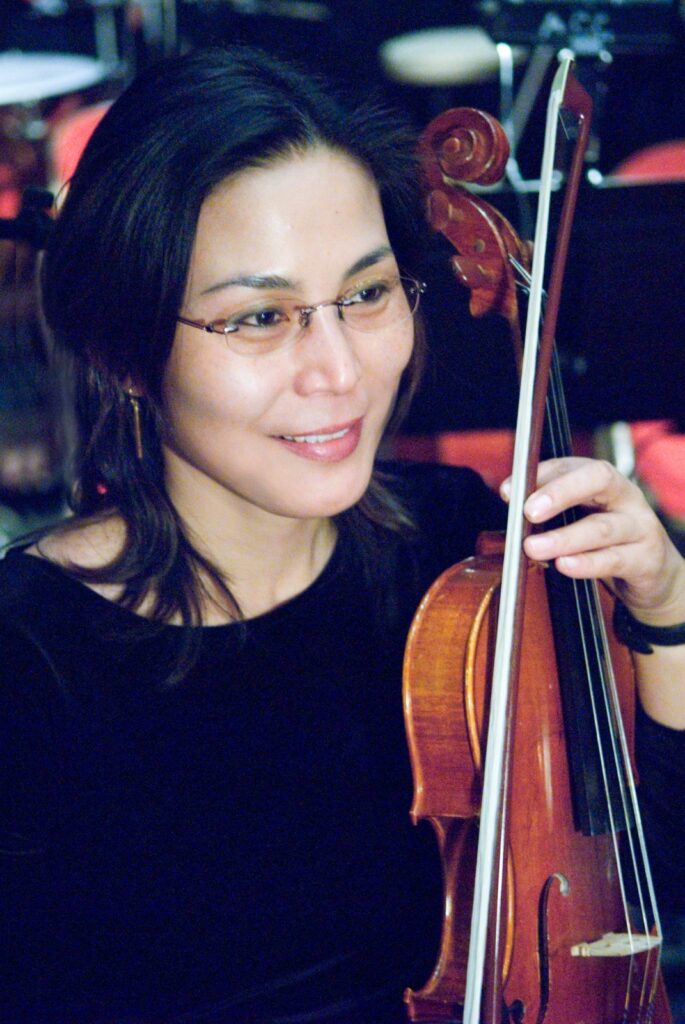
Delian: Hello everyone, I’m Delian. I live in the United States and teach violin and viola. I began learning the violin at the age of eight and had many wonderful teachers over the years, one of whom was Sheng Xue of the Nanjing University of the Arts. I grew up under the guidance of China’s older generation of music teachers and have indelible memories of their strict, patient and selfless way of teaching. I was once second violinist in a Chinese youth orchestra and also worked in radio and television. Influenced by my father, who worked at the Ministry of Foreign Affairs in Beijing, I came to the American South to study.
I later won a place as violist in a professional orchestra in New York. I loved the artistic atmosphere of the orchestra, especially the world tours, which let me experience the cultures, music, artistic architecture and ways of life of many countries. After having children, I left the orchestra to give them a stable environment to grow up in and began working in music education. My students come from New York as well as from Australia, Canada and other US states, and most of them have gone on to be admitted to professional music schools in the United States.
Now I work in music education. My students come from New York as well as from Australia, Canada and other US states, and most of them have gone on to be admitted to professional music schools in the United States.
Reporter: How did you come to know the Zhang Shixiang violin teaching method?
Delian: In my teaching I found that most American teachers use Japan’s Suzuki materials. The most common books in music shops were also Suzuki or modern beginner editions published in the United States. Most American music teachers place more emphasis on making music learning enjoyable for children, though of course for exceptionally gifted children they also use more academic, traditional classical teaching repertoire. After I began working in music education, I started paying attention to materials and trends in violin education.
The popular teaching materials and teaching practices on the market often struck me as having many shortcomings and gaps. At that point, on the recommendation of a friend from the orchestra, I read Professor Zhang Shixiang’s Zhang Shixiang’s Questions and Answers on Violin Teaching.
Professor Zhang’s answers are incisive, and they reminded me of the patient guidance our older generation of music teachers gave us: the bow in the right hand must be drawn straight, the fingers of the left hand must rise and fall cleanly, the ear must be keen, the rhythm precise, and so on…
But as the years went by, those memories gradually blurred or faded. Although I still instinctively applied these elements myself, when it came to improving the learning process of young students, Professor Zhang’s book truly brought everything deep in my memory back into focus. I am very grateful to Professor Zhang for this. It also made me want to learn more about his teaching method and his teaching experience.
I began searching online and, bit by bit, actually found a whole series of teaching materials Professor Zhang had published. I had friends in China mail them to me in the United States, and with a friend’s help I got in touch with Professor Zhang himself and had the opportunity to go to Australia to meet him in person and learn the old professor’s lifetime of teaching experience and his rigorous, scientific teaching method. I feel very honored by this.
Reporter: Can you give a concrete example of how the Zhang Shixiang violin method has affected your students?
Delian: As I became familiar with Professor Zhang’s violin method and materials, I found myself liking them more and more. I was very interested and found them very scientific and excellent.
All the teaching materials Professor Zhang compiled, together with his unique way of teaching and disseminating them, have given me much more confidence in my own music teaching. This is truly wonderful.
I first tried it with the student who had the biggest problems of all those learning violin with me, a seven-year-old girl. By the time she came to me she had already studied with other teachers for more than two years, yet when she played a piece from Suzuki Book 1, even an extremely simple tune was unbearable to listen to: from holding the violin to rhythm to intonation, everything was a mess.
After about two months of studying with Professor Zhang’s New Violin for Beginners in 100 Days, she played as if she were a different child; she had made great progress. Her mother was also very happy and said she now played properly.
This child lives quite far away; each lesson required her parents to drive more than two hours. At first, to correct her mistakes, she had to come for lessons twice a week. I worried that when she practiced at home she would fall back into her old bad habits, and during the winter break she even had to stay at my house. But since we began using Professor Zhang’s method and the website videos, she practices at home following the videos online, and there are far fewer problems when she plays back her lesson.
Through practicing this way, her rhythm has become steady and her intonation has improved. Even her piano playing has become rhythmic; her piano teacher of almost two years was puzzled as to why the child’s sense of musical rhythm had suddenly become so much better, and kept speeding up her piano lessons!
Using Professor Zhang’s materials and method, these children whose problems had given me headaches made gratifying progress within a month and a half. Not only did the parents gain confidence in their children’s violin learning, the children’s interest in the violin also grew greatly.
This child’s transformation was a great encouragement to me as a teacher too. Through the experience of having newly arrived children actually apply Professor Zhang’s method, I gradually had more children start using his method at all levels. With several children who come from Canada to study with me, I can also teach weekly lessons by video, though of course I still ask them to come to the United States for in-person lessons during school holidays or long weekends.
The children’s progress has indeed been clear and steady. In particular, their enthusiasm for learning has grown, and the parents’ involvement has become relaxed, lively and fun. They are more willing to let the children practice on their own without watching over them every moment, and everything has become much easier for everyone. And my teaching has become more effective.
Reporter: What is your view of the Zhang Shixiang violin method?
Delian: When I learned the violin as a child, my teachers often praised my good memory and strong ability to imitate. But after class, back home, I still had to try hard to remember what the teacher had said in the lesson and how the teacher had demonstrated a particular phrase. Sometimes when I forgot the teacher’s demonstration I got terribly anxious, always afraid of being punished in the next lesson.
Children’s ability to imitate is usually extremely strong. Now, with this way of learning the violin that Professor Zhang has devised, and the video demonstrations on the website, children have something to imitate and no longer have to rely entirely on memory in tedious practice at home. For teachers, each lesson no longer wastes so much time repeatedly correcting the same, or simple but persistent, mistakes, and the time can be spent on other details.
For children, it helps them avoid making the same mistakes when practicing. Practicing with errors means that the more one practices, the deeper and more ingrained the errors become, which causes the teacher even greater trouble, because changing a habit is not an easy process.
Now, with Professor Zhang’s violin-learning website and videos, children won’t stray far off course when they practice at home. This effectively improves the results and efficiency of their practice, and also helps violin teachers improve the quality of their teaching and keep it progressing steadily. There are also piano accompaniment videos online, so children can play along with the piano, which greatly promotes and helps their listening and performance skills…
I even hope this method can soon be applied to the teaching of viola and cello; it would no doubt be equally astonishing in improving the practice results of children learning viola and cello.
Reporter: Do you have any message for children learning the violin?
Delian: To children who want to learn the violin, I sincerely suggest trying Professor Zhang’s materials and method. You will discover a different world of learning that will make our learning more accurate and more fun. This method is also what I often dreamed of when I learned the violin as a child: how wonderful it would be to have a teacher practicing with me every day!
This childhood dream has actually been realized by Professor Zhang. I feel it is truly good news in our time for young violinists who want to study the violin systematically, especially during the pandemic, when schools everywhere are under quarantine and students cannot attend school normally.
A teaching course that crystallizes art and modern science and technology, So amazing!
With this article I thank Professor Zhang for his selfless contribution to violin education, and express my respect and gratitude to the older generation who taught me so diligently.
(Reposted with the authorization of teacher Delian)
