

This English version was translated from the Chinese original with AI assistance. The Chinese text is authoritative.
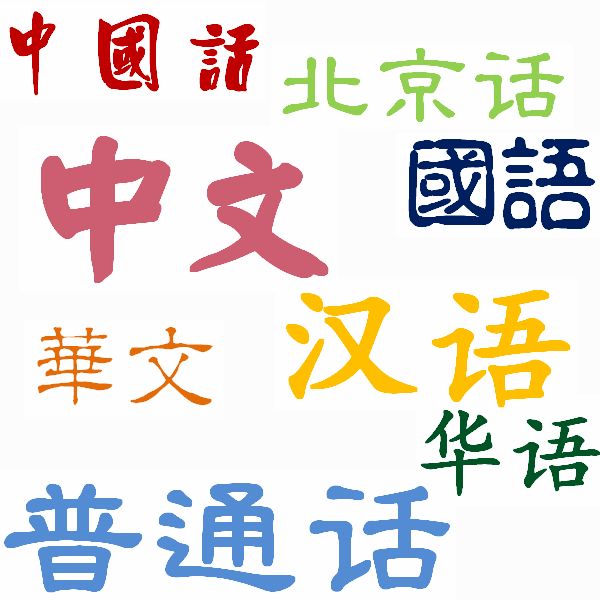
In mainland China, a yuwen (language and literature) class is generally understood to mean a Hanyu (Chinese language and literature) class, while other languages used in China, such as Uyghur, Mongolian and Tibetan, and languages used in other countries and regions, such as English and French, are specifically called by the names of those languages. As for the Chinese language itself, in mainland China it is called Hanyu; among emigrants from mainland China overseas it is called Zhongwen; in Taiwan and among Taiwanese emigrants overseas it is called Guoyu or Huayu. These different names naturally have different historical developments and backgrounds.
In mainland China, many languages besides Hanyu are in use, so even though Hanyu is the official language, it is awkward to call it Zhongwen, “the language of China.” Abroad, however, Hanyu is not only the official language but also the language used by the vast majority of Chinese people, so calling it Zhongwen, “the language and writing of China,” is a convenient and easily understood name. But this name has a problem: countries and regions such as Singapore and Taiwan also have Chinese Mandarin as one of their official languages, and naming it directly Zhongwen — “the language and writing of China” — causes a certain awkwardness, so the expression Huayu came into being. Understanding Huayu as “the language used in Greater China,” “the language that carries on Chinese culture,” or “the language used by the Huaxia people” seems to be a more inclusive expression.
The name Guoyu (“national language”) has quite a history. The concept of “China” as a country arose only in modern times. In ancient times there was simply one dynasty succeeding another. “All under heaven is the king’s land; all within the shores of the land are the king’s subjects.” The imperial court was the court of all under heaven, and states and kings were enfeoffed and invested by the court. Although different regions, states and peoples under the Huaxia court had different languages and dialects, the court always had its own unified language: in the Xia dynasty there was Xiayan, after the Zhou there was Yayan (the elegant speech), and by the Han dynasty the language understood everywhere was called tongyu (common speech), fanyu (general speech), or tongming (common names).
In the Ming dynasty the name guanhua (“officials’ speech,” Mandarin) appeared, and Nanjing Mandarin was current throughout the Ming. At that time officials were posted all over the country, and examination graduates, whether serving in the capital or posted to the provinces, could not speak home dialects that people from the capital and other provinces could not understand; objective need forced them to learn to speak Mandarin. The spread of Mandarin was at first only spontaneous among officials. In the Yongzheng reign of the Qing, it was decreed that all juren, xiucai, gongsheng and tongsheng candidates who did not understand Mandarin were barred from the examinations. Although this order was not enforced for long, Yongzheng’s edict still played an important role in promoting the spread of Mandarin.
At the end of the Qing dynasty, as foreign powers gradually grew strong, the Chinese court gradually came to define its territory as a nation-state. In the first year of the Xuantong reign (1909), the Qing government formally established the “National Language Editing and Review Committee” and formally proposed changing guanhua to Guoyu. After the Republic of China was founded in early 1912, it confirmed the name Guoyu and decided to promote Guoyu nationwide.
Today overseas, Hanyu, Zhongwen, Guoyu and Huayu divide the field among them. Chinese who have just come from mainland China habitually say Hanyu; those who have been abroad longer say Zhongwen; Chinese from the southeastern coast — Zhejiang, Fujian, Jiangxi and so on — mostly say Guoyu; in Taiwan Guoyu and Huayu are used about equally; and overseas Chinese in Southeast Asia also mostly say Guoyu. These different names are not hard for Chinese people to understand, but for people whose mother tongue is another language they still cause much inconvenience. As more and more people learn Chinese, gradually arriving at a unified name is the trend of the times.
