This English version was translated from the Chinese original with AI assistance. The Chinese text is authoritative.
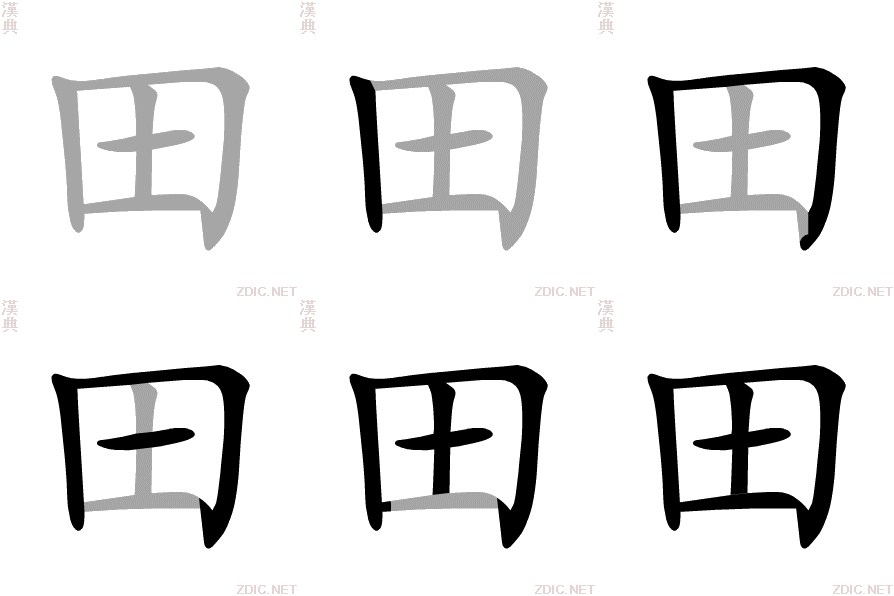
田 (tián, “field”) is a common character, a radical and a frequently used component. The basic meaning of 田 is land where crops are grown: ~野 (fields). 耕~ (to till the field). By extension, things related to agriculture: ~家 (farming family). ~园 (fields and gardens, the countryside). In ancient times it was also used for 畋 (to hunt) and 佃 (to cultivate). It is also a surname.
The Kangxi Dictionary says: “Land where grain is planted is called 田; it depicts four 口 (enclosures). The 十 is the system of paths between the fields. [Yupian] Soil; land. [Zhengyun] Soil already tilled is called 田. [Shiming] To fill: the five crops fill it. [Book of Changes, hexagram Qian] ‘The dragon appears in the field.’ [Book of Songs, ‘Lesser Odes’] ‘Rain on our public fields.’ [Tongdian] In ancient times there were well-fields: nine plots marked out like the character 井, tilled by eight families, the middle one being the public field, relied on by the ruling house. Gui fields were fields beyond one’s salary, to provide for sacrifices. Jia fields were fields granted as an additional reward on top of a reward already given.”
There are also many views on how the character 田 is constructed. The general understanding is that 田 comes from the well-field system. Here we break it down as follows.
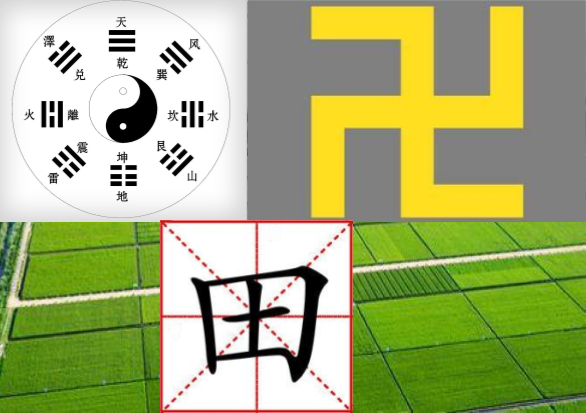
From land where grain and trees are grown, it can be extended to the space and time in which life arises and grows. So the construction is this: the square outer frame represents the four directions, east, south, west and north; the eight nodes where the lines meet represent the eight directions — that is, the four sides and eight directions; the 十 in the middle is the worlds of the ten directions. Together they are the four sides and eight directions and the worlds of the ten directions — that is, the world in which we live and grow.
The four sides and eight directions can also represent the Four Images and the Eight Trigrams, corresponding to the Daoist school. The 十 in the middle is the central part of the Buddhist swastika 卐, or one may also regard the character 田 as concealing a 卐 within it. In the Kangxi Dictionary, 十 is the radical of the swastika; see [Zi collection, part 2] [十 radical]: 卍 · Kangxi stroke count: 6 · strokes beyond the radical: 4. Some people hold that 卐 and 卍 are the manifestations of the cross 十 rotating clockwise and counterclockwise. So what the character 田 expresses is the world formed by the Buddhist and Daoist schools. This should be the original meaning when Cangjie created the character. In later ages, each dynasty’s understanding of the character was gradually added.
The character 田 is the same in all the different script systems, so it is a very basic ancient character.