

This English version was translated from the Chinese original with AI assistance. The Chinese text is authoritative.
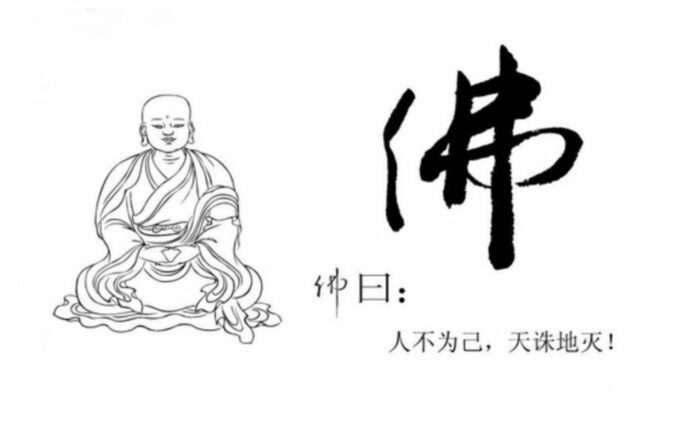
“If a person does not act for himself, heaven and earth will destroy him” (人不为己,天诛地灭) is a very popular saying in China. Many people take it to mean that one ought to look out for oneself, that one may use any means to satisfy one’s selfish desires and not hesitate to harm others, or else heaven and earth will destroy you. This is in fact a terrible understanding, because it is enormously destructive to the spiritual civilization of society: it can utterly destroy the normal, harmonious relations between people formed through the traditional virtues of benevolence, righteousness, propriety, wisdom and trustworthiness.
The saying comes from Buddhism; its source is the twenty-fourth collection of the Sutra of the Path of the Ten Wholesome Deeds Spoken by the Buddha: “For a person to act for himself is the law of heaven and the principle of earth; if a person does not act for himself, heaven and earth will destroy him.”
“Acting for oneself” as Buddhism speaks of it is different from the modern understanding. Buddhism holds that “good and evil being repaid is the principle of heaven; he who does many unrighteous deeds will bring about his own ruin.” Not doing bad things, not creating new evil consequences for oneself, not creating new calamities for oneself — this is “acting for oneself,” and only so will one have a good future. Conversely, doing things that heaven’s principle cannot tolerate, such as cheating and harming others, is “not acting for oneself,” and will bring destruction by heaven and earth. Buddhism holds that people have souls and that the soul is indestructible; it regards our physical body as a garment the soul wears in this world, not where true life resides. In the cycle of rebirth through the six paths, a life that does good deeds receives blessings in return, and one that does bad deeds receives evil retribution; one who does great or many bad deeds will go down to hell and bring on the punishment of heaven and earth. What Buddhism means by “if a person does not act for himself, heaven and earth will destroy him” is really that people should be responsible for themselves, responsible for the eternity of their own lives. The traditional culture and traditional morality created by China’s five thousand years of civilization are precisely what make people truly responsible for themselves, truly responsible for the eternity of their own lives.
Being responsible for oneself, guarding one’s heart and nature (心性), doing only good and no evil, was a natural and easy thing in times past, because our Chinese nation has a rich traditional culture, also called divinely imparted culture — such as “poetry, books, rites and music, folk customs, traditional beliefs, and statutes and institutions.” Traditional culture set strict norms for human morality; people’s thoughts and actions all had a reference and standards for weighing good and evil, right and wrong. That is why the Chinese nation came to be universally recognized as a land of rites and propriety and an ancient civilization.
With the collapse of rites and music — especially the modern “Destroy the Four Olds” campaign and the “Cultural Revolution,” which destroyed traditional culture and traditional morality and made people disbelieve in gods and Buddhas, become unrestrained and extremely selfish — this Buddhist saying exhorting goodness came to be understood in exactly the opposite sense, which in itself truly leads people toward “destruction by heaven and earth.”
If people want to be truly responsible for their own lives, they must have a clear mind, a spirit of independent thinking and the ability to tell right from wrong. Under any circumstances and pressure they must guard their heart and nature, keep righteous thoughts, not drift with the current, and hold fast to their righteous thoughts under the pressure of great forces.
