

This English version was translated from the Chinese original with AI assistance. The Chinese text is authoritative.
Ancient Chinese emperors and empresses had many titles, each with its own origin. The titles of the sovereign include: 王 (king), 帝 (emperor), 天子 (Son of Heaven), 皇 (august one), 帝, 皇帝 (emperor), and 陛下 (Your Majesty); the forms by which he referred to himself include 朕 and 寡人. Below their origins are explained one by one.
朕 (zhèn): in ancient times this was originally a first-person pronoun used by everyone, equivalent to “I.” For example, the patriotic poet Qu Yuan says in the first line of the Li Sao: “I am a distant descendant of the god-king Gaoyang; my late father was named Boyong” — using 朕 for “my.” After the First Emperor of Qin unified China, 朕 became a word reserved for the sovereign to refer to himself, and no one else was allowed to use it. 天子 (Son of Heaven): rulers held that they were “sons of heaven” whose position was conferred by heaven, so “Son of Heaven” became a byname for the ruler. 万岁 (wànsuì, “ten thousand years”): this began roughly in the Qin and Han. The word 万岁 was originally a cheer people gave on joyful occasions. For example, the Strategies of the Warring States records that when Feng Xuan burned the debt bonds on behalf of Lord Mengchang, the common people “shouted ‘ten thousand years!’” After the Qin and Han, it became customary for ministers, when attending the ruler at court, bowing in gratitude and offering congratulations, to shout 万岁, and so it became a byname for the emperor.
The empress may not call herself 哀家 哀家 and 本宫 are different
哀家 (āijiā, “this bereaved one”) was generally how an empress dowager or grand empress dowager referred to herself, while an empress generally referred to herself as 本宫 (běngōng, “this palace”). An empress dowager or grand empress dowager would not generally call herself 本宫, but 哀家. Only after her husband had died could an empress call herself 哀家. Moreover, the term 哀家 was used only for widowed empresses and appears only in literature, film and television; empresses in real history never called themselves 哀家 at any time. An empress calling herself 哀家 would be a joke — otherwise, wouldn’t she be cursing the emperor?
The origin of the title 皇帝
Calling the ruler 皇帝 (huángdì, “emperor”) began in history with the First Emperor of Qin. Before that, China’s supreme rulers were called 王 (wáng, “king”), or simply 皇 or 帝, as in King Wen of Zhou, King Wu of Zhou, the “Three Sovereigns” (三皇) and the “Five Emperors” (五帝). In the Spring and Autumn and Warring States periods, the Zhou royal house declined and the feudal lords contended for supremacy; the rulers of some powerful states also called themselves kings, such as the kings of Qin, Chu, Qi, Zhao and Yan. In 221 BC, Ying Zheng, King of Qin, destroyed the six states and pacified the realm. Ying Zheng considered this an unprecedented achievement, beyond even the Three Sovereigns and Five Emperors; if he did not change the title “king,” there would be “nothing to proclaim his success and hand it down to later generations.” So he had Li Si and others study how the title should be changed to display his glory. After deliberating, Li Si and the others reported to the King of Qin that in high antiquity there were the Heavenly Sovereign, the Earthly Sovereign and the Supreme Sovereign (泰皇), of whom the Supreme Sovereign was the most noble, and that “king” could be changed to “Supreme Sovereign.” The King of Qin considered this repeatedly, and holding that his “virtue was higher than the Three Sovereigns and his achievements surpassed the Five Emperors,” he decided to adopt the title 帝 as well, and called himself 皇帝, to show his own nobility.
Another account:
After Qin destroyed the six states, King Zheng of Qin felt that his achievements surpassed the Three Sovereigns and Five Emperors; if he did not change his title, his greatness would not be displayed, still less would later generations understand his lofty and abundant virtue. So he summoned Li Si and the court scholars to discuss changing the imperial title.
The chancellor Wang Wan memorialized: “The titles of the Three Sovereigns and Five Emperors were those of common lords of the realm, but the territory they actually possessed was no more than a thousand li square. Only after the Shang and Zhou took the title of king did they truly possess the whole realm, and the Zhou maintained its dynasty for eight hundred years. So your servant thinks the title of king is best.”
King Zheng of Qin said displeased: “I do not want a realm of seven hundred years like the Shang or eight hundred years like the Zhou, but a dynasty handed down for ten thousand generations.”
Li Si memorialized: “Your Majesty has pacified the realm; now everything within the seas has become commanderies and counties, and laws and decrees are unified by the centre. This has never happened since antiquity, so Your Majesty’s achievements are beyond the reach of the Three Sovereigns and Five Emperors. Your servant notes that in antiquity there were the Heavenly Sovereign, the Earthly Sovereign and the Supreme Sovereign, and the Supreme Sovereign was the most noble; your servant proposes the title Supreme Sovereign.”
Hearing this, King Zheng of Qin said happily: “‘Supreme Sovereign’ still cannot be told apart from those before. I think we should drop 泰 and keep 皇, adopt the ancient title 帝, and be called 皇帝. I shall be called the First Emperor (始皇帝); later generations will be counted by number, the Second Generation, the Third Generation, up to the Ten-Thousandth Generation, handed down without end. Further, King Zhuangxiang shall be posthumously honoured as Taishang (Supreme Elder).” And so Ying Zheng was called “the First Emperor of Qin” (秦始皇帝), commonly known as Qin Shi Huang.

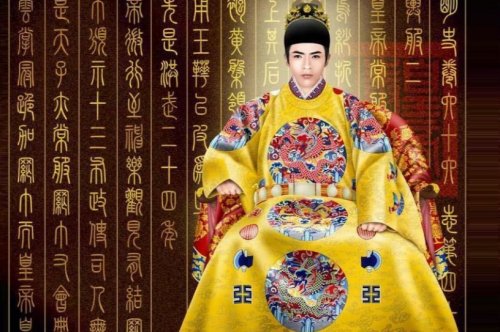
In some films and television dramas, the empress calls herself 哀家, which is in fact a mistake. (Image from the web)
Why the emperor called himself “朕”
Before the First Emperor of Qin, 朕 was just an ordinary character that anyone could use; it was not exclusive to rulers. Before that, the terms exclusive to rulers were 孤 (gū, “the orphaned one”) and 寡人 (guǎrén, “the person of little virtue”), modest ways of calling oneself a person of scant virtue. From the First Emperor of Qin onward, only the emperor could use 朕. 孤 passed to nobles below the rank of prince, such as marquises: when Sun Quan wrote to Cao Cao, “As long as you do not die, 孤 cannot be at ease,” he was then only the Marquis of Wu. 寡人 was then used by no one; after all, there was no longer any need to be modest.
Why the emperor called himself “寡人”
寡人 means a person of little virtue. The usage of this word is a little more complex than that of 孤. In ancient times kings and lords could modestly call themselves 寡人. The Zuo Zhuan: “I ask you to support him as master of the altars of the state; then even if 寡人 dies, I shall have no regret.” The “Biographies of Lian Po and Lin Xiangru”: “The King of Qin offers fifteen cities in exchange for 寡人’s jade disc — shall we give it?” “Zou Ji Persuades the King of Qi to Accept Criticism”: “The king said, ‘Good.’ And he issued an order: ‘Any minister, official or commoner who can point out 寡人’s faults to my face will receive the highest reward.’” Ancient scholar-officials also sometimes called themselves 寡人. The Shishuo Xinyu: “The sons-in-law of Wang Yan of Jin held a great gathering; Guo’s family talked with Yan’s son-in-law Pei Xia, and Yan said to everyone: ‘Do not carry on so, or you will be put in difficulty by 寡人’s son-in-law.’” The wives of ancient feudal lords also called themselves 寡人, as in the Book of Songs, “Odes of Bei”: “The kindness of my late lord encourages 寡人” — this is Zhuang Jiang, wife of Duke Zhuang of Wei, referring to herself. After the Tang, only the emperor could call himself 寡人.
The origin of “陛下”
In literary and artistic works we often see subjects addressing the emperor as 陛下 (bìxià, “Your Majesty”). Why is the emperor called 陛下? 陛下 was the form of address used by subjects for the emperor in the feudal era. 陛下 originally meant the steps of a palace, and specifically the steps before the emperor’s throne. When the emperor held court, close attendants bearing weapons stood in rows on both sides of the 陛 (steps), to guard against the unexpected and to display majesty. The ministers often could not speak directly to the emperor, but had to have their words relayed by the guards standing at the foot of the steps (陛下), to show the loftiness of imperial power.
The form of address 陛下 is first seen in Sima Qian’s Records of the Grand Historian (Shiji). The “Basic Annals of the First Emperor of Qin” in the Shiji records: “Now 陛下 has raised righteous armies, punished the cruel and the wicked, and pacified the realm; all within the seas has become commanderies and counties, and laws and decrees are unified — something never seen since high antiquity, beyond the reach of the Five Emperors.” Later, people used 陛下 as the direct form of address for the emperor, signifying that although one was speaking to the emperor, in terms of etiquette one did not dare forget that one was not, by rights, qualified to do so.
The origin of “太上皇”
At the end of the Qin dynasty, Chu and Han contended for supremacy, and Liu Bang, Emperor Gaozu of Han, finally won. In the twelfth month of the fifth year of the King of Han (202 BC), Xiang Yu was ambushed on ten sides by Liu Bang and surrounded at Gaixia (southeast of present-day Lingbi County, Anhui). Xiang Yu failed to break out and cut his own throat at the Wu River (Wujiangpu, northeast of present-day He County, Anhui). After Liu Bang became emperor, he went every day to pay respects to his old father. But one day, when he went again to pay respects to his father, Liu Taigong, he saw his father in an old padded jacket, broom in hand, respectfully welcoming him. Liu Bang was greatly startled and hurried forward to support his father, but Liu Taigong kept stepping back. Liu Taigong said: “You are honoured as the Son of Heaven; who dares not show you respect? Although I am your father, I am only a common man, and a common man who does not respect the emperor will be beheaded. I do not want to break the laws of the realm over this.” Emperor Gaozu began to think about how to treat his father without breaching propriety, but he could not think of a good way. Later, a minister said that the First Emperor of Qin had honoured his deceased father as Taishang Huang (太上皇, “Supreme Emperor”), and suggested making Liu Taigong 太上皇. On hearing this, Liu Bang immediately held a grand ceremony and raised Liu Taigong to the position of 太上皇. From then on the emperor’s father was called 太上皇, and this name was passed down through the dynasties.
