

This English version was translated from the Chinese original with AI assistance. The Chinese text is authoritative.
The Origins and Evolution of the Titles of Ancient Rulers
Li Xutong
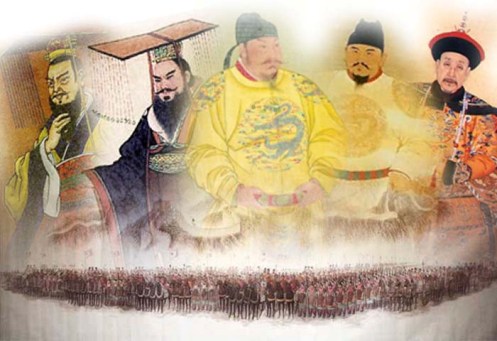
Today, mention of ancient emperors and kings, generals and ministers, princes and nobles always calls to mind words like power, luxury and eminence. But in ancient China, 帝 (dì, “emperor”), 王 (wáng, “king”) and 天子 (tiānzǐ, “Son of Heaven”) were honorific titles the common people gave to those who served the people in various ways, while these rulers humbly referred to themselves as 孤 (gū, “the orphaned one”) and 寡 (guǎ, “the lacking one”). The historical text Yi Zhou Shu describes a conversation between Prince Jin, eldest son of King Ling of Zhou, and Shi Kuang, the famous statesman, educator and musician of the Spring and Autumn period, which lets us understand how people of that time understood the meanings of emperor, king and Son of Heaven.
Shi Kuang asked Prince Jin: “When titles are publicly distinguished, including those of other clans and foreign states, king, marquis, lord, duke and so on, which is the most honored and which the highest?”Prince Jin replied: “From birth people value sons, and call them ‘heirs’ (胄子); when an heir grows up and can manage affairs and hold office, he is called a ‘gentleman’ (士); when a gentleman leads the people to work in due season, he is called an ‘elder’ (伯); when an elder can spread good deeds among the people and shares their loves and hates, he is called a ‘duke’ (公); when a duke can establish a name, nurture other beings and coexist with the Way of Heaven, he is called a ‘marquis’ (侯); when a marquis can bring a community to fulfillment, he is called a ‘lord’ (君); a lord of great virtue who appoints the feudal lords and is sincere and trustworthy is called ‘the One Man’ (予一人); one whose good deeds reach the four seas is called ‘Son of Heaven’ (天子); one who reaches the four wild frontiers is called ‘Heavenly King’ (天王); when the remote lands in all four directions come to pay homage and no one resents or criticizes him, he ascends to become emperor (帝).”
Clearly, in China’s high antiquity, emperors, kings, Sons of Heaven, dukes and marquises were determined by a person’s virtue. Because a person had virtue, people followed him willingly and sincerely, and as followers increased he was gradually called gentleman, elder, duke, marquis, lord, Son of Heaven, Heavenly King and emperor. These rulers and Sons of Heaven would also humbly call themselves 寡人, “a person of little virtue”: what virtue or ability do I have that everyone should follow me?
By the Qin dynasty, things had completely changed. In 221 BCE, Ying Zheng, King of Qin, destroyed the six states by force of arms, pacified the realm, imposed harsh laws and severe punishments, and established a regime of unprecedented cruelty. Ying Zheng believed this was an achievement without precedent, unmatched even by the Three Sovereigns and Five Emperors, and that if he did not change the title of “king,” there would be “no way to proclaim his success and pass it on to later ages.” After repeated deliberation, considering that his “virtue surpassed the Three Sovereigns and his merit exceeded the Five Emperors,” he decided to adopt the title “帝” as well and call himself “皇帝” (huángdì, “emperor”) to show his own exalted status.
In ancient times 朕 (zhèn) was originally a first-person pronoun used by everyone, equivalent to “I.” For example, the patriotic poet Qu Yuan writes in the first line of Li Sao (Encountering Sorrow): “A descendant of the high lord Gaoyang am I; my late honored father was called Boyong (朕皇考曰伯庸).” After the First Emperor of Qin unified China, 朕 became a word reserved for the emperor to refer to himself, and no one else was allowed to use it. “万岁” (wànsuì, “ten thousand years,” “long live”) also began in the Qin and Han. Originally the word was a cheer people gave at joyful occasions. For instance, the Strategies of the Warring States records that when Feng Xuan burned the debt bonds on behalf of Lord Mengchang, the common people “shouted ‘ten thousand years.'” After the Qin and Han, it became customary for ministers paying audience to the ruler, bowing in gratitude and offering congratulations, to shout “ten thousand years,” and so it became a byword for the emperor.
“陛下 (bìxià, ‘Your Majesty’)” as a form of address first appears in Sima Qian’s Records of the Grand Historian (Shiji). The “Basic Annals of the First Emperor of Qin” records: “Now Your Majesty has raised a righteous army, executed the cruel and the wicked, pacified the realm, made all within the seas into commanderies and counties, and unified laws and decrees, something never seen since high antiquity and beyond the reach of the Five Emperors.” Afterwards people used 陛下 as the direct form of address to the emperor, indicating that although one was speaking to the emperor, in terms of ritual one dared not forget that one had no such standing in the first place.
Clearly, as history evolved, the meaning of the titles of emperors, kings and rulers changed from expressing the people’s respect for and voluntary following of these rulers to expressing fear and submission.
