

This English version was translated from the Chinese original with AI assistance. The Chinese text is authoritative.
What have we lost over the past sixty years? Through the changes in Chinese characters we can see the truth.
In the past, within the borders of “國” (guó, “country”) there had to be “戈” (gē, “dagger-axe”), symbolizing the power of national defence, “口” (kǒu, “mouth”), representing the population, and “一” (yī, “one”), representing the land.
Now, what is held inside “国” is “玉” (yù, “jade”), symbolizing wealth, power and status.
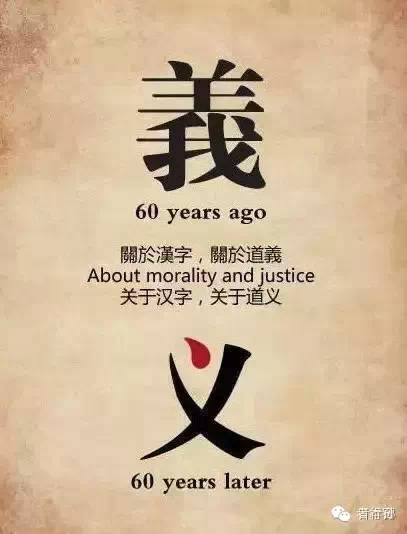
Sixty years ago, “義” (yì, “righteousness”) was still a compound-ideative character: the “羊” (yáng, “sheep”) on top represents the sacrificial animal, and below is “我” (wǒ, “self”), meaning that sacrificing oneself is “義”.
Sixty years later, what on earth is “义”? A cross with a dot.
Sixty years ago, people thought that if you lived in a room where you could only stay bent over, that was “窮” (qióng, “poor”).
Sixty years later, the simplified character tells us that if your family puts in effort (力) and labours, you are poor (穷).
Sixty years ago, demolition and relocation (拆遷) was a troublesome business; you had to move away a lot of things.
Sixty years later, demolition and relocation only needs an administrative order and a thousand or so yuan. Won’t move? Do you see a “人” (rén, “person”) in the character “迁”?
Sixty years ago, people called mammals like dogs “獸” (shòu, “beast”);
sixty years later, what is called “兽” does not necessarily resemble a dog, and there are quite a lot of them.
Sixty years ago, two dogs guarding speech made “獄” (yù, “prison”).
Sixty years later, we have “ i” (the simplified speech component 讠), yet speech is still not free, because the Chinese characters kept up with the times and were simplified: “獄” became “狱”, and the dogs now guard the “ i”.
Sixty years ago, most “魚” (yú, “fish”) were in the water.
Sixty years later, most 鱼 are on plates.
In ancient times, a 伎女 (jìnǚ, “female performer”) sold her art but not her body, because such performers could usually dance and sing, recite poems and compose couplets.
In modern times,
a 妓女 (jìnǚ, “prostitute”) sells her body but not her art, because apart from her body she has no special talent.
