

This English version was translated from the Chinese original with AI assistance. The Chinese text is authoritative.
Introduction: A twofold reading of the design of Chinese characters
Chinese characters, the symbolic system that has carried Chinese civilization for thousands of years, have long been a focus of research into Chinese culture, both in their origin and in their structure. The traditional exegetical school mostly explores the changes in their form, sound and meaning from the perspective of the evolution of the script. However, in his book Exploring the Design Mysteries of Chinese Characters, Mr. Li Xutong proposes that Chinese characters did not evolve naturally but were designed as a whole by beings of great wisdom, and that every basic character seals within it a “rationale” concerning the world and life.
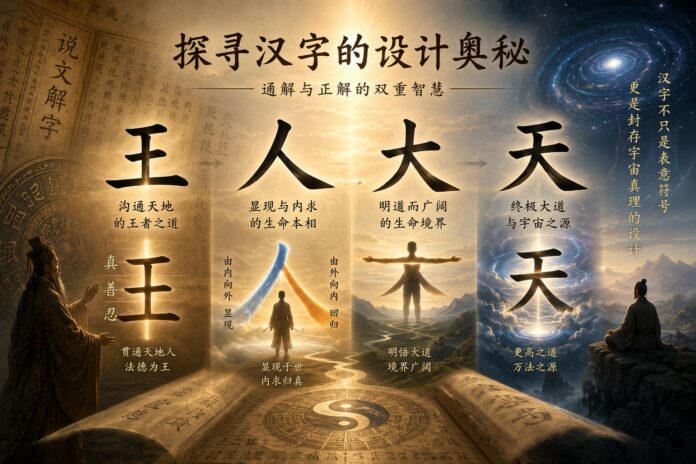
This article adopts this distinctive perspective and, following the two-layer format of the “common reading” and the “design reading,” analyzes in depth the single-unit characters 【王】, 【人】, 【大】 and 【天】. The “common reading” is based on traditional classics such as the Shuowen Jiezi and on ordinary understanding; the “design reading” uses the character-formation method of the New Six Scripts, combined with the deeper meanings of the strokes, to try to recover, from the dimensions of cultivation culture and the philosophy of life, the true meaning embedded in each character as a “designed symbol.” Through this comparison we hope to show readers the beauty of Chinese characters and their profound design wisdom.
【王】 (wáng, “king”): the kingly way that connects heaven and earth
The character 【王】 has simple strokes, yet contains profound principles of governance and of life.
Common reading: The original meaning of 【王】 is the Son of Heaven, the sovereign. In oracle-bone script, the form of 【王】 resembles a battle-axe, symbolizing power. By small seal script, the form had evolved into three horizontal strokes and one vertical stroke. Xu Shen’s Shuowen Jiezi quotes Dong Zhongshu: “Those who created writing in ancient times drew three strokes and connected them through the middle, and called it 王. The three are heaven, earth and humanity; and the one who links all three is the king.” This explanation emphasizes the king’s function of connecting heaven, earth and humanity.
Design reading: From the standpoint of character design, the three horizontal strokes of 【王】 do not simply stand for heaven, earth and humanity; they also symbolize the three most fundamental principles of the universe: 【Truthfulness, Compassion, Forbearance】 (Zhen-Shan-Ren). The top stroke represents 【Truthfulness】, the middle stroke 【Compassion】 and the bottom stroke 【Forbearance】. The vertical stroke running through them symbolizes the cultivator’s path of cultivation, by which, through cultivating Truthfulness, Compassion and Forbearance together, he links the Three Powers of heaven, earth and humanity. Therefore the true 【王】 is not a worldly holder of power, but a being of great wisdom who can awaken to and follow the great law of the universe, thereby connecting heaven, earth and humanity and seeing into the true meaning of life. He takes the law as his measure and wins people over by virtue; he is the true “king among men.”
【人】 (rén, “person”): the true face of life, manifesting outward and seeking inward
The character 【人】 is one of the basic single-unit characters; its form directly depicts the state of life in the world.
Common reading: In both oracle-bone and bronze script, 【人】 looks like a human figure standing in profile, with head, body and feet, highlighting the feature of upright walking. It later evolved into the form of a left-falling and a right-falling stroke meeting. The Shuowen Jiezi says: “Of all natures between heaven and earth, the most precious.” This emphasizes the honoured position of humanity among all things. Its meaning extends to human relationships, human society and so on.
Design reading: In the context of character design, the left-falling and right-falling strokes of 【人】 carry special meanings. The left-falling stroke symbolizes “from inside to outside, from hidden to manifest, manifestation,” representing life descending from higher-dimensional spaces into the human world and manifesting its existence in the material world. The right-falling stroke symbolizes “from outside to inside, concealment, return,” representing the longing and effort of life, after being tempered in the world, to return to its origin and true self. Therefore 【人】 does not merely depict an upright body; it profoundly reveals the dual state of life in the world: both manifestation and experience in the mortal world, and the search for and return to the inner true self. This dynamic balance between manifestation and inward seeking constitutes the complete meaning of life in the world.
【大】 (dà, “great”): the vast realm of a life that understands the Dao
The character 【大】 evolved from 【人】, adding one stroke to it and thereby sublimating its meaning.
Common reading: In both oracle-bone and bronze script, 【大】 looks like a person with arms and legs spread out, expressing the human body stretched wide. Its original meaning is that an object is large in volume, extended to wide in scope, deep in degree, older in age and so on. The Shuowen Jiezi says: “Heaven is great, earth is great, and humanity is also great. Hence 大 depicts the form of a person.” This emphasizes the greatness of humanity standing alongside heaven and earth.
Design reading: In the system of character design, 【大】 adds one horizontal stroke to 【人】. According to the meanings of the strokes, the horizontal stroke symbolizes the “Dao” or the “Law.” This means that when an individual life (【人】) can comprehend and follow the great Dao of the universe (the horizontal stroke), its inner realm can be expanded and sublimated, transcending the limits of the small self and becoming boundlessly vast, thereby achieving true “greatness.” This “greatness” refers not merely to physical size, but to the richness of life’s inner content, the breadth of one’s heart, and accord with the truth of the universe. Therefore 【大】 implies that only one who understands the Dao can have a truly great pattern and realm of life.
【天】 (tiān, “heaven”): the ultimate great Dao and the source of the universe
The character 【天】 goes a step further, adding a horizontal stroke above 【大】, pointing to a level of heavenly bodies, a universe, a world, and even to the ultimate truth and origin.
Common reading: In oracle-bone script, 【天】 looks like the top of a person’s head, or is written as a human figure with a horizontal stroke added on top, indicating what is above the human head, namely the sky. Its original meaning is the sky, the firmament, extended to the natural world, the seasons, the Lord on High and so on. The Shuowen Jiezi says: “The crown of the head. Supreme and unsurpassed. Composed of 一 and 大.” This emphasizes its supreme position.
Design reading: 【天】 adds another horizontal stroke above 【大】. As said above, 【大】 is the 【人】 who understands the Dao, while 【天】 represents that beyond the realm a person who understands the Dao can reach, there is a still more fundamental and greater “Dao.” This stroke symbolizes the deep, ineffable “Dao” or “Law” of the universe, which is 【天】. It refers not only to the firmament above our heads, but to a level of heavenly bodies, a universe, a world, and even to the origin of the ultimate universe, the principle by which all things are created, and the destination to which the cultivation of life must return. Therefore 【天】 reveals the ultimate mystery of the universe; it points finally to the source of all laws, to the highest embodiment of truth, and it is the fundamental basis of the existence of all life in the universe and the world. It reminds us that between the individual life and the vast universe there is a path of exploration from shallow to deep, from near to far, and 【天】 is the ultimate direction of this path.
Conclusion: the design of Chinese characters and reflections on life
Through this analysis of the four single-unit characters 【王】, 【人】, 【大】 and 【天】 by “common reading” and “design reading,” we gain a glimpse of the profound wisdom contained in the design of Chinese characters. These forms did not arise by chance but were carefully designed, using the simplest strokes to carry the ancients’ deep understanding of the universe, life, society and cultivation culture. From the manifestation and inward seeking of 【人】, to the vastness of 【大】 in understanding the Dao, to the ultimate great Dao of 【天】, and the linking of heaven and earth in 【王】, each character is like a miniature universe, embedding a complete philosophy of life and view of the cosmos.
This structural method of the “mutual generation of form and meaning,” together with the inner mechanism of the “character rotor,” makes Chinese characters more than mere ideographic symbols: they become a living cultural gene capable of reproducing itself and inspiring wisdom. They not only record history but, through their unique design language, transmit the Chinese nation’s search for truth and its insight into life. Exploring in depth the design mysteries of Chinese characters is a bridge reconnecting us with ancient wisdom, and an opportunity to re-examine our own relationship with the universe.
