

This English version was translated from the Chinese original with AI assistance. The Chinese text is authoritative.
A netizen recalled that when he was in the army, one of his comrades had the surname 马 (mǎ, “horse”) and the given name 驫.
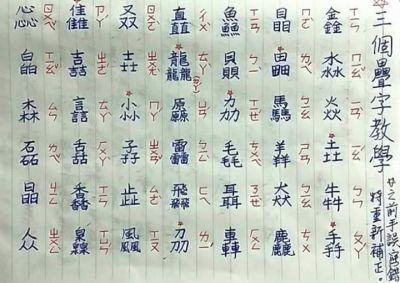
When an officer reached him during roll call, he skipped the surname altogether and read out: “A herd of horses!” Naturally the whole room roared with laughter. But once you have finished laughing, do you know how to pronounce this character? This 驫 is pronounced the same as 飙 (biāo). A netizen has compiled the following list of triple-stacked characters.
Things and creatures:
1. Three 十 make 卉, read like 会 (huì); it means “a general term for flowers and grasses.”
2. Three 犬 make 猋, read like 飙 (biāo); it means “dogs running.”
3. Three 马 make 驫, read like 飙 (biāo); it means “horses galloping.”
4. Three 鹿 make 麤, read like 粗 (cū); it means “coarse, not refined.”
5. Three 虫 make 虫, read like 虫 (chóng); it means “a general term for insects.”
6. Three 鱼 make 鱻, read like 鲜 (xiān); it means “fresh; the ancient form of 鲜.”
7. Three 牛 make 犇, read like 奔 (bēn); it means “rushing; the ancient form of 奔.”
C. The facial features and the body:
1. Three 口 make 品, read like 聘 in the third tone (pǐn); it means “quality, appraisal.”
2. Three 耳 make 聂, read like 孽 (niè); it means “whispering softly into someone’s ear.”
D. Nature:
1. Three 石 make 磊, read like 垒 (lěi); it means “many stones; by extension, open and honest.”
2. Three 日 make 晶, read like 精 (jīng); it means “bright.”
3. Three 田 make 畾, read like 雷 (léi); it means “the land between fields.”
E. Others:
1. Three 力 make 劦, read like 协 (xié); it means “joining forces with one heart; the ancient form of 协.”
2. Three 女 make 奸, read like 奸 (jiān); it means “improper sexual conduct.”
3. Three 毛 make 毳, read like 翠 (cuì); it means “the fine down of animals.”
4. Three 车 make 轰, read like 哄 (hōng); it means “destruction by gunfire; to drive away.”
5. Three 人 make 众, read like 众 (zhòng); it means “numerous; the simplified form of 众.”
