

This English version was translated from the Chinese original with AI assistance. The Chinese text is authoritative.
A History of Chinese Pronunciation
Li Xutong
In the period of the Five Emperors, after Cangjie created the characters, the royal house promoted them, and the writing of the Central Plains was gradually unified into the characters Cangjie had made. A common pronunciation corresponding to this script, 雅言 (yǎyán, “elegant speech”), also began to appear. The entry “雅言” in the Cihai dictionary says: “雅言: in ancient times called the ‘common language,’ in contrast to ‘dialects.’” Kong Yingda says in his Correct Meanings: “雅言 means correct speech.” Its phonological system was that of Old Chinese.
This elegant speech was inherited by the Xia and became the speech of Xia (夏言). There are many examples showing that 雅 (yǎ) and 夏 (xià) were interchangeable in ancient times: the “Prince Ya” (公子雅) of the Zuo Zhuan appears as “Prince Xia” (公子夏) in the Hanfeizi; in the Guodian Chu bamboo slips’ Confucius on the Odes, “Greater Ya” and “Lesser Ya” (大雅, 小雅) are written “Greater Xia” and “Lesser Xia” (大夏, 小夏); and when the Mozi quotes the “Greater Ya” it also writes “Greater Xia.” Most notably, the Xunzi, in the chapter “On Honor and Disgrace,” says “The people of Yue are at ease in Yue, the people of Chu are at ease in Chu, the gentleman is at ease in 雅 (elegance),” while the chapter “The Achievements of the Ru” says “Living in Chu, one becomes Chu; living in Yue, one becomes Yue; living in Xia, one becomes Xia.”
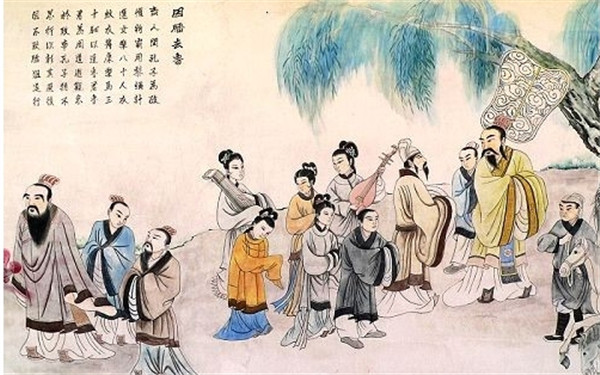
The Xia dynasty established its capital at Luoyang, and the Yin (Shang) dynasty also had its capital in the area around Luoyang. So the standard pronunciation of elegant speech through the ages circulated in the Luoyang region; one can say that the old Luoyang speech was the Mandarin of ancient times, that is, the elegant pronunciation. The Zhou dynasty in turn inherited the elegant speech of Shang-Yin. When Confucius taught in the state of Lu, his three thousand disciples came from all directions, and Confucius too used elegant speech in his teaching. The Analects, “Shu Er” (Book 7), says: “What the Master spoke in elegant speech: the Odes, the Documents, and the performance of rites; all these he spoke in elegant speech.”
After the Zhou, every orthodox Han Chinese dynasty spared no effort to promote elegant speech. It reached its peak in the Tang and Song dynasties, achieving one sound for each character; Tang poems and Song lyrics appeared in great numbers, and the surrounding countries all vied to learn the elegant speech of the Central Plains. But as the capitals of the various dynasties moved, elegant speech was also modified under the influence of local dialects.
With each change of dynasty, many loyalists of the former dynasty left the Central Plains and migrated to what are now Zhejiang, Fujian, Guangdong and Guangxi, and even Yunnan and Guizhou. When such loyalists settled together in remote, isolated areas, they often preserved the pronunciation of their time even thousands of years later. According to research, in some remote mountain areas of Yunnan and Guizhou people still use the language and pronunciation of the Xia and Shang, and even of more ancient times.
In the Tang and Song, Chinese pronunciation reached its peak and developed and perfected the system of eight tones. The eight tones were modeled on the Eight Trigrams of the Zhou Yi (Book of Changes). The eight tones are divided into yin and yang, and each of yin and yang is further divided into the four tones “level, rising, departing and entering” (平上去入), giving “yang level,” “yang rising,” “yang departing,” “yang entering,” “yin level,” “yin rising,” “yin departing” and “yin entering.”
The eight tones sound roughly as follows. “The level tone runs level, neither low nor high”: the sound is resonant, relaxed and long. “The rising tone calls out high, fierce and strong”: it rises and is heavy. “The departing tone is clear, a lament along a distant road”: the sound is light and sharp with a long tail. “The entering tone is short and abrupt, quickly gathered in”: the sound is very light and is cut off quickly.
After the Tang and Song, the Mongols, long dwelling in bitterly cold lands, entered the Central Plains bringing their own primitive sound system. As the gentry fled south and the northern peoples permeated Chinese culture, the pronunciation of Chinese in the Central Plains changed greatly, falling back from eight tones to four. In the late Yuan dynasty, the Chinese pronunciation of the Yuan capital Dadu (today’s Beijing) became the standard, called “the common speech of all under heaven” (天下通语). This pronunciation evolved into the official speech (Mandarin) of the Ming and Qing, and later into the National Language (国语) of the Republic and the Putonghua (普通话) of mainland China after 1949.
The eight tones, and now the four tones, are a principal feature of Chinese, and this tonal feature is very special among the world’s languages. Although Korean and Japanese both contain Chinese vocabulary, neither has the tones of Chinese. In fact, apart from Chinese, the pronunciation of the major languages in use in the world today, such as English, French and Japanese, distinguishes only between stressed and unstressed. In terms of China’s theory of yin and yang, they have only divided into yin and yang and have not yet developed into the Four Images and the Eight Trigrams.
Although the eight tones have not survived in today’s Putonghua, they are fully preserved in Cantonese and other southeastern dialects. Because Cantonese is rich in tones, it has few of the homophones found in Putonghua, and in many cases the same meaning is expressed more concisely. Reciting classical poems in Cantonese better conveys their original rhymes and tones.
Until modern times, Chinese scholars always chanted classical texts. This chanting was more like singing, and was never the word-by-word, bean-popping reading of texts we do today. Chanting classical poetry and prose in Cantonese or other dialects is especially rich in the flavor of antiquity, and the meaning lingers endlessly in the rise and fall of the cadence.
