

This English version was translated from the Chinese original with AI assistance. The Chinese text is authoritative.
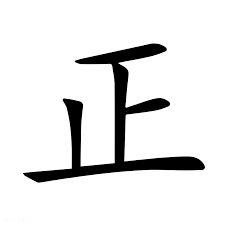
The character 正 (zhèng, “upright, correct”) is composed of 止 (zhǐ, “to stop”) and 一 (yī, “one”). Hence 正 carries the meaning of establishing the center and setting up the pole, being neither partial nor biased, and resting in the very best state.
In ancient times regular script (楷书) was also called 正书, “upright script.” The earliest occurrence of the term 正书 is found in the Song-dynasty Xuanhe Shupu (Xuanhe Catalogue of Calligraphy). 正书 and 真书 (“true script”) are pronounced the same.
As for 一, Xu Shen says in Shuowen Jiezi: “One: in the very beginning, the Supreme Ultimate; the Dao is established in the One, which divided and created heaven and earth and transformed into the myriad things.” Laozi’s Daodejing says: “The Dao gives birth to One, One gives birth to Two, Two gives birth to Three, and Three gives birth to the myriad things.” One is the manifestation of the Dao and virtue. As for 止, it means 足, “foot”; by extension it means to reach, to rest in the highest good.
