

This English version was translated from the Chinese original with AI assistance. The Chinese text is authoritative.
Chinese characters are one of the most important components of traditional Chinese culture. Yet a little over half a century ago, Chinese characters were very nearly abolished by a campaign for the Latinization of Chinese driven by the Communist Party of the Soviet Union.
After the October Revolution, the Soviet Union launched a script Latinization campaign that Lenin called “the great revolution of the East.” Under the influence of this campaign, to speed up literacy work among the 100,000 Chinese workers then in the Soviet Far East, the “Institute for Chinese Problems” of the Communist University of the Toilers in Moscow began to study the Latinization of Chinese writing. The main participants were Chinese Communist Party members in the Soviet Union, Qu Qiubai, Wu Yuzhang, Lin Boqu and Xiao San, together with the Soviet sinologists Kolokolov (Guo Zhisheng), Lekhtin and Shpintsyn (Shi Pingqing), among others. In February 1929, with Kolokolov’s help, Qu Qiubai drew up the first Chinese Latinization scheme, and in October wrote it up as a booklet, The Chinese Latinized Alphabet. After its publication it attracted great attention in Soviet linguistic circles.
In April 1930, the sinologist Dragunov of the China section of the Institute of Oriental Studies of the Soviet Academy of Sciences in Leningrad formed a special group with Qu Qiubai and Kolokolov to revise the scheme. Soon after, Qu Qiubai returned to China, and Wu Yuzhang, Lin Boqu and others moved to Vladivostok in the Far East; the work was continued by the “Chinese Latinization Committee” organized by the Institute of Oriental Studies of the Soviet Academy of Sciences in Leningrad. The chairman of the committee was V. M. Alekseyev, the secretary-general Dragunov, and its members included Xiao San and several Soviet sinologists. After studying and consulting several major earlier Chinese schemes, the committee drew up the “Chinese Latinized New Script scheme” on the basis of Qu Qiubai’s scheme. A Latinized example sentence in this scheme, transcribed from Sichuan speech: “When the feet are straight, one need not fear crooked shoes: Giuo zen bupa xai uai.”
In May 1931 this scheme was approved by the All-Union Central Committee of the New Alphabet, and on 26 September it was formally adopted at the “First Congress on the Latinization of Chinese Writing” held in Vladivostok.
The Latinized New Script scheme adopted at the Vladivostok congress comprised two parts: principles and the scheme proper.
There were 13 principles of the Latinized New Script, the main ones being: (1) “A popular phonetic script close to the masses, suited to the demands of modern science, and international must be created”; (2) “the Latin alphabet should be adopted”; (3) “what this phonetic script spells is not Classical Chinese, nor merely a ‘national language’ standardized on the dialect of Beijing alone, but the popular spoken language of each major dialect area”; (4) “politically harmful and ideologically incorrect words must be eliminated, obscure local expressions eliminated, and international revolutionary, political, scientific and technical vocabulary organically imported”; (5) “oppose the negative view that the Latinization of Chinese writing is impossible, and also oppose the ‘leftist’ view of abolishing Chinese characters immediately”; (6) “the study of Chinese dialects is extremely important and must be greatly expanded.” Taken together, these principles say that a Chinese phonetic script must be modernized, internationalized, popularized and dialect-based.
The scheme adopted by the congress was only one: the Latinized New Script for Northern speech. Its phonetic standard was close to the “Old National Pronunciation”; it distinguished sharp and round initials but did not mark tones. The scheme had the following 4 parts.
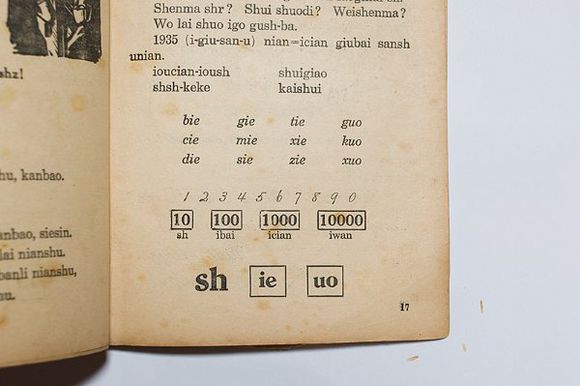
(1) The alphabet and the tables of initials (originally called “consonants”) and finals (originally called “vowels”). The alphabet had 28 letters, 5 of which were written as digraphs.
(2) The composition of syllables (originally called “sound segments”). There were 3 forms: a. an initial combined with a final; b. an initial alone forming a syllable — 8 of these: zh, ch, sh, rh, z, c, s, r; c. a final alone forming a syllable.
(3) How to write words. 9 rules in all, including: a. writing words joined together; b. writing suffixes joined to words; c. the boundary-marking method (i.e. syllable separation); d. how to write numbers; e. how to write onomatopoeia; f. how to write particles; g. how to write set phrases; h. abbreviations and contractions; i. special spellings (to distinguish a few common homophones).
(4) How to write speech. Mainly rules on capitalization, punctuation, line breaking and syllable division.
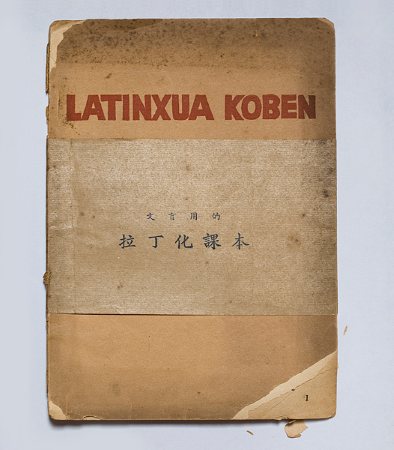
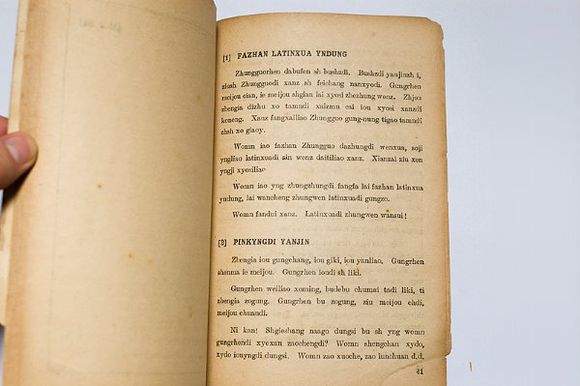
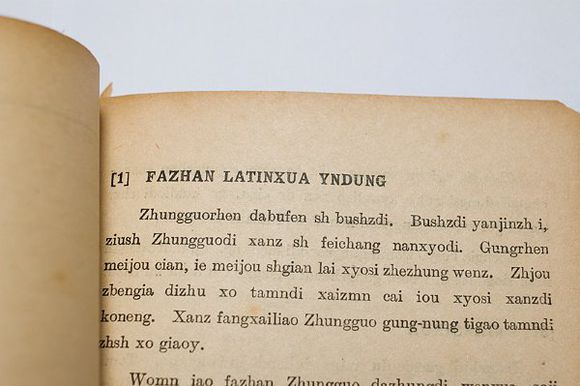
A spelling example (from A Latinized Textbook for Workers’ Literacy Classes, edited by Ye Laishi):
Ba sin Wenz nianxui ixou,iao shchang yng sin
After learning to read the new script, you should often use the new
Wenz kanshu siesin.Gang kaish siedi shxou,shui
script to read books and write letters. When you first start writing, anyone
ie mianbuliao iou cowu.Dansh bu iao xaipa,iao
is bound to make mistakes. But don’t be afraid; you must
buduandi sie,buduandi yng,iding manmandi xui
keep writing and keep using it, and you will surely, little by little,
shuliankilaidi.
become proficient.
In the Soviet Union, at the “First Congress on the Latinization of Chinese Writing” held in Vladivostok on 26 September 1931, the “Far Eastern Regional New Alphabet Committee” was established to take charge of promotion. After the congress, the Northern-speech Latinized New Script was taught among Chinese workers in the Soviet Far East, and later among the units of the Northeast Anti-Japanese Volunteer Army that had retreated into Soviet territory. The “Far Eastern Regional New Alphabet Committee” ran many new-script study classes, supplementary classes and short-term schools, compiled and published textbooks, teaching materials, readers and reference books, and founded in Khabarovsk a new-script paper appearing every six days, Yngxu Sin Wenz (Support the New Script); the Chinese-character newspaper Workers’ Road opened a special new-script page. According to 1933 statistics of the Institute of Oriental Studies of the Soviet Academy of Sciences, over three years more than 100,000 copies of textbooks, readers, grammars and dictionaries were published.
On 26 October 1932 the Congress on the Latinization of Chinese Writing held its second session, discussing the publication and teaching of the Latinized New Script, and set up a special committee of 11 to make a number of revisions to the scheme and its orthography.
In the areas governed by the Chinese Nationalist government, news of the Soviet promotion of the Chinese Latinized New Script was reported in 1932. Then in 1933 the Esperantist Jiao Feng (Fang Shanjing) translated and introduced Xiao San’s The Latinization of Chinese Writing, attracting the attention of some Esperantists. Through contacts between Shanghai Esperantists and Soviet Esperantists, various materials on the Latinized New Script were obtained and published successively in Language Science, a supplement to The World, the organ of the Shanghai Esperanto Association, attracting the attention and discussion of people from all walks of life.
In 1934, Shanghai cultural figures such as Chen Wangdao and Hu Yuzhi initiated a discussion promoting a “language of the masses.” In the discussion, the Shanghai Esperantist Ye Laishi and others introduced the Latinized New Script, considering it the best tool for writing the language of the masses and spreading cultural and scientific knowledge among the people. This view received strong support from Lu Xun, who wrote in succession the famous essays “On the Language of the Masses — A Reply to Mr. Cao Juren,” “An Outsider’s Chat on Writing,” “Chinese Characters and Latinization,” “The Rebirth of the Chinese Language,” and “On the New Script,” and donated his fees to fund the publication of books and periodicals in the Latinized New Script. But this Latinized New Script was banned by the Nationalist government and met with wide opposition from people in all circles.
The promotion of the Latinized New Script in China can be divided into 4 stages. The first stage ran from the founding of the “Chinese Latinization Research Society” in August 1934 to the eve of the War of Resistance against Japan in 1937, centered in Shanghai, Beiping, Guangzhou, southern Fujian and other places; its high point was around the “December 9th” student national-salvation movement of 1935. The second stage ran from the outbreak of the War of Resistance in 1937 to its end in 1945, centered in Yan’an and in Shanghai, Wuhan, Guangzhou, Hong Kong and other places; its high points were the new-script experiment in Shanghai refugee shelters in 1938 and the new-script winter schools of the Shaan-Gan-Ning Border Region in 1940–1942. The third stage ran from victory in the War of Resistance in 1945 to the founding of the People’s Republic of China in 1949, centered in Shanghai and Hong Kong; its high point was around the democratic movement of 1947. The fourth stage ran from the founding of the People’s Republic of China to the National Conference on Script Reform in 1955, centered in Shanghai, Guangzhou, Wuhan, Lüda and other places; its high point was the resumption of promotion in the early years of CCP rule.
From beginning to end, the Latinized New Script was spread under the leadership of the Communist Party of the Soviet Union, through the vigorous promotion of the CCP and left-wing intellectuals supported by the CCP. Promotion was carried out mainly in the following ways:
(1) Founding organizations. Many Latinized New Script organizations were founded, under names such as research society, learned society, association, promotion society and promotion club. According to statistics, in the early period of the movement more than 80 organizations were founded nationwide, the earliest being Shanghai’s “Chinese Latinization Research Society” (August 1934). The most organizations were founded in Beiping during the “December 9th” student national-salvation movement. The national organization was the “Chinese New Script Research Society” initiated in Shanghai in December 1935 by Tao Xingzhi and others. Quite a few organizations, some 40–50, were also founded after the War of Resistance began, but all found it difficult to carry out their work. After the founding of the People’s Republic of China, from 1949 to 1950, organizations were founded in more than 20 cities and counties nationwide.
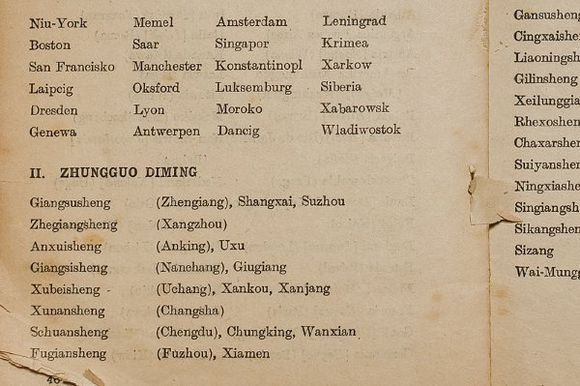
(2) Drawing up dialect Latinized New Script schemes. The dialect Latinized New Script schemes drawn up in various places numbered 13: Shanghainese (later changed to “Jiangnan speech”), Suzhou, Wuxi, Ningbo, Wenzhou, Fuzhou, Xiamen, Hakka, Cantonese, Chaozhou, Guangxi, Hubei and Sichuan speech. Of these the Shanghainese new-script scheme was drawn up earliest, published and promoted in February 1936.
(3) Advocacy by well-known figures. Before the War of Resistance, the most active supporter of this movement was Lu Xun, along with Tao Xingzhi. In the early period of the war, the educator Chen Heqin and the linguist Chen Wangdao organized and led the new-script work in Shanghai. In Beiping, before the war, some professors, such as the linguist Wang Li, also supported this movement. In Hong Kong, active supporters of the movement included Zhang Yilin, who in the Beiyang government era had enthusiastically promoted the Zhuyin phonetic alphabet, as well as the local notable Feng Yufang and the University of Hong Kong professors Xu Dishan, Ma Jian and Chen Junbao. In the Shaan-Gan-Ning Border Region, Mao Zedong, Zhu De, Wu Yuzhang, Xu Teli, Lin Boqu, Xie Juezai and others were all active advocates of the Latinized New Script.
(4) Running classes. Study classes run throughout the country, including various teacher-training classes, workshops and literacy classes, numbered over 1,000 in all, with more than 100,000 participants. In the early period of the War of Resistance, Shanghai ran many new-script classes for refugees, and the Shaan-Gan-Ning Border Region ran many new-script winter-school classes; after the founding of the People’s Republic of China, the railway bureaus of the Northeast ran many new-script classes for telegraph operators in order to use new-script railway telegraphy.
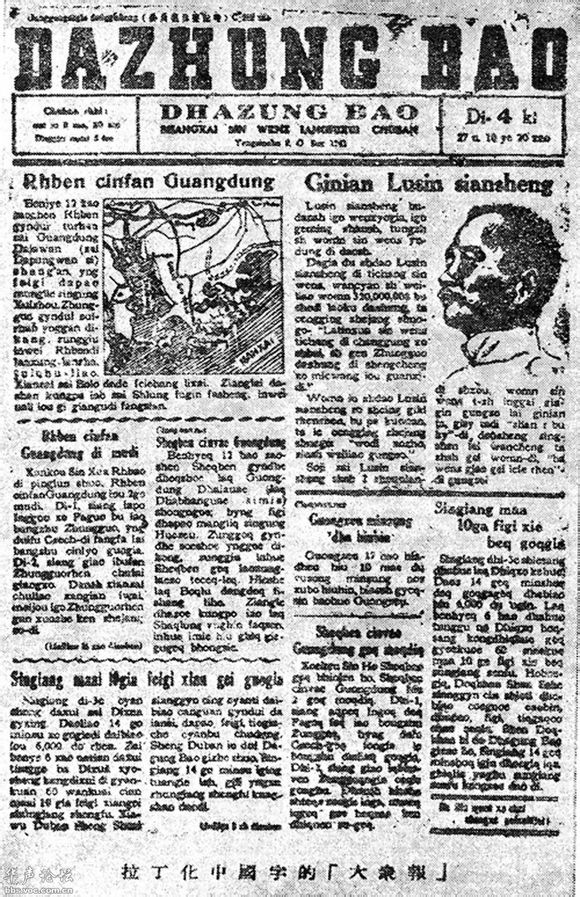
(5) Publishing books and periodicals. Before the War of Resistance, 61 books — including introductions, textbooks, readers and reference works — and 36 newspapers and periodicals were published nationwide. In the early period of the war, 54 books and 23 newspapers and periodicals were published in Shanghai, and 16 books and 1 newspaper in the Shaan-Gan-Ning Border Region. Among these, the more influential book was The Latinization of Chinese Writing — Theory, Principles, Scheme, edited by the Shanghai Chinese Latinization Research Society; the periodicals were the Shanghai monthly SinWenz (New Script), the semimonthly Zhungguo Yjan (Chinese Language) and the monthly Yuwen (Language), and the Beiping semimonthly Beiping Sin Wenz (Beiping New Script); the newspapers were the Shanghai Womndi Shgie (Our World) and Dazhung Bao (The Masses), and the New Script Newspaper of the Shaan-Gan-Ning Border Region. In the early years of the People’s Republic of China, sales of new-script books and periodicals soared to more than 1.3 million copies. The monthly Language Knowledge, edited by the Shanghai Association of New Script Workers, printed 150,000 copies per issue.
(6) Social application. The social application of the Latinized New Script was mainly in Northeast railway telegraphy and in the navy’s semaphore flags, signal lamps and radio communications. From 1950 until the publication of the Hanyu Pinyin Scheme in 1958, Northeast railway telegrams were all in the new script. From 1953 until the publication of the Hanyu Pinyin Scheme in 1958, the navy’s semaphore, signal lamps and radio communications were also all in the new script. In addition, the new script was used in some cases for phonetic notation in textbooks and dictionaries, shorthand, indexing, and foreigners’ learning of Chinese.
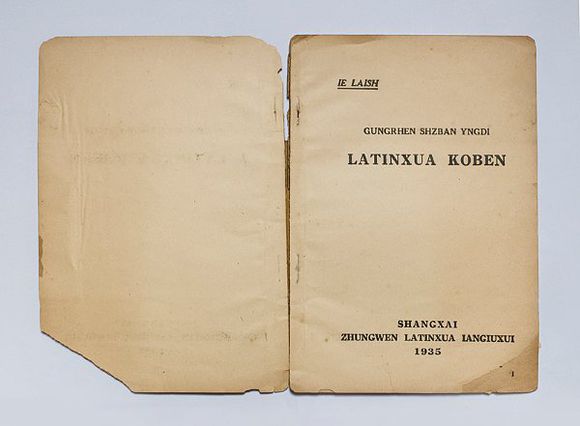
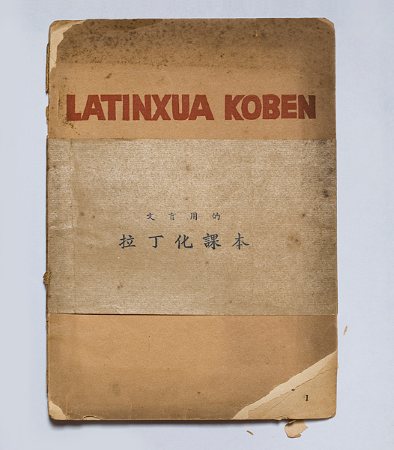
The author, Ye Laishi (IE LAISH, 1911–1994), was originally named Bao Shuyuan, with pen names Ye Laishi, Luo Dianhua, Suo Yuan and others. He was from Wu County, Jiangsu Province. He studied at the Lida School in Shanghai and at the Higher Normal School in Japan. He joined the Chinese Communist Party in 1938. He was a member of the Committee on the Hanyu Pinyin Scheme and served successively as a deputy to the People’s Congress, a Party congress delegate, a member of the CPPCC, and in other posts. In the Latinized New Script movement he took an active part in its promotion, and put forward the view that “only the implementation of Latinization is the correct
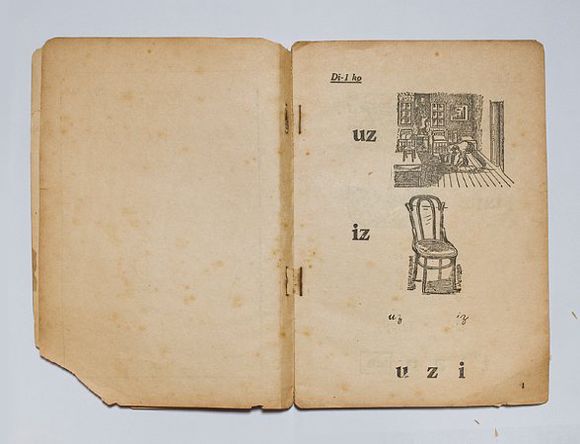
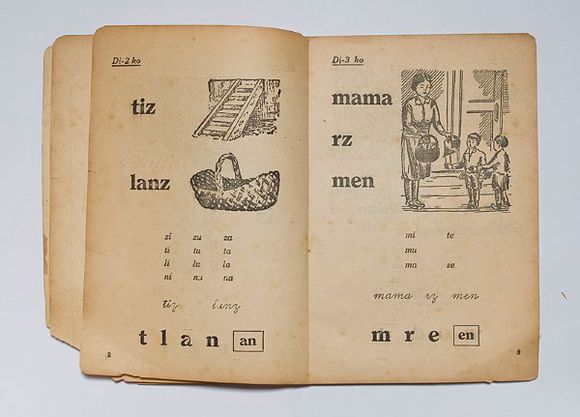
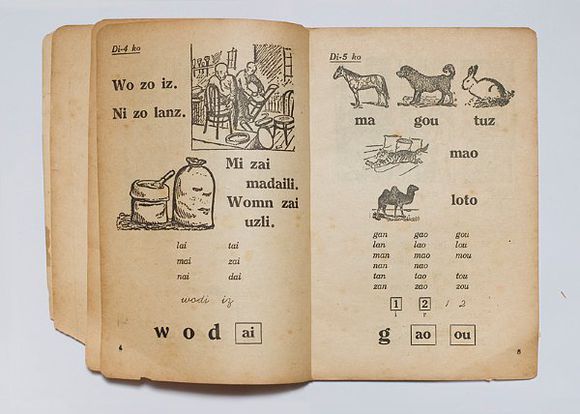
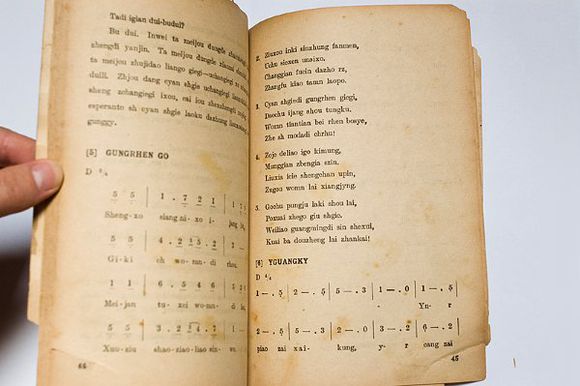
There are many records of Mao Zedong’s remarks on abolishing Chinese characters after the CCP took power. In October 2008, when Ji Xianlin was staying in Building X of the West Wing of the CCP’s 301 Hospital, he recalled: in the early years after Liberation, Mao Zedong’s script reform aimed to eliminate Chinese characters and switch to Latin letters. In addition, according to Snow’s Red Star Over China, Mao Zedong told Snow in Yan’an about promoting the Latin alphabet, abolishing Chinese characters and wiping out illiteracy. Ji Cheng’s book My Father Ji Xianlin and I mentions: “In the early years after Liberation the Script Reform Committee was set up, and he was a member. Nominally it was reform; in reality it was to eliminate Chinese characters and achieve Latinization. This was Mao Zedong’s idea, but no one dared say it openly; it was to be kept secret. Wu Yuzhang became director on orders to carry out the reform. Chinese writing has continued for thousands of years, and Chinese characters have played an enormous role. To read ancient texts you must read traditional characters, because all of China’s cultural information is in the characters. Simplifying Chinese characters was going astray. People say Chinese characters are inconvenient — we used them for thousands of years and never felt any inconvenience, and now in our hands we would throw them away; this is wrong. Pursuing efficiency is no reason either — now that we use computers, Chinese characters are no obstacle.” (Original text from Ji Cheng, My Father Ji Xianlin and I, p. 226)
