

This English version was translated from the Chinese original with AI assistance. The Chinese text is authoritative.
The pronunciation of Chinese characters has inner laws and rules. Since romanized pinyin and other phonetic schemes were introduced, the inner connection between the sounds of characters and their meanings has essentially been severed. Seemingly this has simplified the marking of character pronunciation, but in fact it has greatly increased the difficulty of learning and understanding Chinese characters.
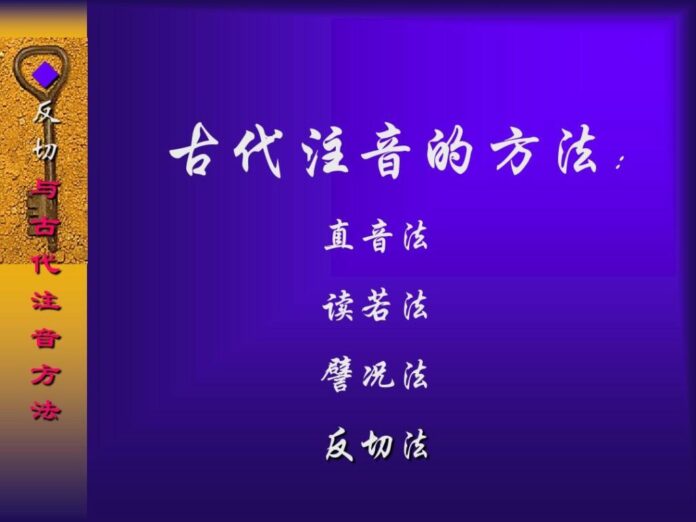
In ancient times there were many methods of indicating the pronunciation of characters, and they were also one of the tools for recording and passing on civilization. The more commonly used ones were the analogical-description method (pikuang), the “read as” method (duruo), the direct-sound method (zhiyin), and the fanqie method.
The analogical-description method uses simple language to describe how a character is pronounced. It is generally divided into description by mouth shape, by tongue position, and by the speed of aspiration and the length of tone, among others. The Huainanzi, “Cultivating Effort,” says: “Among the Hu people there are those who know what is profitable, yet people call them 駤 (zhì, ‘stubborn’).” Gao You’s commentary says: “駤 is read like 质, spoken with a slow breath; it is obtained at the tip of the tongue.”
The book Guanzi records a little story related to the analogical-description method: Duke Huan of Qi and Guan Zhong secretly discussed attacking the state of Ju, but word quickly leaked out, and it was later learned that the minister Dongguo Ya had told others. Duke Huan asked Dongguo Ya in surprise how he had come to know of it. He said: “I watched you two lords on the terrace: your mouths were open and did not close — that is saying ‘Ju’; you raised your hands and pointed — the direction was toward Ju; and moreover, as I see it, among the lords of the small states, the only one not submitting is Ju.” That is, Dongguo Ya guessed their intention to attack Ju by watching the mouth shapes and gestures of Duke Huan and Guan Zhong and combining these with the political and military situation of the time.
The “read as” method uses a homophone or near-homophone to indicate the pronunciation of the annotated character. For example, the Shuowen Jiezi: “唉 means to respond. It takes 口 as its form and 矣 as its sound; read as 埃.” “鼾 means the breathing of one lying down; 干 gives the sound; read as 汗.” Sometimes “read as” (读若) is also written “read like” (读如), “read as” (读为), “read as” (读曰), “same sound” (声同), “near sound” (声近), and so on. Another example:
儡 means mutual defeat … read as 雷. (Shuowen Jiezi)
An example of the “read as” (读为) method:
“父义和” (Charge to Marquis Wen); Zheng Xuan’s commentary: “义 is read as 仪.”
An example of the “direct sound” method:
“肇” is annotated “兆.” (Erya)
From the examples above it can be seen that if one knows how to read 雷, 仪 and 兆, one naturally knows how to read 儡, 义 and 肇.
The direct-sound method chooses a character whose pronunciation is exactly the same as the annotated character to indicate its sound. For example, the “Annals of Emperor Gaozu” in the Book of Han records “Lü Gong of Shanfu was on good terms with the magistrate of Pei,” and the commentary quotes Meng Kang: “单 is pronounced 善; 父 is pronounced 甫.” The famous Qing scholar Chen Li pointed out in his Qieyun Kao: “Today’s direct-sound method differs from the ancients’ ‘read as’: the ancients’ ‘read as’ took what was close; today’s direct sound must be exact.”
The direct-sound method was used in China for a long time, and even today some reference books occasionally use it. But this method of indicating sound still has certain limitations. In explaining “direct sound,” the Cihai says: “If there is no homophone, the method is at its end; or if there is a homophone but it is obscure and hard to recognize, the method is again at its end.” That is, if the annotated character has no homophone, there is no way to indicate its sound; or if it has a homophone but that homophone is rare, readers will still find it hard to pronounce even when it is noted.
The fanqie method uses two characters together to indicate the pronunciation of one character: the initial of the first character and the final of the second character are combined to spell out a new sound. Some scholars have found that the fanqie method was originally called “fan” (反); for example, the Eastern Han scholar Fu Qian, in his commentary on the Book of Han, wrote “惴, sound: 章瑞反.” Later, in the time of Emperor Daizong of Tang, the rulers strongly disliked the character 反 (“rebel”), so it was changed to 翻, and later 翻 was changed to 切. For example, volume 25 of the Bencao Gangmu writes “糗, 去九切.” This way of indicating sound also lasted a considerable time; later, the characters in the Kangxi Dictionary were mainly annotated by fanqie, such as “武, 文甫切,” and so on.
The fanqie method can indicate the pronunciation of a character accurately, but it still has weaknesses of its own. For example, the sound of 武 can be written “文甫切,” but also “闻斧切,” “温鲁切” and so on, so the two characters used for annotation are hard to fix and inconvenient to remember. Sometimes the two characters used for annotation have many strokes (in ancient times they were mostly traditional characters) and are very complicated to write, which greatly inconveniences writing.
Another example:
缓, 胡管切. (Guangyun)
The pronunciation of 缓 is obtained by taking the initial of 胡 (h) and the final and tone of 管 (uan), and then combining them (huan = h + uan).
Other examples:
哀, 乌开切.
敖, 五劳切.
收, 式州切.
器, 去冀切.
矣, 于纪切.
The main reason the “read as” and fanqie methods above have been criticized is that one character has many ways of being annotated — for example, the sound of 武 can be written “文甫切,” or “闻斧切,” “温鲁切” and so on — and the reason for this is that the connection between sound and meaning has been severed. For example, 武 (wǔ, “martial”) and 舞 (wǔ, “dance”) are homophones; ancient dance grew out of martial arts and combat skills, hence the saying “武 in literary use stands for 舞, and 舞 in martial use stands for 武.” If the pronunciations of these two characters were annotated by each other through “read as” or fanqie, it would directly reflect the connection between their inner meanings.
