

This English version was translated from the Chinese original with AI assistance. The Chinese text is authoritative.
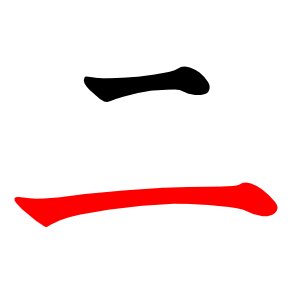
Pangu split open primordial chaos with one stroke of his axe: the light rose and the turbid sank; above was heaven, below was earth. When yin and yang first divided, there was “二” (èr, “two”) — this is called “one gives birth to two.” The upper “一” represents heaven and the lower “一” represents earth. People are on the earth, close to the earth and far from heaven; people see near things as large and far things as small, so the lower “一” is long and the upper “一” is short.
Above is yang, is heaven, is the Way of Heaven, expressing the Dao, principles and rules that lie above and apart from physical things — what philosophy calls the metaphysical. Below is yin, is earth, expressing the laws of the growth and change of all physical things on earth — the Way of Earth.
“二” is the same in oracle-bone script, bronze script, the Qin bamboo-slip script and regular script, so “二,” like “一,” should be among the oldest characters.
“二” is a basic component in Chinese characters; a great many characters contain it, such as 工, 天, 上 and so on. When explaining these characters, their relation to 二 always comes up.
In “二” one horizontal stroke is long and one is short, which gives a relationship of order. In addition, the two parts into which “二” divides one are stacked one above the other, supporting and depending on each other, not existing independently. This also expresses a universal phenomenon in the world.
The basic meanings of 二 are:
As a numeral: one plus one (on banknotes and receipts the formal character 贰 is commonly used instead); the sum of one plus one.
Double, to compare: 独一无~ (unique, without a second).
Two kinds, other: ~话 (a different word, objection). 不~价 (no second price, fixed price).
“The number of earth. From a pair of 一; compound-ideative. The ancient form also takes 弋.” — Shuowen Jiezi
“By means of the two it aids the people’s conduct.” — Book of Changes, “Appended Statements.” Yu Fan’s commentary: “This refers to Qian and Kun. Later official documents wrote it as 贰, to prevent fraudulent alteration.”
“Ci hears one thing and thereby knows two.” — the Analects, “Gongye Chang”
“Before the grandfather has died, he already has twenty-five grandsons.” — Han Feizi, “The Five Vermin”
In some places, to say a person is very “二” means he is very silly.
