

This English version was translated from the Chinese original with AI assistance. The Chinese text is authoritative.
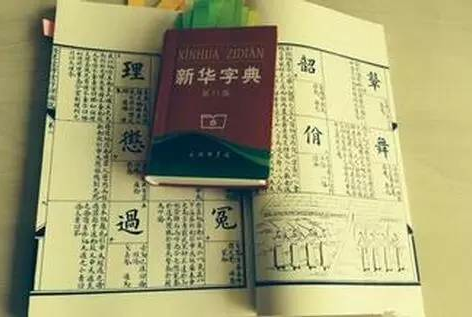
The encyclopedic late-Qing dictionary Chengzhong Mengxuetang Zike Tushuo (Illustrated Character Lessons of the Chengzhong Primary School) was first published in the 27th year of the Guangxu reign of the Qing dynasty (1901). In four volumes (eight books), it selects 3,291 Chinese characters with 762 illustrations. It is a Shuowen Jiezi of its own kind, explaining the meanings of character roots and setting things right at their source. It was the first language textbook in history compiled by a school, and today it has been deliberately forgotten, which is lamentable.
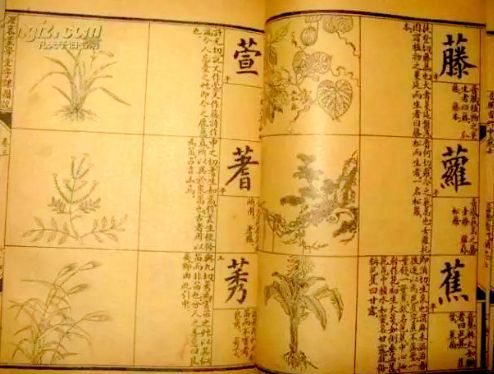
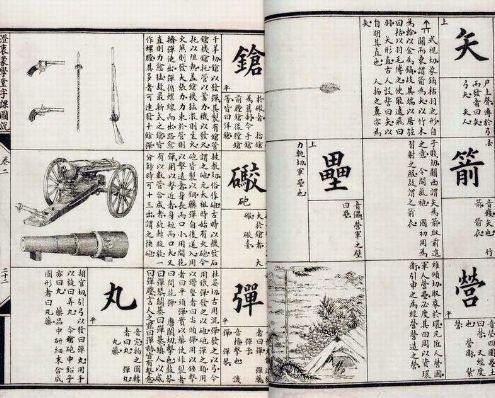
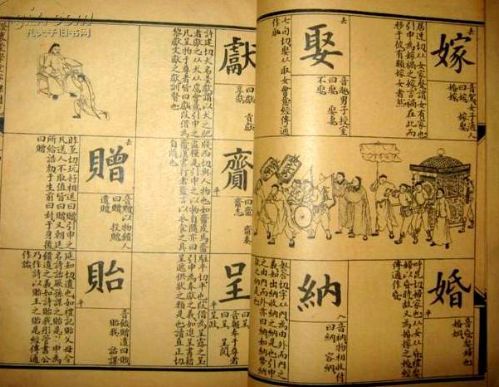
Today, starting from kindergarten, students place blind faith in the Xinhua Dictionary.
This author’s attention was drawn to the Chengzhong Mengxuetang Zike Tushuo by a blog post from the well-known blogger Lao Yu.
Lao Yu recently published a blog post comparing the Chengzhong Mengxuetang Zike Tushuo with the Xinhua Dictionary compiled after 1949, and was startled to discover that, in explaining Chinese characters, the Xinhua Dictionary had castrated the profound Chinese culture into dead knowledge, completely cutting off the source of Chinese culture and at the same time blocking the transmission of world civilization.
Lao Yu said: I am from Shaanxi, but I never understood what “Shaanxi” (陕西) meant. Shanxi (山西) lies west of the Taihang Mountains and Shandong east of them — that is obvious at a glance. But what do the two characters 陕西 mean? If there is a Shaanxi (“west of Shan”), there must be a “Shan-east”; where is the dividing line? I looked through all the place names in Shaanxi and not a single one contains the character 陕. The Xinhua Dictionary explains “Shaanxi” as: a province of our country. As for 秦 (qín), the former gives two meanings: a surname, and specifically Shaanxi; the latter is even more blunt: another name for Shaanxi Province. After going round the authoritative dictionaries, I still could not grasp the true meaning of 陕 and 秦. Through my long years of schooling, from the first grade of primary school to graduating from a university Chinese department, I never had the chance to learn the original information of these two characters. “Then Hu Jiujiu brought over a yellowed copy of the Chengzhong Mengxuetang Zike Tushuo and told me it was the book from which Mr. Hu Shi first learned to read. I opened it, and in the section of Volume One on administrative divisions and place names, my eye fell at once on 陕 and 秦 placed side by side. The editors explain 陕 thus: ‘In the time of King Cheng of Zhou, the Duke of Zhou governed east of Shan, and the Duke of Shao governed west of Shan; Shan was the dividing point. The province now called Shaanxi is the land governed by the Duke of Shao. Since ancient times it has been the seat of emperors: Zhou rose there like a dragon, Qin watched the realm like a tiger from there, and from Han onward it has been called Guanzhong. It is truly the mightiest of the Lands of Abundance, and Xinjiang, Long and Shu must treat it as their throat.’”
“The primer that Hu Shi and his generation studied discusses 秦 thus: ‘The present Shaanxi Province was all the land of the state of Qin. It is suited to grain (禾), hence the character contains 禾. In ancient times it was called the fattest of lands; Chang’an, capital through the dynasties, was the richest in the realm, and the present provincial capital Xi’an Prefecture is Chang’an.’ So the original meaning of 秦 emerged as well, and before my eyes rolled the waves of wheat across the eight-hundred-li Qinchuan plain. The contemporary scholar Mr. Zuo Min’an says 秦 is a compound-ideative character whose original meaning is ‘grain’ — could that derive from this too? Mr. Zhang Ziqiang, a professor of mathematics at Lanzhou University, holds that the original meaning of 秦 is putting grain into a vessel, that is, brewing wine. These two later views may well be good supplements to the explanation in the Chengzhong Mengxuetang Zike Tushuo. The only regret was that the original meaning of 陕 still had no answer. I turned to the Shuowen Jiezi and found the explanation: 陕 means narrow pass — a strategic place, difficult to traverse. At this point all my doubts melted away. The name ‘Shaanxi’ comes from the Dukes of Zhou and Shao ‘dividing at Shan and governing.’ The area around Zhangbianyuan in present-day Shan County was anciently called ‘Shan Plateau,’ and ‘Shaanxi’ at that time meant the Jing–Wei plain west of the Shan Plateau. After the An Lushan Rebellion in the Tang dynasty, a Shaanxi military governorship was established and ‘Shaanxi’ began to become an administrative name; through Song’s Shaanxi Circuit, Yuan’s Shaanxi Province, Ming’s Shaanxi Provincial Administration Commission, to the separation of Shaanxi and Gansu in the Qing, the administrative boundaries of Shaanxi Province were broadly settled.”
Lao Yu said: As a native of Shaanxi, I have finally understood, and I have found the roots of my own home province.
So he went looking for the similarities and differences between the Xinhua Dictionary and the Chengzhong Mengxuetang Zike Tushuo, and what he found was truly shocking.
★Look at the explanation of Anhui, Hu Shi’s home province. The official, standard dictionary says: Anhui, short for Anhui Province; 皖 (wǎn), another name for Anhui Province.
The Chengzhong Mengxuetang Zike Tushuo says: Anhui is the combined name of Anqing Prefecture and Huizhou Prefecture; 皖 is a place name — the ancient state of Wan lay within present-day Anhui, hence the province is called 皖.
★The explanations of 京 (jīng, “capital”) and 都 (dū, “capital city”) are even more astonishing. The Xinhua Dictionary explains 京 as: “The capital city, the capital of a country, specifically the capital of our country.”
The Chengzhong Mengxuetang Zike Tushuo says: “The foremost region of good is called 京, as in Beijing and the capital; it means great — 京 is where the Son of Heaven dwells, and therefore it is made great. Our dynasty follows the precedent of the former dynasty in making Shuntian Prefecture the capital. Its city has three walls, its palaces are magnificent, it has two million inhabitants, and its population is dense, surpassing every province.”
★The Xinhua Dictionary explains 都 as: “Capital, the place where the highest leading organs of the whole country are located; a big city; a surname.”
The Chengzhong Mengxuetang Zike Tushuo explains 都: “The palace of the Son of Heaven is called 都, as in great capital and capital gates; it means gathering together, beauty and abundance, and therefore it is used as the name of the place where the Son of Heaven resides.”
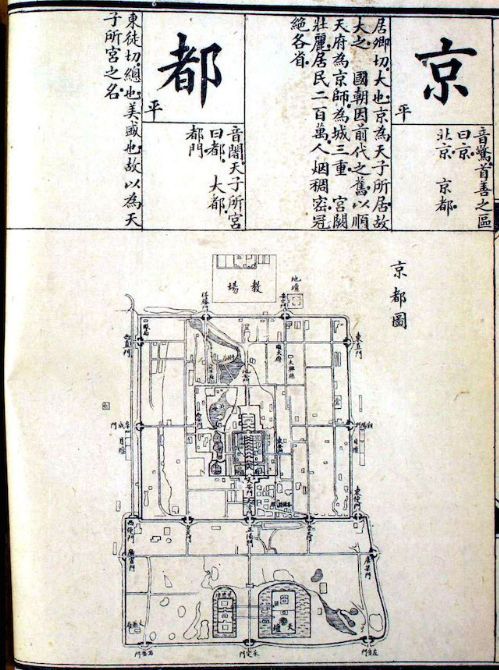
If place names do not make the point clearly enough, let us look at the explanations of a few simple characters.
★天 (tiān, “heaven, sky”): the Xinhua Dictionary gives six meanings: the high space above the ground; natural; day; weather; season or time of year; and what superstitious people mean by gods, buddhas and immortals or the place where they live.
The Chengzhong Mengxuetang Zike Tushuo says: “That which is supreme and has nothing above it is called 天,” and then explains the sky to students over eleven thus: “Heaven is accumulated air; the air envelops the earth. Near the earth the air is dense, and the farther from the earth the thinner it becomes. When the air is exhausted there is emptiness, hence it is called the sky (天空).”
★物 (wù, “thing”): the Xinhua Dictionary gives two explanations: things; people or circumstances other than “oneself,” mostly referring to the public.
The Chengzhong Mengxuetang Zike Tushuo explains: all that is born between heaven and earth is called 物, divided into animals, plants and minerals.
★Most interesting of all is the explanation of 党 (dǎng, “party”). The first sense in the Xinhua Dictionary is: “a political party, in our country specifically the Communist Party of China”; the second sense is a clique formed out of private interests; the third is to be partial; and the last is, in former times, kinsfolk, as in father’s kin, mother’s kin and wife’s kin.
The Chengzhong Mengxuetang Zike Tushuo says: “Five hundred households form a 党, as in fellow villagers (乡党) and partisans (党人)”; that is for those under ten, and for those over eleven it goes further: “Under the Zhou system, five households formed a 比, five 比 a 闾, five 闾 a 族, and five 族 a 党. 党 means friends, means help; when friends help one another and conceal wrongdoing, that is the 党 of partisanship and factions.” The former offers no knowledge and never tells the reader the original meaning of 党 from beginning to end — it goes from near to far, and the far has no roots; the latter generates meaning out of knowledge and is convincing.
A few examples picked at random are enough to reveal the fundamental difference between today’s standard dictionary and late-Qing humanistic common knowledge.
This primer, published in 1901, is filled with a fresh, vigorous and natural spirit that cleanses the heart. It teaches people to love nature, all things and their fellow human beings; it embraces both China and the West and unites past and present; it is rich in content and well illustrated, giving readers a strong sense of a shared human destiny. Morality and knowledge move in step; it can truly be called a guide leading students into the civilized world.
Lao Yu said: Before the Chengzhong Mengxuetang Zike Tushuo, I feel like an illiterate.
The Chengzhong Mengxuetang Zike Tushuo has four volumes (eight books) in all:
★Book 1 contains the general notes, the character classification and the index;
★Book 2 is Volume One, whose characters cover astronomy and geography, natural phenomena, mountains and rivers, knowledge of various countries, local records and so on;
★Books 3 and 4 are Volume Two, whose characters concern human affairs and the nature of things, musical instruments and weapons, flowers, birds, fish and insects, minerals and metals and so on;
★Books 5 and 6 are Volume Three, whose characters cover weights and measures, daily life, agriculture and industry, insects and animals, wild plants and so on;
★Books 7 and 8 are Volume Four, the last volume, whose characters concern more abstract human activities and language and writing.
As the first language textbook in history compiled by a school, the spirit this book handed down directly influenced the later Guomin Zike Tushuo (Illustrated Character Lessons for Citizens, 1915), and also influenced the contemporaneous Republican National Education Textbooks (1912). From the late Qing to the Republic, this hidden thread persisted; it can be called a model for modern Chinese language textbooks, shining brilliantly and striving unceasingly all the way. Yet in our own time the book has fallen into obscurity.
Some commentators call this set of textbooks “one of the important milestones in the history of civilization.” Its eight books contain an index, a character classification, and the illustrated character lessons. The lessons are divided into brief explanations and detailed explanations: the brief ones are for students under ten, the detailed ones for students over eleven; pronunciation and meaning each have their own emphasis; common characters predominate and rare ones are not included; meanings come in detailed and brief forms, and the order of learning characters has two levels, shallow and deep, shallow first and deep later. Thus this book is at once a small encyclopedia and a primary school dictionary, and also a Shuowen Jiezi explaining the meanings of character roots and setting things right at their source. Many well-known figures such as Hu Shi and Mao Dun used this book as their first reading primer in childhood.
The Xinhua Dictionary, on the other hand, through its explanations of characters, has completely cut off the source of Chinese culture and at the same time blocked the transmission of world civilization. In the course of defining words, they removed religious belief one by one, mowed away imagination and passion for all things, and forcibly injected the dye of a self-exalting ideology. As a result, almost all the Chinese characters created by our ancestors have turned into corpses — you can hardly draw much cultural nourishment from them, yet you are very easily brainwashed by their distorted interpretations: the more you know, the further you are from true knowledge and the truth. They deliberately sever the historical and cultural links of characters and words; their principle of annotation is to take today’s meaning as the meaning and today’s use as the use, castrating knowledge into dead knowledge, blocking the link with history and preventing you from making that link; every Chinese character becomes so dry and dull.
The living, natural connection between people and their history and culture has thus been brutally severed.
The Xinhua Dictionary is a dictionary that “severed the roots of the wisdom of the Chinese nation and its cultural life.” For more than sixty years, generation after generation of Chinese people have entered China’s humanistic world through this completely ideologized object. From this it is not hard to understand why, over these sixty-odd years, the more diligent the so-called good students were, the more seriously they were harmed: from the very beginning they lost the possibility of entering the long-standing humanistic world of the Chinese nation, and grew increasingly out of step with the mainstream civilization of the world.
There is a true story on the Internet that lets one see the whole leopard through a single spot.
Little John attended secondary school in Britain and knew some simple Chinese. Mr. A was a teacher at a school in China and a colleague of Little John’s father. During the Lunar New Year, Little John came to China to be reunited with his father. One evening, Little John went to Mr. A’s home to play with Mr. A’s child. Seeing the Xinhua Dictionary on Mr. A’s desk, Little John began leafing through it. Suddenly he said to Mr. A: “Why is ‘pig’ explained like this? That’s unbelievable!”
★The dictionary said: “Pig: a mammal; its meat is edible, its bristles can be made into brushes, its skin into leather, and its dung is excellent fertilizer!” Mr. A looked at it and told Little John that this was correct.
Little John thought for a moment and then said to himself: “That’s the explanation of ‘pig’; what about the explanation of ‘ox’?”
★In a few quick flips he found 牛 (niú, “ox”) and read aloud: “Ox: a mammal with hooves at the ends of its toes and a pair of horns on its head; a ruminant; very strong, able to plough fields and pull carts; its meat and milk are edible, and its horns, hide and bones can be made into articles!”
★Little John was greatly astonished. After a moment’s daze, he looked up 驴 (lǘ, “donkey”), and saw: “Donkey: a mammal, like a horse but smaller; it can carry loads, pull carts, plough fields and be ridden; its hide can be made into donkey-hide gelatin!”
Little John seemed utterly disappointed in this dictionary. He asked Mr. A whether this dictionary was meant for Chinese students to study with, and Mr. A said yes. Hearing this, Little John sighed and said: “That’s really shocking — to explain these animals like this!” Mr. A asked, puzzled: “You think the dictionary’s explanations are wrong?”
“Of course, and very wrong!” said Little John. “People are members of nature; every animal in nature is equal to human beings. Animals are humanity’s friends; we should cherish them, help them and protect them, not use them. Look at the explanations in the dictionary — if they are not for eating, they are tools for labour, and they are even to be killed and made into products. That is not at all what their friends should do. I think those definitions will make Chinese students feel, from the moment they start learning characters, that animals don’t deserve respect, that animals are just food to be killed and eaten, or tools to be ordered about for labour, or even products. That runs completely counter to the call to ‘protect animals’!”
This little story calls to mind at least the following:
★First, most Chinese people have seen such definitions of the ox, the horse and the donkey in the dictionary, but have always considered them perfectly normal, with nothing wrong about them. Living for a long time in China’s cultural environment numbs one’s judgment and dulls one’s vigilance.
★Second, it must be admitted that Western education is healthy; at least under the education of Western textbooks, an awareness of treating animals with equality and kindness has taken root in children’s hearts.
★Third, dictionaries of characters and of words are language reference books. Our dictionaries have many problems — not revering life, not caring for animals, not respecting the value of people and animals… such things are everywhere. Their negative effect on children’s minds is enormous.
It seems that striving to compile good dictionaries for children, giving our dictionaries more humanistic care and more respect and reverence for life, has become an urgent matter.
Yet this situation seems to have grown even worse in recent years. For example, the noted scholar Fu Guoyong recently reposted an online post on Sina Weibo saying that in the newly published 2013 Xinhua Dictionary, “freedom” (自由) had been erased, while “masturbation” (自慰) was kept. Netizens found definitions of “freedom” in both the 2004 and 2010 editions of the Xinhua Dictionary, but in the new edition freedom was gone, while “masturbation,” “being content with oneself,” “deceiving oneself and others” and “courting one’s own destruction” had been added. One netizen said that clearly, this cutting up of Chinese culture through a single Xinhua Dictionary proves that these scoundrels are the greatest enemies of Chinese civilization since the Qin and Han, “not of our kind” to a greater degree than the Mongols and the Manchus. Another netizen commented that for sixty years the Xinhua Dictionary, as a study reference, has played the role of “first teacher” in the growing up of several generations of Chinese; by deleting “freedom,” the new edition means to teach the Chinese people to forget freedom!
