

This English version was translated from the Chinese original with AI assistance. The Chinese text is authoritative.
Chinese idioms contain profound cultural meaning, and idiom stories tell history and explain principles in a way that is easy to understand.
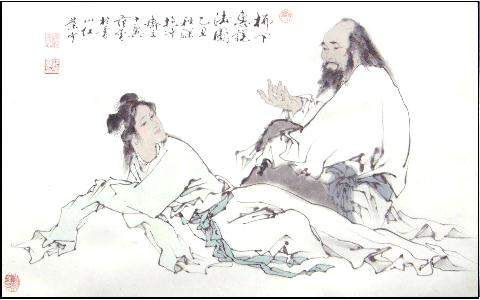
Among speakers of Chinese, 坐怀不乱 (zuò huái bù luàn, “sitting with a woman in his lap without impropriety”) is an idiom almost everyone knows. It tells how Liuxia Hui of the state of Lu in the Spring and Autumn period wrapped a freezing woman in his arms and committed no impropriety. It describes the bearing of a person of high morals who observes propriety and the law from the bottom of his heart. This idiom also made Liuxia Hui’s name last through the ages.
The expression 坐怀不乱 comes from Mao Heng’s commentary on the Book of Songs, “Lesser Odes, Xiang Bo.” When annotating the poem “Xiang Bo,” Mao Heng told a story: in the state of Lu there was a man living alone in a room, whose neighbor was a widow also living alone. One night a violent storm broke out and the widow’s house was destroyed, so she came to the man to ask for shelter. The man would not let her in. She said to him through the window: “Why won’t you let me in?” The man said: “I have heard that a man and a woman under sixteen may not live together. Now I am still young, and so are you, so I cannot let you in.” The woman said: “Why can’t you be like Liuxia Hui, who could warm with his body a woman who had no time to get indoors out of the cold, and yet no one thought he had behaved improperly?” The man said: “Liuxia Hui can open the door; I cannot. So I will use my ‘not opening the door’ to learn from Liuxia Hui’s ‘opening the door.'” This story shows that by the early Western Han at the latest, the legend of Liuxia Hui sitting with a woman in his lap without impropriety already existed, though the details were somewhat vague.
In fact, besides observing propriety, Liuxia Hui did quite a few praiseworthy things in history. Liuxia Hui was a man of Lu in the Spring and Autumn period, surnamed Zhan and named Qin. He was a descendant of Prince Zhan, son of Duke Xiao of Lu. “Liuxia” was his fief, and “Hui” his posthumous title, so later generations called him “Liuxia Hui.” Once, the state of Qi sent someone to demand from Lu a treasured heirloom tripod, the Cen Ding. The Cen Ding was a treasure handed down in Lu; Lu could not bear to part with it but was afraid of offending Qi, so it made a fake tripod to pass off as the real one. The people of Qi did not know whether the tripod was genuine, but they trusted Liuxia Hui, who was famous throughout the land for telling the truth, and said: “We do not trust you; we trust only Liuxia Hui. If Liuxia Hui says this tripod is the real Cen Ding, we will accept it.” So Lu asked Liuxia Hui to say that the fake was the real Cen Ding, but he refused. Liuxia Hui said: “Trustworthiness is the only treasure of my life. If I tell a lie, I destroy my own treasure. To destroy my treasure in order to save Lu’s treasure, the Cen Ding, is something I cannot do.” In the end, Lu had no choice but to send the real Cen Ding to Qi.
To insist on telling the truth and never lie: what a fine character! Unfortunately, Liuxia Hui was born at the wrong time. The Spring and Autumn period was a chaotic age in which rites and music had collapsed, and people with the virtue of truthfulness repeatedly suffered for it in reality. When Liuxia Hui entered office, the government of Lu was in the hands of Zang Wenzhong. In the summer of the twenty-sixth year of Duke Xi of Lu (631 BCE), Duke Xiao of Qi sent troops to attack Lu, and Zang Wenzhong asked Liuxia Hui what diplomatic language could make Qi withdraw. Liuxia Hui spoke the plain truth: “Relations between states should be like this: the great state sets a good example for the small, and the small state serves the great properly; only thus can disaster be averted. Now Lu, a small state, is arrogant and conceited and has angered a great state, which is no different from bringing disaster upon itself. No choice of words will be of any use.” Such words of course displeased Zang Wenzhong greatly. When the leader is displeased, the consequences are serious. Liuxia Hui served in Lu as shishi (an official in charge of punishments and prisons), and during Zang Wenzhong’s time in power he was dismissed three times in a row.
At that time Liuxia Hui was already famous, and the feudal lords of various states competed to recruit him with high office and generous salaries, but he refused them all. When someone asked why, he answered: “If I serve others by the straight path, where could I go and not be dismissed three times? If I serve others by a crooked path, why need I leave the land of my parents?” That is: if I keep to upright principles, how could I not be dismissed three times? If I always hold to these principles, I cannot escape dismissal wherever I go; if I abandon them, I could get high office and a generous salary even in Lu, so why leave the homeland that bore and raised me? Evidently Liuxia Hui understood the chaotic age of the late Spring and Autumn period quite well: “The Way has not prevailed for a long time.” Rites and music had collapsed everywhere, and staying in any feudal state would be much the same.
More than a hundred years later, Confucius was still protesting the injustice of Liuxia Hui’s three dismissals, saying: “Was not Zang Wenzhong one who stole his position? He knew the worth of Liuxia Hui and yet did not give him a place beside him!” That is, Zang Wenzhong clearly knew Liuxia Hui was a worthy man yet did not promote him, which was truly a dereliction of duty.
Mencius also praised Liuxia Hui very highly. Liuxia Hui was not ashamed to serve a bad ruler, nor did he decline a post because it was minor; in office he did not hide his talents but always acted according to his principles; when he was not employed he bore no grudge, and in hardship he did not feel sorry for himself; living among country bumpkins, he could still be cheerful. His reason was: “You are you and I am I. Even if you stood naked beside me, how could you defile me?” So those influenced by Liuxia Hui’s virtue, even the narrow-minded, could become broad-minded, and the mean-spirited could become generous. Therefore Mencius praised Liuxia Hui as “the sage of harmony,” meaning that Liuxia Hui was an easygoing sage.
