

This English version was translated from the Chinese original with AI assistance. The Chinese text is authoritative.
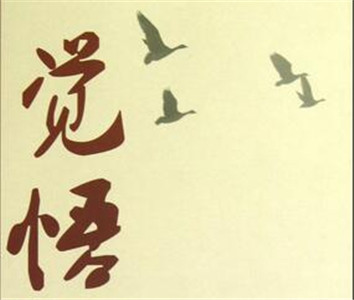
觉 (jué, “awareness”), in traditional characters “覺.” The lower part is “见” (jiàn, “to see”); the bald-roof component 冖 indicates covering, concealing. The three horizontal strokes represent the Way of Heaven, the Way of Earth and the Way of Humanity, the truth of the universe. The two vertical strokes enclose the truth within; when this enclosure is opened, a “爻” (yáo, “line of a hexagram”) is added in the middle to indicate change. So the meaning of the whole character is: the gaze penetrates the covering layer and opens up the concealed truth, seeing the changes that this truth reveals; that is “觉.”
悟 (wù, “to realize”) is the upright-heart side component 忄 plus 吾 (wú, “I”); 吾 is oneself. The sound of 吾 is the same as 无 (wú, “without”). According to the principle that the same sound means the same meaning, 吾 also implicitly carries the meaning of 无: “without” in the heart, that is, without attachment. The understanding a person gains when there is no attachment in his own heart is “悟.”
