

This English version was translated from the Chinese original with AI assistance. The Chinese text is authoritative.
Introduction: Chinese Characters, a Living Cultural Gene
Chinese characters, the most distinctive visual symbols and the crystallized wisdom of Chinese civilization, have design principles that go far beyond the scope of a simple record-keeping tool. They not only carry the practical function of language but are also deeply rooted in the Chinese philosophy of the unity of heaven and humanity and in a distinctive aesthetic outlook. Understanding the mysteries of how Chinese characters are formed is not merely a task for linguistics but a deep exploration of the Chinese people’s ways of thinking and values. Starting from the traditional theory of the Six Scripts (liushu), this article examines in depth the system of the New Six Scripts set out in the book Exploring the Design Mysteries of Chinese Characters, and reveals the core concept running through it, the character rotor, in the hope of presenting readers with a more three-dimensional and culturally meaningful picture of the design principles of Chinese characters.
The Traditional Six Scripts: Cornerstone and Limits of the Evolution of Chinese Characters
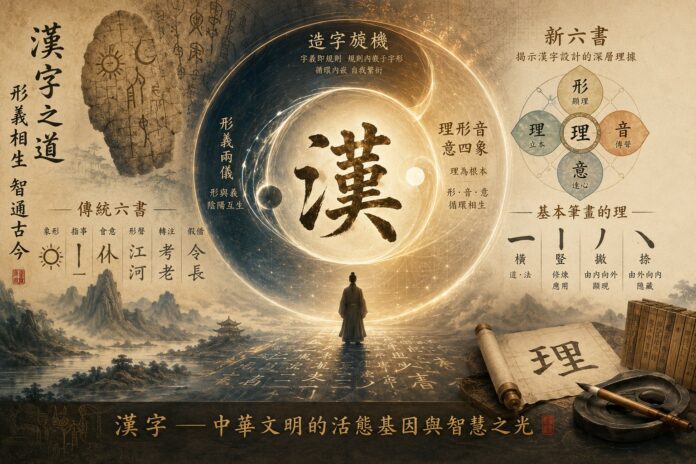
The centuries of war in the Warring States period caused the ancient Six Scripts method of forming characters to be lost. Only in the Eastern Han did Xu Shen, in Shuowen Jiezi, once again systematically expound the theory of the Six Scripts, summarizing it as six principles of forming or using characters: pictographic, indicative, compound-ideative, phono-semantic, transfer and loan characters. Of these, pictographic characters such as 【日】 (rì, “sun”) and 【月】 (yuè, “moon”), indicative characters such as 【上】 (shàng, “above”) and 【下】 (xià, “below”), compound-ideative characters such as 【休】 (xiū, “to rest”: a person leaning against a tree) and phono-semantic characters such as 【江】 (jiāng, “river”) and 【河】 (hé, “river”) are the main methods of forming characters, while transfer and loan characters are methods of using characters. The traditional Six Scripts successfully revealed the systematic rules by which Chinese characters developed from early graphic symbols into symbols that express both meaning and sound. Phono-semantic characters in particular, which hold a dominant 80.5% share of modern Chinese characters, solved the problem of fitting the writing system to the sound system. However, with the transformation of characters into clerical script and then regular script, strokes were brought under a different logic, and in explaining the rationale of the forms of clerical and regular-script characters the traditional Six Scripts drifted somewhat off course, prompting later scholars to keep exploring and seeking a theoretical framework for characters after the clerical and regular-script transformations.
The New Six Scripts in Exploring the Design Mysteries of Chinese Characters: the Two Modes of Form and Meaning and the Four Images of Rationale, Form, Sound and Intent
Unlike the traditional Six Scripts, which focus on the evolution of Chinese characters, the book Exploring the Design Mysteries of Chinese Characters proposes an entirely new theory of the New Six Scripts, aiming to reveal the deep rationale embedded in Chinese characters as a “designed” system of symbols. The core of the New Six Scripts is the Two Modes of form and meaning and the Four Images of rationale, form, sound and intent. The Two Modes of form and meaning refer to the most basic kernel of character formation, emphasizing the yin-yang relationship of mutual generation between a character’s form and its meaning; indicative and pictographic characters mostly belong here and are unrelated to pronunciation. The Four Images of rationale, form, sound and intent cover more complex ways of forming characters, such as compound-ideative, phono-semantic, transfer and loan characters, emphasizing that rationale (理), as the most fundamental law of the universe, cycles and generates through the four dimensions of form, sound and intent to construct Chinese characters together. This theory holds that every basic Chinese character seals within it a rationale concerning the world and life, and that its designer was a being of great wisdom who used the forms of the characters to carry and transmit these rationales.
The Character Rotor: The Generative Logic Embedded in Chinese Characters
In the system of Exploring the Design Mysteries of Chinese Characters, the character rotor is the key concept for understanding the design principles of Chinese characters. It means that the meaning of a character is itself a rule of character formation, and that the rule is embedded in the character’s form, forming a cyclically embedded, self-propagating mechanism. This “self-referential” and “spontaneous” generative logic has allowed Chinese characters to remain stable and unchanged for thousands of years while continually generating new words and concepts. For example, the basic strokes such as 【横】 (the horizontal: the Dao, the Law), 【竖】 (the vertical: cultivation, application), 【撇】 (the left-falling stroke: from inside outward, manifesting) and 【捺】 (the right-falling stroke: from outside inward, concealing) all carry specific meanings for character formation. When these strokes are combined in particular ways, the rationale they contain is manifested through the character’s form, creating a dynamic, self-defining symbolic system. The character rotor not only explains the stability and vitality of Chinese characters but also reveals their rigor as a complete design system.
The Cultural Significance and Contemporary Value of the Design Principles of Chinese Characters
Whether the traditional Six Scripts or the New Six Scripts and the character rotor of Exploring the Design Mysteries of Chinese Characters, all profoundly embody the spiritual core of Chinese culture. The symbolic system of the Six Scripts of Chinese characters is not only a vehicle for transmitting information but also a cultural gene linking the past, present and future of the Chinese nation. The ideas of yin and yang, the Five Phases and the Eight Trigrams contained in their forms, and their reflection of cosmic laws such as Truthfulness, Compassion, Forbearance (Zhen-Shan-Ren), all display the unique charm of Chinese characters as cultural symbols. In our time, the exploration of the design principles of Chinese characters continues. For example, different New Six Scripts methods of character formation have been proposed for clerical and regular-script characters, to suit their stroke-based, symbolic features. These ongoing explorations, whether deepening our understanding of ancient wisdom or applying it to fields such as modern logos, type design and visual communication, all aim to better transmit and spread the essence of Chinese culture through the unique medium of Chinese characters.
Conclusion: The Light of Wisdom Across Time and Space
Chinese characters, the crystallized wisdom of the Chinese nation, contain in their design principles deep cultural and philosophical thought that goes beyond the scope of linguistics. From Xu Shen’s Six Scripts to the New Six Scripts and the character rotor constructed in Exploring the Design Mysteries of Chinese Characters, what we see is a living symbolic system that is continually being interpreted and reactivated. It not only records history but, through its distinctive way of forming characters, carries the Chinese nation’s profound understanding of the universe, life and morality. In the digital age, in-depth research into the design principles of Chinese characters not only helps us better understand our own cultural roots, but also injects new vitality and possibilities into Chinese characters in modern design and international communication, so that they continue, as the distinctive emblem of Chinese civilization, to shine with the light of wisdom across time and space.
