家 博客

Chinese 365: Day 12

This English version was translated from the Chinese original with AI assistance. The Chinese text is authoritative.

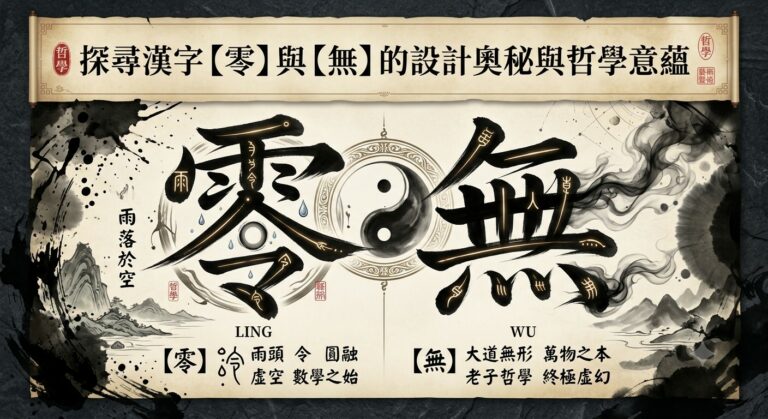
——Exploring the Design Mysteries and Philosophical Meaning of the Characters 零 (Zero) and 无 (Nothing)

Introduction: being and non-being give rise to each other; heaven and earth seen within a square inch

In the vast universe of Chinese characters, the two characters 【零】 (líng, “zero”) and 【无】 (wú, “nothing”) both seem to point to the image of “vacancy” or “not having.” Yet their design concepts, paths of evolution and the cultural content they carry are like two gates opening onto different worlds, each profound and unique. One sprouted from a concrete natural phenomenon and finally took its place in the field of numbers; the other was born of ancient philosophical speculation and became a foundational concept of Chinese civilization. This article uses the character-formation theory of the New Six Scripts to explore the design mysteries and philosophical wisdom hidden behind these two characters, which look similar but are in fact quite different.

【零】: from light rain to the empty place in numbers (common reading)

The origin of the character 【零】 has no direct connection with the number “0” as we understand it today. Its ancient form was 【霝】; in oracle-bone script it looks like fine raindrops falling from the sky, and its original meaning was “light rain” or “scattered rain.” The Shuowen Jiezi explains it as “slow rain,” vividly depicting raindrops falling scattered. In terms of form, 【零】 is a typical phono-semantic character, with the 【雨】 (yǔ, “rain”) top component expressing meaning and 【令】 (lìng) as the phonetic component. Over its long history, the meaning of 【零】 gradually extended to scattered, fragmentary, withered and fading, as in “fallen and scattered, crushed into mud and dust.” Only in modern times, with the introduction of the Western mathematical system, was the character 【零】 borrowed and established as the symbol for the number “0,” completing its semantic leap from a natural phenomenon to an abstract mathematical concept. This is a unique case of cultural exchange and functional borrowing, showing the great inclusiveness and adaptability of Chinese characters.

【零】: microscopic order within the Two Modes of form and meaning (design reading)

Viewed through the Two Modes of form and meaning of the New Six Scripts, the design of 【零】 is by no means accidental. In the rationale of character formation, its radical 【雨】 refers not only to the water of nature but also symbolizes the “virtue of water”: supremely soft and supremely good, nourishing things silently, as well as the most fundamental principle of the universe, “Truthfulness, Compassion, Forbearance.” Water can wash all things clean and can also nourish life; its nature is diffuse and formless, yet it is everywhere. The character 【令】 carries the meaning of “command, rule, order,” and can also mean “minute, subtle.” Therefore the design of 【零】 reveals precisely a kind of “microscopic order” or “truth within scattering.” It is not true “nothing,” but a state that is extremely subtle and scattered everywhere, yet exists in accordance with the fundamental laws of the universe (the virtue of water; Truthfulness, Compassion, Forbearance). Just as in cultivation culture the principles of the great Dao manifest in all things, even the most minute “scattered” places contain higher-dimensional order and laws. This is the “character rotor” shown by the mutual generation of form and meaning in 【零】: within the apparent “emptiness” is reflected a subtle “principle of existence.”

【无】: philosophical origin and the realm of non-existence (common reading)

Unlike the concrete origin of 【零】, the character 【无】 carried profound philosophical meaning from the very beginning. Scholars interpret its oracle-bone and bronze-script form 【無】 differently: some think it depicts a person dancing with feathers in hand, performing a shamanic prayer, symbolizing a state of communicating with the divine and transcending material limits; others take it to depict flames burnt out, with nothing left. Whatever exactly it depicts, its core points to the concept of “not having, not existing, emptiness.” In pre-Qin philosophy, 【无】 was further raised to the level of ontology. The Daodejing says at its very beginning, “The nameless is the beginning of heaven and earth,” regarding 【无】 as the origin of heaven, earth and all things, the initial state of the “Dao.” It is not “nothing at all,” but the infinite potential of “everything is possible,” the foundation from which “being” arises. This “non-being” transcends sensory experience; it is a profound philosophical concept full of tension.

【无】: the ultimate Taiji of rationale generating form (design reading)

In the New Six Scripts’ system of the Four Images of rationale, form, sound and intent, the character 【无】 is the supreme embodiment of “rationale generating form.” The “rationale” it carries is the ultimate noumenon at the beginning of cosmic creation, when all things had not yet taken form. If the original character 【無】 is taken in the sense of “a person dancing with feathers,” then the 【人】 figure symbolizes the cultivator’s search for and penetration of the origin of the great Dao, and the 【羽】 (yǔ, “feather”) can be seen as a medium for communicating with higher-dimensional spaces. This suggests that “non-being” is not emptiness, but an ineffable “being” of a higher dimension. If it is taken in the sense of “flames burnt out,” then the extinguishing of 【火】 (light, wisdom) does not mean extinction, but a return to a purer, more primordial state of energy. In the Two Modes of form and meaning, 【无】 is the Taiji state of supreme yin and supreme yang, the chaos in which forms are not yet differentiated and all things not yet born. With its abstract form, it directly reflects the formlessness and imagelessness, the beginninglessness and endlessness of the “Dao”; it is the highest abstraction and distillation of the laws of the universe at the level of writing. It reminds us that true “emptiness” is not void, but the origin that holds infinite vitality.

The cultural interweaving and philosophical divergence of 【零】 and 【无】

Although 【零】 and 【无】 are both related to the concept of “emptiness,” their cultural positions and philosophical depth are entirely different. 【零】 starts from a concrete natural phenomenon (raindrops, scattering) and finally represents an “empty place” or “minuteness” at the quantified, discrete level; its meaning points to the “non-being” within “being,” a relative vacancy. It is concerned with the subtleties of the material world and the order embodied in fine details. 【无】, by contrast, points directly to the noumenon and origin of the universe; it is the “non-being” above “being,” an absolute, transcendent state of “non-existence,” the starting point from which all things arise. It is concerned with metaphysical philosophical speculation, the mystery of cosmic creation. One microscopic and one macroscopic, one concrete and one abstract, together they build the Chinese nation’s unique understanding of the philosophical categories of “emptiness” and “being,” showing the infinite possibilities of Chinese characters in carrying cultural and philosophical thought.

Conclusion: the profound wisdom in the design of Chinese characters

By exploring the design mysteries and cultural content of the two characters 【零】 and 【无】, we gain a glimpse of the profound wisdom contained behind the system of Chinese characters. They are not simple piles of symbols, but carry the sages’ deep insight into nature, life and the laws of the universe. Whether the microscopic order revealed by 【零】 or the philosophy of origins reflected by 【无】, both embody the unique charm of the “mutual generation of form and meaning” in Chinese characters. They are an important part of the genes of Chinese culture, continually inspiring us to reflect on the dialectical relationship between “being” and “non-being,” “existence” and “non-existence,” and on the formless and eternal “rationale” behind all things.
The New Six Scripts and the Character Rotor: A Cultural Reading of the Design Principles of Chinese Characters

This English version was translated from the Chinese original with AI assistance. The Chinese text is authoritative.

Introduction: Chinese Characters, a Living Cultural Gene

Chinese characters, the most distinctive visual symbols and the crystallized wisdom of Chinese civilization, have design principles that go far beyond the scope of a simple record-keeping tool. They not only carry the practical function of language but are also deeply rooted in the Chinese philosophy of the unity of heaven and humanity and in a distinctive aesthetic outlook. Understanding the mysteries of how Chinese characters are formed is not merely a task for linguistics but a deep exploration of the Chinese people’s ways of thinking and values. Starting from the traditional theory of the Six Scripts (liushu), this article examines in depth the system of the New Six Scripts set out in the book Exploring the Design Mysteries of Chinese Characters, and reveals the core concept running through it, the character rotor, in the hope of presenting readers with a more three-dimensional and culturally meaningful picture of the design principles of Chinese characters.

The Traditional Six Scripts: Cornerstone and Limits of the Evolution of Chinese Characters

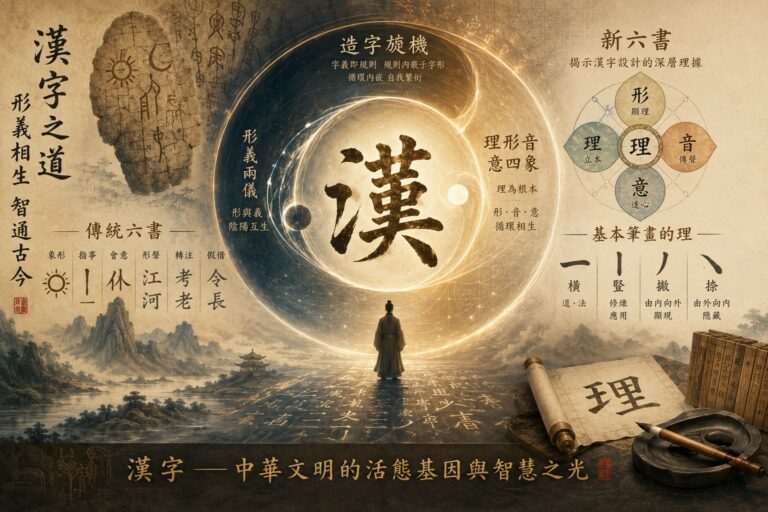
The centuries of war in the Warring States period caused the ancient Six Scripts method of forming characters to be lost. Only in the Eastern Han did Xu Shen, in Shuowen Jiezi, once again systematically expound the theory of the Six Scripts, summarizing it as six principles of forming or using characters: pictographic, indicative, compound-ideative, phono-semantic, transfer and loan characters. Of these, pictographic characters such as 【日】 (rì, “sun”) and 【月】 (yuè, “moon”), indicative characters such as 【上】 (shàng, “above”) and 【下】 (xià, “below”), compound-ideative characters such as 【休】 (xiū, “to rest”: a person leaning against a tree) and phono-semantic characters such as 【江】 (jiāng, “river”) and 【河】 (hé, “river”) are the main methods of forming characters, while transfer and loan characters are methods of using characters. The traditional Six Scripts successfully revealed the systematic rules by which Chinese characters developed from early graphic symbols into symbols that express both meaning and sound. Phono-semantic characters in particular, which hold a dominant 80.5% share of modern Chinese characters, solved the problem of fitting the writing system to the sound system. However, with the transformation of characters into clerical script and then regular script, strokes were brought under a different logic, and in explaining the rationale of the forms of clerical and regular-script characters the traditional Six Scripts drifted somewhat off course, prompting later scholars to keep exploring and seeking a theoretical framework for characters after the clerical and regular-script transformations.

The New Six Scripts in Exploring the Design Mysteries of Chinese Characters: the Two Modes of Form and Meaning and the Four Images of Rationale, Form, Sound and Intent

Unlike the traditional Six Scripts, which focus on the evolution of Chinese characters, the book Exploring the Design Mysteries of Chinese Characters proposes an entirely new theory of the New Six Scripts, aiming to reveal the deep rationale embedded in Chinese characters as a “designed” system of symbols. The core of the New Six Scripts is the Two Modes of form and meaning and the Four Images of rationale, form, sound and intent. The Two Modes of form and meaning refer to the most basic kernel of character formation, emphasizing the yin-yang relationship of mutual generation between a character’s form and its meaning; indicative and pictographic characters mostly belong here and are unrelated to pronunciation. The Four Images of rationale, form, sound and intent cover more complex ways of forming characters, such as compound-ideative, phono-semantic, transfer and loan characters, emphasizing that rationale (理), as the most fundamental law of the universe, cycles and generates through the four dimensions of form, sound and intent to construct Chinese characters together. This theory holds that every basic Chinese character seals within it a rationale concerning the world and life, and that its designer was a being of great wisdom who used the forms of the characters to carry and transmit these rationales.

The Character Rotor: The Generative Logic Embedded in Chinese Characters

In the system of Exploring the Design Mysteries of Chinese Characters, the character rotor is the key concept for understanding the design principles of Chinese characters. It means that the meaning of a character is itself a rule of character formation, and that the rule is embedded in the character’s form, forming a cyclically embedded, self-propagating mechanism. This “self-referential” and “spontaneous” generative logic has allowed Chinese characters to remain stable and unchanged for thousands of years while continually generating new words and concepts. For example, the basic strokes such as 【横】 (the horizontal: the Dao, the Law), 【竖】 (the vertical: cultivation, application), 【撇】 (the left-falling stroke: from inside outward, manifesting) and 【捺】 (the right-falling stroke: from outside inward, concealing) all carry specific meanings for character formation. When these strokes are combined in particular ways, the rationale they contain is manifested through the character’s form, creating a dynamic, self-defining symbolic system. The character rotor not only explains the stability and vitality of Chinese characters but also reveals their rigor as a complete design system.

The Cultural Significance and Contemporary Value of the Design Principles of Chinese Characters

Whether the traditional Six Scripts or the New Six Scripts and the character rotor of Exploring the Design Mysteries of Chinese Characters, all profoundly embody the spiritual core of Chinese culture. The symbolic system of the Six Scripts of Chinese characters is not only a vehicle for transmitting information but also a cultural gene linking the past, present and future of the Chinese nation. The ideas of yin and yang, the Five Phases and the Eight Trigrams contained in their forms, and their reflection of cosmic laws such as Truthfulness, Compassion, Forbearance (Zhen-Shan-Ren), all display the unique charm of Chinese characters as cultural symbols. In our time, the exploration of the design principles of Chinese characters continues. For example, different New Six Scripts methods of character formation have been proposed for clerical and regular-script characters, to suit their stroke-based, symbolic features. These ongoing explorations, whether deepening our understanding of ancient wisdom or applying it to fields such as modern logos, type design and visual communication, all aim to better transmit and spread the essence of Chinese culture through the unique medium of Chinese characters.

Conclusion: The Light of Wisdom Across Time and Space

Chinese characters, the crystallized wisdom of the Chinese nation, contain in their design principles deep cultural and philosophical thought that goes beyond the scope of linguistics. From Xu Shen’s Six Scripts to the New Six Scripts and the character rotor constructed in Exploring the Design Mysteries of Chinese Characters, what we see is a living symbolic system that is continually being interpreted and reactivated. It not only records history but, through its distinctive way of forming characters, carries the Chinese nation’s profound understanding of the universe, life and morality. In the digital age, in-depth research into the design principles of Chinese characters not only helps us better understand our own cultural roots, but also injects new vitality and possibilities into Chinese characters in modern design and international communication, so that they continue, as the distinctive emblem of Chinese civilization, to shine with the light of wisdom across time and space.

Chinese 365: Day 13

This English version was translated from the Chinese original with AI assistance. The Chinese text is authoritative.

Introduction: A twofold reading of the design of Chinese characters

Chinese characters, the symbolic system that has carried Chinese civilization for thousands of years, have long been a focus of research into Chinese culture, both in their origin and in their structure. The traditional exegetical school mostly explores the changes in their form, sound and meaning from the perspective of the evolution of the script. However, in his book Exploring the Design Mysteries of Chinese Characters, Mr. Li Xutong proposes that Chinese characters did not evolve naturally but were designed as a whole by beings of great wisdom, and that every basic character seals within it a “rationale” concerning the world and life.

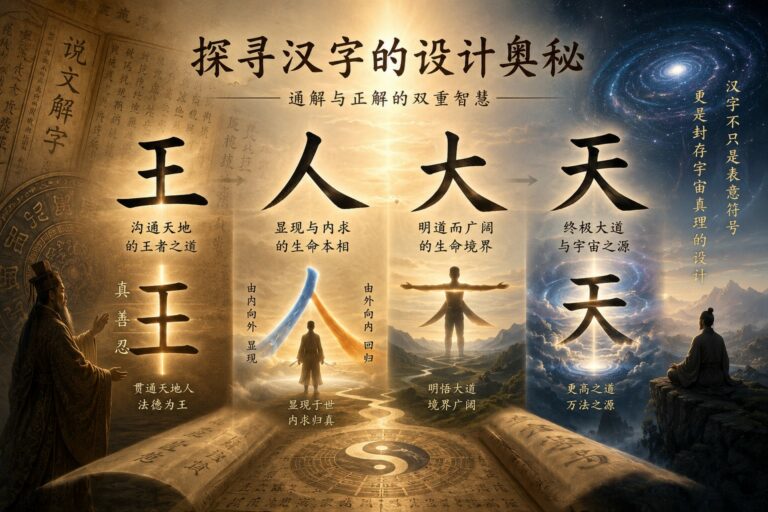
This article adopts this distinctive perspective and, following the two-layer format of the “common reading” and the “design reading,” analyzes in depth the single-unit characters 【王】, 【人】, 【大】 and 【天】. The “common reading” is based on traditional classics such as the Shuowen Jiezi and on ordinary understanding; the “design reading” uses the character-formation method of the New Six Scripts, combined with the deeper meanings of the strokes, to try to recover, from the dimensions of cultivation culture and the philosophy of life, the true meaning embedded in each character as a “designed symbol.” Through this comparison we hope to show readers the beauty of Chinese characters and their profound design wisdom.

【王】 (wáng, “king”): the kingly way that connects heaven and earth

The character 【王】 has simple strokes, yet contains profound principles of governance and of life.

Common reading: The original meaning of 【王】 is the Son of Heaven, the sovereign. In oracle-bone script, the form of 【王】 resembles a battle-axe, symbolizing power. By small seal script, the form had evolved into three horizontal strokes and one vertical stroke. Xu Shen’s Shuowen Jiezi quotes Dong Zhongshu: “Those who created writing in ancient times drew three strokes and connected them through the middle, and called it 王. The three are heaven, earth and humanity; and the one who links all three is the king.” This explanation emphasizes the king’s function of connecting heaven, earth and humanity.

Design reading: From the standpoint of character design, the three horizontal strokes of 【王】 do not simply stand for heaven, earth and humanity; they also symbolize the three most fundamental principles of the universe: 【Truthfulness, Compassion, Forbearance】 (Zhen-Shan-Ren). The top stroke represents 【Truthfulness】, the middle stroke 【Compassion】 and the bottom stroke 【Forbearance】. The vertical stroke running through them symbolizes the cultivator’s path of cultivation, by which, through cultivating Truthfulness, Compassion and Forbearance together, he links the Three Powers of heaven, earth and humanity. Therefore the true 【王】 is not a worldly holder of power, but a being of great wisdom who can awaken to and follow the great law of the universe, thereby connecting heaven, earth and humanity and seeing into the true meaning of life. He takes the law as his measure and wins people over by virtue; he is the true “king among men.”

【人】 (rén, “person”): the true face of life, manifesting outward and seeking inward

The character 【人】 is one of the basic single-unit characters; its form directly depicts the state of life in the world.

Common reading: In both oracle-bone and bronze script, 【人】 looks like a human figure standing in profile, with head, body and feet, highlighting the feature of upright walking. It later evolved into the form of a left-falling and a right-falling stroke meeting. The Shuowen Jiezi says: “Of all natures between heaven and earth, the most precious.” This emphasizes the honoured position of humanity among all things. Its meaning extends to human relationships, human society and so on.

Design reading: In the context of character design, the left-falling and right-falling strokes of 【人】 carry special meanings. The left-falling stroke symbolizes “from inside to outside, from hidden to manifest, manifestation,” representing life descending from higher-dimensional spaces into the human world and manifesting its existence in the material world. The right-falling stroke symbolizes “from outside to inside, concealment, return,” representing the longing and effort of life, after being tempered in the world, to return to its origin and true self. Therefore 【人】 does not merely depict an upright body; it profoundly reveals the dual state of life in the world: both manifestation and experience in the mortal world, and the search for and return to the inner true self. This dynamic balance between manifestation and inward seeking constitutes the complete meaning of life in the world.

【大】 (dà, “great”): the vast realm of a life that understands the Dao

The character 【大】 evolved from 【人】, adding one stroke to it and thereby sublimating its meaning.

Common reading: In both oracle-bone and bronze script, 【大】 looks like a person with arms and legs spread out, expressing the human body stretched wide. Its original meaning is that an object is large in volume, extended to wide in scope, deep in degree, older in age and so on. The Shuowen Jiezi says: “Heaven is great, earth is great, and humanity is also great. Hence 大 depicts the form of a person.” This emphasizes the greatness of humanity standing alongside heaven and earth.

Design reading: In the system of character design, 【大】 adds one horizontal stroke to 【人】. According to the meanings of the strokes, the horizontal stroke symbolizes the “Dao” or the “Law.” This means that when an individual life (【人】) can comprehend and follow the great Dao of the universe (the horizontal stroke), its inner realm can be expanded and sublimated, transcending the limits of the small self and becoming boundlessly vast, thereby achieving true “greatness.” This “greatness” refers not merely to physical size, but to the richness of life’s inner content, the breadth of one’s heart, and accord with the truth of the universe. Therefore 【大】 implies that only one who understands the Dao can have a truly great pattern and realm of life.

【天】 (tiān, “heaven”): the ultimate great Dao and the source of the universe

The character 【天】 goes a step further, adding a horizontal stroke above 【大】, pointing to a level of heavenly bodies, a universe, a world, and even to the ultimate truth and origin.

Common reading: In oracle-bone script, 【天】 looks like the top of a person’s head, or is written as a human figure with a horizontal stroke added on top, indicating what is above the human head, namely the sky. Its original meaning is the sky, the firmament, extended to the natural world, the seasons, the Lord on High and so on. The Shuowen Jiezi says: “The crown of the head. Supreme and unsurpassed. Composed of 一 and 大.” This emphasizes its supreme position.

Design reading: 【天】 adds another horizontal stroke above 【大】. As said above, 【大】 is the 【人】 who understands the Dao, while 【天】 represents that beyond the realm a person who understands the Dao can reach, there is a still more fundamental and greater “Dao.” This stroke symbolizes the deep, ineffable “Dao” or “Law” of the universe, which is 【天】. It refers not only to the firmament above our heads, but to a level of heavenly bodies, a universe, a world, and even to the origin of the ultimate universe, the principle by which all things are created, and the destination to which the cultivation of life must return. Therefore 【天】 reveals the ultimate mystery of the universe; it points finally to the source of all laws, to the highest embodiment of truth, and it is the fundamental basis of the existence of all life in the universe and the world. It reminds us that between the individual life and the vast universe there is a path of exploration from shallow to deep, from near to far, and 【天】 is the ultimate direction of this path.

Conclusion: the design of Chinese characters and reflections on life

Through this analysis of the four single-unit characters 【王】, 【人】, 【大】 and 【天】 by “common reading” and “design reading,” we gain a glimpse of the profound wisdom contained in the design of Chinese characters. These forms did not arise by chance but were carefully designed, using the simplest strokes to carry the ancients’ deep understanding of the universe, life, society and cultivation culture. From the manifestation and inward seeking of 【人】, to the vastness of 【大】 in understanding the Dao, to the ultimate great Dao of 【天】, and the linking of heaven and earth in 【王】, each character is like a miniature universe, embedding a complete philosophy of life and view of the cosmos.

This structural method of the “mutual generation of form and meaning,” together with the inner mechanism of the “character rotor,” makes Chinese characters more than mere ideographic symbols: they become a living cultural gene capable of reproducing itself and inspiring wisdom. They not only record history but, through their unique design language, transmit the Chinese nation’s search for truth and its insight into life. Exploring in depth the design mysteries of Chinese characters is a bridge reconnecting us with ancient wisdom, and an opportunity to re-examine our own relationship with the universe.

2025–2027: The Future of Chinese Culture and Language — An In-Depth Outlook on Trends

This English version was translated from the Chinese original with AI assistance. The Chinese text is authoritative.

Introduction: Tides Surging in the East — A New Chapter for Chinese Culture and Language, 2025–2027

From 2025 to 2027, as the global landscape continues to evolve, Chinese culture and language are entering a key period full of vitality and change. In this three-year cycle, China will continue to promote the creative transformation and innovative development of China’s fine traditional culture, while drawing on the power of cutting-edge technology to accelerate the intelligent processing and international spread of the language. This article analyses in depth the development trends of Chinese culture and language over the next three years from several angles — policy orientation, technological empowerment, global opportunities, educational innovation and the influence of young people — in an effort to sketch a clear and forward-looking blueprint for readers. We will see not only a brilliant fusion of tradition and modernity, but also witness the unique charm of Chinese civilization blossoming on the global stage.

Technological Empowerment: The Future of Language Learning and Cultural Dissemination

Technological progress is an indispensable driving force for the development of Chinese culture and language. Over the next three years, cutting-edge technologies such as artificial intelligence (AI), big data, virtual reality (VR) and augmented reality (AR) will be deeply integrated into every stage of Chinese learning and cultural dissemination. Personalized, immersive language-learning platforms will mature, greatly improving the efficiency and enjoyment of learning through AI recommendations and interactive virtual scenarios. AI translation and speech recognition technology will break down language barriers further, enabling smoother and more precise cross-cultural communication. In addition, digital humanities projects and the digital preservation and display of cultural heritage will allow more people to transcend the limits of time and space and experience the breadth and depth of Chinese civilization, providing users around the world with unprecedented interactive cultural experiences.

Opportunities and Challenges in a Global Perspective: A New Pattern of Mutual Learning Among Civilizations

Although geopolitical complexity may increase, the international community offers unique opportunities for the global spread of Chinese culture. Overseas Chinese communities will continue to serve as important cultural bridges, spreading Chinese culture in their countries of residence through community activities, educational transmission and the like. The challenge lies in how to deal effectively with cultural misreadings and stereotypes and achieve deeper cultural understanding and dialogue. Over the next three years, Chinese culture will become more diverse and inclusive, displaying its unique charm and wisdom in exchange and mutual learning with the world’s other civilizations. Balancing tradition and modernity, the local and the international, will be the key to the sustainable development of Chinese culture amid the tide of globalization.

Educational Innovation and Paths to Cultivating Versatile Talent

At home, the educational philosophy of 【大语文】 (“broad Chinese,” an integrated, culture-rich approach to language education) will deepen further, and the Chinese classics and traditional cultural elements will be integrated more deeply into primary and secondary textbooks and the system of well-rounded education, with the aim of cultivating a next generation with a deep cultural foundation. Internationally, as China’s international influence grows, global demand for learning Chinese continues to rise. Over the next three years, international Chinese education will focus on professionalizing the teaching force, modernizing textbook content and innovating teaching methods. Blended online and offline teaching will become the norm, providing learners around the world with more convenient and efficient ways to learn Chinese. At the same time, society’s demand for versatile talent who understand both Chinese and foreign cultures and can communicate across cultures will remain strong, driving the education system in a more open and diverse direction.

The Power of Youth: The Guochao Wave as an Inexhaustible Source of Cultural Innovation

China’s Generation Z is increasingly becoming the main force in consuming and creating Chinese culture. They embrace tradition with an open attitude and give it new meaning for the times. Over the next three years, the 【国潮】 (Guochao, “national trend”) phenomenon will keep heating up, and fashion, art and cultural-creative products that blend traditional elements with modern aesthetics will appear in an endless stream. Emerging forms of expression such as ACG (anime, comics and games) culture and new-media art will become important vehicles through which young people spread Chinese culture. Through short videos, live-streaming, social media and other platforms, the younger generation reinterprets and spreads Chinese culture in more creative ways closer to global popular trends. This youth-driven cultural innovation will let Chinese culture attract the attention of the world, especially young people, in a more fashionable, diverse and vibrant guise.

Conclusion: Carrying On the Past and Opening Up the Future, Painting a New Picture of Chinese Civilization Together

Looking ahead to 2025–2027, the development of Chinese culture and language will be the combined result of policy dividends, technological innovation, global interaction, educational reform and youthful vitality. We foresee Chinese culture going out into the world in a more open and inclusive manner, and the international influence of its language continuing to rise. In the interweaving of tradition and modernity, the local and the international, Chinese civilization will keep taking on new vitality and contributing its unique wisdom and strength. The next three years will undoubtedly be a richly coloured page in the history of the development of Chinese culture and language, one we can all look forward to and witness together.

A New Wave in Chinese Character Research: Breakthroughs and Frontiers of the 2020s

This English version was translated from the Chinese original with AI assistance. The Chinese text is authoritative.

From Oracle Bones to Algorithms: The Contemporary Transformation of an Ancient Field

Chinese characters are one of the few ancient writing systems still in continuous use today, with a history spanning more than three thousand years. Yet this seemingly traditional field of learning is undergoing a quiet revolution in the 2020s.

Over the past decade, research on Chinese characters has gradually broken through the boundaries of linguistics alone and become deeply integrated with archaeology, cognitive science, computer science and even the digital humanities. Researchers no longer simply sit in their studies leafing through rubbings; with large-scale corpora, machine learning models and international collaborative platforms, they are advancing the systematic understanding of Chinese characters at unprecedented speed.

Behind this shift are three clear threads. First, mature digital technology has made it possible to organize and analyze massive bodies of texts. Second, the continued expansion of international Chinese language education has created an urgent need to understand how Chinese characters are acquired. Third, a growing awareness of cultural heritage protection has given unprecedented importance to recording endangered character forms and local character usage. These three threads intertwine and together shape the new face of contemporary Chinese character research.

AI Meets the Oracle Bone Script: The Boundary Between Technological Aid and Humanistic Judgment

The study of ancient scripts has always been the most difficult and slowest-moving area of Chinese character studies. About 4,500 distinct oracle bone characters have been discovered so far, of which fewer than a third have readings accepted by the scholarly community; a great many forms remain unsolved. In the 2020s, the introduction of deep learning has brought new possibilities to this situation.

Several research teams have developed automatic oracle bone recognition systems based on convolutional neural networks that can perform preliminary matching and classification of character forms in images of rubbings within seconds. Some systems already exceed 85% accuracy in recognizing known forms, greatly improving the efficiency of organizing texts. At the same time, digital sharing platforms for ancient scripts jointly built by universities in China and abroad have systematized scattered materials of bronze inscriptions and bamboo and silk manuscripts, breaking the long-standing research bottleneck that “a single piece of evidence cannot establish a character.”

However, technological progress has not shaken the central place of expert judgment. AI is good at finding similarities among known samples but struggles with ambiguity in the evolution of character forms, regional differences and individual variation in carving habits. The role of senior paleographers is shifting from tedious preliminary comparison to higher-level contextual judgment and cultural interpretation. Technology is a magnifying glass, not a replacement: this is the prevailing consensus in the field today.

How Chinese Characters Are Learned: Cognitive Research and Teaching Innovation

For millions of international learners of Chinese, Chinese characters are often the hardest threshold to cross. Complex strokes, similar-looking forms, opaque relationships between form and sound… these features have made the mechanisms of character acquisition a hot topic in language cognition research.

Research in the 2020s has revealed several important patterns. First, cultivating component awareness significantly aids the memorization of characters. Take 清 (qīng, “clear”) as an example: if learners understand that the 氵 on the left relates to water and the 青 on the right hints at the pronunciation, they memorize far more efficiently than through purely mechanical copying. Second, training in visual associations between character form and meaning is especially effective for learners whose native languages use alphabetic scripts. Several eye-tracking experiments show that learners with component awareness have reading fixation patterns closer to those of native speakers.

At the level of teaching tools, evaluating the effectiveness of digital applications has also become a research focus. Studies have found that learning software combining instant feedback with spaced-repetition algorithms can significantly improve long-term retention of characters. But researchers also point out that the effects of technological tools vary considerably with learners’ backgrounds, motivation and frequency of use, and there is no “one-size-fits-all” digital solution. Personalized, contextualized instructional design remains the key to improving the quality of Chinese character teaching.

Guarding and Evolving Character Forms: Heritage Protection and New Internet Characters

The vitality of Chinese characters shows on the one hand in the guarding of historical forms, and on the other in their continued response to contemporary language life. In the 2020s these two forces have formed an intriguing tension.

At the level of heritage protection, the many variant and vernacular characters found in dialect documents, folk contracts and stone inscriptions in various regions are being recorded through systematic digitization projects. These forms often do not appear in standard dictionaries, yet they faithfully preserve the actual use of writing in particular places and times, and are living fossils of the diversity of Chinese characters. Scholars have come to realize that the richness of Chinese characters goes far beyond the standard character lists, and that the disappearance of local characters means the permanent loss of a form of cultural memory.

At the same time, internet culture is driving the evolution of Chinese characters in another way. The character-like use of emoticons, new coinages spawned by internet slang (such as giving “囧” a new modern meaning), and all kinds of creative homophonic characters form a lively cross-section of today’s Chinese character ecology. Linguists take a cautiously open attitude toward this: these phenomena reflect the powerful ideographic potential of Chinese characters and the creative energy of their users, but the boundary between standard writing and creative expression still needs to be continually clarified in education and social practice. The debate over simplified versus traditional characters also continues in this context, and most scholars tend to see it as an expression of cultural diversity rather than an either-or opposition.

Outlook: The Next Decade of Chinese Character Research

Looking back from the mid-2020s, the landscape of Chinese character research is richer and more open than ever. Deciphering ancient scripts, cognitive acquisition, heritage protection, international dissemination: every direction is growing new research questions at the intersection of technology and the humanities.

Over the next decade, several trends deserve continued attention. The unification of encoding standards and multilingual compatibility will become ever more pressing as the demand for sharing digital texts grows; the historical influence of Chinese characters in the East Asian cultural sphere and their contemporary reinterpretation will become an important topic in regional cultural studies; and pathways for non-native speakers to acquire Chinese characters will become clearer as large-scale empirical data accumulate.

Chinese characters are not exhibits in a museum but a symbolic system that is still breathing. They carry one of the longest writing traditions in human civilization and are given new meaning in the hands of each generation of users. To understand Chinese characters is both to understand the past and to understand how we use symbols to build a shared world.

Characters with the Same Side Component: Understanding the Logic and Memory Tricks of Phono-Semantic Characters

This English version was translated from the Chinese original with AI assistance. The Chinese text is authoritative.

What Is a Phono-Semantic Character? Cracking the Code of Character Formation Through One Character

There are many ways Chinese characters are constructed, but the most important and most numerous class is called phono-semantic characters. A phono-semantic character is made up of two parts: one part indicates the general area of meaning and is called the semantic component (also called the meaning component or side component); the other part hints at the pronunciation and is called the phonetic component. Together, they let people guess the rough meaning of a character and also help them remember its pronunciation; one could say this is a highly efficient writing system designed by the ancients.

Take 清 (qīng, “clear”) as an example: the 氵 on the left is the semantic component, indicating that the character relates to water or liquid; the 青 (qīng) on the right is the phonetic component. In ancient Chinese, the pronunciation of 青 was very close to that of 清, so it serves to mark the sound. By the same token, 情 (qíng, “feeling”), 请 (qǐng, “request”), 晴 (qíng, “sunny”) and 蜻 (qīng, as in “dragonfly”) all keep the phonetic 青 on the right, showing that in ancient times their pronunciations were all close to 青.

It should be noted that because Chinese has undergone thousands of years of phonological change, the sound-marking function of phonetic components in modern Chinese is greatly diminished. Characters sharing the same phonetic may be pronounced very differently today. So when learning phono-semantic characters, the semantic association indicated by the semantic component (side component) is often more stable and more useful than the phonetic. Mastering the meanings of side components is the first key to learning Chinese characters efficiently.

The Semantic Fields of Common Side Components: Why Characters with the Same Side Component Have Similar Meanings

The greatest value of semantic components is that they gather a batch of related characters into the same semantic field. Once you know the core meaning of a side component, you can make reasonable inferences about the meanings of a large number of characters.

The water radical (氵) is the most typical example. 河 (river), 湖 (lake), 海 (sea), 泪 (tears), 泡 (bubble), 流 (flow), 漂 (float) and 洗 (wash) all have 氵, and without exception relate to water, liquid or flowing. The same goes for the wood radical (木): 树 (tree), 林 (forest), 板 (board), 桌 (table), 椅 (chair), 根 (root) and 枝 (branch) all point to plants or wooden materials. Characters with the heart radical (忄 or 心) are concentrated in the realm of emotion and thought: 想 (think), 忧 (worry), 怒 (anger), 悦 (joy), 恨 (hate) and 忍 (endure) are each closely tied to inner activity.

Of course, the semantic component only indicates the direction of meaning and cannot precisely determine each character’s specific meaning. For example, among characters with 氵, 清 emphasizes purity, 泪 tears, and 漂 floating; the specific meaning still has to be understood in context. In addition, the side components of some characters have been simplified or have evolved so that their connection with the original meaning is no longer visible on the surface; in such cases knowledge of character origins is needed to help understand them.

Other common high-frequency side components include: the mouth radical (吃 eat, 唱 sing, 叫 call, 喝 drink), the hand radical (扌, as in 打 hit, 拉 pull, 推 push, 握 grasp), the fire radical (灬 or 火, as in 烧 burn, 热 hot, 煮 boil, 炒 stir-fry) and the earth radical (地 ground, 坡 slope, 坑 pit, 堆 pile). Remembering these side components and their representative characters is like having a semantic map of the world of Chinese characters.

Positions and Structures of Side Components: Left-Right, Top-Bottom and Enclosure, All Covered

Besides their semantic function, the positions of side components within characters also follow patterns. By structural position, Chinese characters can be roughly divided into the following types.

Left-right structure is the most common type: the semantic component is usually on the left and the phonetic on the right, as in 清, 情, 请, 材 (material) and 植 (plant). But there are exceptions, such as 攻 (attack) and 放 (release), where the phonetic is on the left and the semantic component (the 攴 radical) is on the right.

In top-bottom structures, the semantic component may be on top (as in 草, “grass,” with 艹 on top indicating plants) or at the bottom (as in 忘, “forget,” with 心 at the bottom indicating emotion).

Enclosure structures are more special: in 园 (garden), 围 (surround) and 国 (country), the outer frame 囗 is itself the semantic component, expressing the concept of enclosure or area.

There is also a class of easily confused side components that deserves special attention. For example, 辶 (the “walking” component, as in 道, 迷, 追) and 廴 (the “建” component, as in 建, 延, 廷) look similar but are two different side components with different meanings. Similar easily confused pairs include 土 and 士, and 己, 已 and 巳, which must be carefully distinguished when learning.

Understanding the positional patterns of side components not only helps you write characters correctly but also lets you quickly locate the semantic component in an unfamiliar character and infer its meaning, greatly improving the efficiency of reading and learning.

Practical Memory Techniques: A Four-Step Method for Never Forgetting Characters with the Same Side Component

Once you have mastered the theoretical basis of phono-semantic characters, how do you turn the knowledge into lasting memory? The following four methods have been tested and are markedly effective.

Step one: learning by side-component group. Don’t memorize single characters in isolation; learn characters with the same side component together. For example, learning ten characters with 氵 in one go is far more efficient than learning one in each of ten separate lessons. Group learning activates the brain’s recognition of shared features and forms a stable memory network.

Step two: the word-meaning association method. Find a core keyword for each side component, then use it to link the characters in the group. For example, with 水 (water) as the core, think of 河流 (river), 泪水 (tears), 泡泡 (bubbles) and 漂浮 (floating); each word calls up a concrete scene from life, so the memory naturally runs deeper.

Step three: the perspective of character origins and evolution. Knowing the original pictographic meaning of a side component lets you understand at root why a batch of characters belongs together. For example, the oracle bone form of the hand radical 手 (扌) is an open palm; from this you understand that 打, 拉, 推 and 握 are all actions of the hand, and your memory has logical support instead of relying on rote memorization.

Step four: the contrast-and-distinguish method. Specially collect easily confused pairs of side components, make comparison cards, and practice telling them apart repeatedly. For example, the four characters 戊戌戍戎 look alike; take apart the differences in their components one by one, and you can say goodbye for good to the trouble of miswriting them.

Using these four steps together, learning Chinese characters turns from mechanical repetition into a systematic project with patterns to follow, achieving twice the result with half the effort.

Passing On Chinese Character Culture in 2027: Where Is the Beauty of Chinese Headed in the Digital Age?

This English version was translated from the Chinese original with AI assistance. The Chinese text is authoritative.

When the Keyboard Replaces the Brush: The Writing Anxiety of an Era

You pick up a pen and cannot remember how to write the 尬 in 【尴尬】 (gāngà, “awkward”) — this scene is familiar to many. With the spread of smart input methods, speech recognition and AI text-generation tools, an unprecedented rift is opening between the “use” and the “writing” of Chinese characters.

This rift is not unique to China, but the special nature of Chinese characters makes them especially sensitive to it. Chinese characters are an ideographic script, and every character form carries historical sediment and cultural codes. In the character 【清】 (qīng, “clear”), the 【氵】 (water component) on the left hints at a connection with water, and the 【青】 (qīng, “blue-green”) on the right conveys colour and purity; together they form a semantic unit with a complete image. Once this inner logic is replaced by pure pinyin input, the connection between writing and culture quietly loosens.

However, simply branding digitization as the “gravedigger” of Chinese character culture is both inaccurate and too pessimistic. The question really worth asking is this: around 2027, as AI tools mature further and digital natives fully become the mainstay of society, what new face will the transmission of Chinese character culture take on? How exactly will challenges and opportunities coexist?

Understanding this question requires us to step out of the linear logic of “decline in writing = decline in culture” and instead examine the many paths of transmission the digital age has opened up for Chinese character culture.

Technological Empowerment: AI and Digital Tools Reshape Character Learning

Criticism that digital technology causes people to “pick up the pen and forget the character” is heard constantly, but the same technologies are giving back to character education in another way.

On the learning side, AI-driven character recognition and stroke demonstration apps can already correct writing errors in real time and, through animated stroke-order demonstrations, let learners grasp intuitively the structural logic of Chinese characters. Some platforms, combined with etymological databases, automatically show the evolution of the oracle-bone form when a user writes the character 【木】 (mù, “tree”), turning an ordinary act of writing practice into a miniature journey back to cultural origins.

On the creative side, digital calligraphy and virtual seal carving are becoming new art forms. Using pressure-sensitive tablets and vector tools, designers turn the brush momentum and ink tone of traditional calligraphy into editable digital assets, applied to brand visuals, game interfaces and film subtitles. Such practice is not a dilution of tradition but an extended expression of the aesthetics of Chinese characters in new media.

Looking ahead to 2027, as AR glasses and spatial computing devices become widespread, immersive learning scenarios of “writing Chinese characters in the air” will no longer be mere concept demos. By then, the way characters are acquired will evolve from “pen-and-paper memory” to “multisensory interaction,” and the tension between technology and cultural transmission may be resolved more creatively.

Educational Innovation: An Ecology of Transmission from Classroom to Community

Schools are the most systematic setting for transmitting Chinese character culture, but also where the pressure of reform is most concentrated. At present, the digital transformation of Chinese-language classrooms faces a dilemma: on the one hand, electronic whiteboards and online homework platforms have improved teaching efficiency; on the other, the compression of pen-calligraphy class hours and fewer chances for students to write by hand are common problems in primary and secondary schools in many places.

The key to breaking the deadlock may lie not in “restoring tradition” but in redefining the value of “writing.” Bringing character writing into aesthetic education rather than mere skills training, and emphasizing its intrinsic connection with cultivating concentration and building cultural identity, may be more persuasive than simply adding class hours.

At the same time, the value of informal learning settings is being rediscovered. Intergenerational interaction as grandparents and grandchildren copy model calligraphy together at home, offline gatherings of community calligraphy clubs, and “weekend seal-carving workshops” run by city cultural centres form a network of transmission outside school education that cannot be ignored. What these settings have in common is that character writing is deeply bound up with emotional connection and identity, and their effectiveness in transmitting culture often exceeds that of pure skills training.

Toward 2027, the triangular transmission ecology of “school + community + digital platform” may achieve closer coordination, turning character education from an isolated curricular task into a cultural practice that runs through daily life.

Cultural Industrialization: Chinese Character IP Breaks Through to the Young

The vitality of Chinese character culture must ultimately be tested by the active identification of the younger generation. Encouragingly, the market has already given positive signals.

In recent years, cultural and creative products, mobile games and short-video content with Chinese characters as their core element have shown clear growth. A puzzle game whose core gameplay is taking characters apart once sparked wide discussion among young users: as players cracked the puzzle of 【明】 (míng, “bright”) being composed of 【日】 (sun) and 【月】 (moon), they naturally went through an immersive experience of Chinese character culture. The brilliance of such designs is that they do not ask users to “study” characters, but make the inner logic of the characters the fun of the game itself.

On short-video platforms, content such as popular explanations of character origins, slow live-streams of calligraphy and character-design challenges continues to generate high engagement, confirming that young audiences are not indifferent to Chinese character culture but need presentation that better fits their media habits.

The rejuvenation of traditional cultural IP is equally noteworthy. Working seal-script forms into streetwear designs and creating emoji inspired by oracle-bone script may look like “dumbing down,” but in fact they widen the points of contact with Chinese character culture. When a young person, because he likes a hoodie printed with a bronze-inscription pattern, begins to look into inscriptions on bronze vessels of his own accord, the chain of transmission has quietly been rejoined.

Toward 2027: Seeking a New Balance Between Convenience and Standards

In predicting the landscape of Chinese character culture in 2027, several trends deserve particular attention.

First, the “contexts of use” of Chinese characters will become further differentiated. High-frequency daily communication will rely more on voice and smart input, while the cultural status of “ceremonial writing” such as calligraphy, inscriptions and handwritten letters may actually rise because of its scarcity — much like the logic of the vinyl record’s revival in the streaming era.

Second, international dissemination will create a reverse incentive for transmission at home. As Chinese learning continues to grow in popularity around the world, overseas users’ appreciation and exploration of the beauty of Chinese characters are giving young people in China an outside perspective from which to re-examine their own nation’s script. “The gaze of the other” can sometimes awaken cultural self-awareness in those who take things for granted.

Third, the tension between “standardization” and “creativity” will persist, but need not be an either-or choice. Allowing digital art to deform character shapes creatively, while holding firm to the baseline of stroke norms at the stage of basic education, is not contradictory.

For every individual who cares about Chinese character culture, the most effective transmission may not be a grand narrative but daily practice: now and then put down your phone and write a letter with a fountain pen; open a calligraphy copybook in front of your child; consciously bring Chinese character elements into your design work. The future of Chinese characters lies hidden in countless such everyday choices.

Chinese Language and Characters in 2027: Trends and Cultural Outlook

This English version was translated from the Chinese original with AI assistance. The Chinese text is authoritative.

On the Threshold of Linguistic Change

Language is never still. Chinese, the language with the most speakers in the world, is undergoing a quiet but far-reaching transformation. This transformation is not the result of any single policy decision, but the product of three forces acting together: accelerating technology, generational turnover and deepening globalization.

In 2027, it will be nearly seventy years since the Scheme for the Chinese Phonetic Alphabet (pinyin) was promulgated, and half a century since the last large-scale reform simplifying Chinese characters. Looking back from this point in time, we find that Chinese has never before faced such diverse pressures and opportunities. Input methods have replaced the brush and the fountain pen, algorithms are beginning to “understand” Classical Chinese, young people convey classical moods through memes, while dialects are being lost ever faster in the tide of urbanization. All of this together makes up the complex picture of the Chinese language and characters in 2027.

Digital Technology: From Optimizing Tools to Transmitting Culture

Over the past decade, Chinese language information processing technology has grown explosively. The accuracy of speech recognition is approaching human level; natural language processing models can generate fluent Classical Chinese and vernacular Chinese; smart input methods not only predict words but also recognize context and suggest idioms. Maturity at the technical level marks the completion of one stage and also the beginning of the next.

Around 2027, the central question of Chinese digitization will shift from “how to process Chinese more efficiently” to “how to use technology to transmit the cultural content of Chinese.” This shift is already beginning to show: the intelligent ancient-book retrieval system launched by the Palace Museum, dialect digital archive projects across the country, AI Chinese teachers for overseas learners… What these applications have in common is that technology is no longer just a tool of efficiency but is beginning to take on the role of cultural intermediary.

However, the involvement of technology also brings new worries. As AI-generated Chinese text becomes harder and harder to distinguish from human writing, and as input methods’ predictive features quietly shape people’s word choices, the boundary between the natural evolution of language and the systematic influence of algorithms will become an issue that linguists and policymakers must take seriously.

Generational Divide: The Tension Between Internet Slang and Standard Chinese

The way Generation Z and Generation Alpha use Chinese differs markedly from their parents. This shows not only at the level of vocabulary — internet words such as “yyds” (“eternal god,” the greatest of all time), “绝绝子” (“absolutely amazing”) and “破防” (“defences broken,” emotionally overwhelmed) emerge at astonishing speed — but even more in deep changes in linguistic logic and habits of expression. Bullet-comment (danmaku) culture has given rise to highly compressed, context-dependent forms of expression; memes fuse Chinese characters with images, creating a new symbolic system; and mixed-language phenomena (Chinese mixed with English, dialects interwoven with Putonghua) are increasingly common among young urban groups.

Does this innovation threaten the “purity” of Chinese? The question itself may need re-examining. The history of language tells us that the “vulgar speech” of every age may become the “elegant speech” (雅言) of the next. The vernacular poems of the Tang, the ci tune patterns of the Song and the chaptered novels of the Ming and Qing were all once regarded as departures from orthodoxy, yet ultimately became important legacies of Chinese culture.

What really deserves attention is the time lag between grassroots linguistic innovation and official norms. Around 2027 this tension is not expected to dissolve, but new balancing mechanisms may emerge: educational institutions may more actively bring internet language into the scope of linguistic research instead of simply rejecting it; and language standardization bodies may explore more flexible, dynamic updating mechanisms to shorten the cycle from “popular use” to “official recognition.”

Writing Chinese Characters: Revaluation Amid Decline

The decline of handwritten Chinese characters is an indisputable fact. The spread of keyboard and voice input has left many people in the predicament of “picking up the pen and forgetting the character.” Research shows that users who rely on input methods for long periods remember the forms of characters markedly less accurately. Behind this phenomenon lies a fundamental shift in how Chinese characters are cognized: from “active writing” to “passive recognition.”

Yet, contrary to pessimistic expectations, the aesthetic and educational value of writing Chinese characters is being rediscovered. Calligraphy classes have returned to primary and secondary school curricula, adult calligraphy classes keep growing in popularity in major cities, and the “Guochao” (national trend) design craze has brought the aesthetics of Chinese characters into the commercial realm. This reveals an interesting paradox: once writing is no longer a daily necessity, it gains a purer cultural significance.

In 2027, the picture of character writing is likely to be this: functional handwriting continues to shrink, while ceremonial and artistic writing gains greater social recognition. Calligraphy will no longer be an everyday skill for the masses, but will become a mark of cultural refinement and a vehicle of transmission. The key challenge for education policy is how, within limited class hours, both to secure basic character-writing ability and to cultivate a feeling for and love of the aesthetics of Chinese characters.

Dialects: Digital Vitality Under the Impact of Urbanization

The promotion of Putonghua and accelerating urbanization have been the two great drivers of the decline of dialects over the past several decades. The younger generation has grown up in a Putonghua environment, and many are now deeply estranged from their grandparents’ dialects. From Southern Min to Cantonese, from Wu to Hakka, the active speakers of every dialect are ageing visibly.

But the dialect picture of 2027 need not be painted only in the colour of decay. Digital technology offers unprecedented possibilities for dialect preservation: the building of dialect corpora, the development of dialect speech recognition models, and the emergence of dialect podcasts and short videos are creating new living space for endangered dialects. More importantly, some young people are beginning to see dialects as symbols of identity and cultural belonging, and are actively learning and using their grandparents’ language.

This bottom-up revival of dialects echoes the protective measures at the policy level, and may form a more systematic ecology of dialect transmission around 2027. Of course, the process still faces great challenges: whether digital records can be turned into living transmission, and how dialect education can gain institutional support without hindering the promotion of Putonghua, remain unresolved questions.

International Chinese: Opportunities and Challenges Side by Side

The number of Chinese learners worldwide has grown steadily over the past two decades, and Chinese has become an important foreign language option in the education systems of many countries. But growth in numbers is not the same as improvement in quality. Chinese teaching has long faced two core challenges: first, high difficulty — the system of Chinese characters is a significant obstacle for learners whose native languages use alphabetic scripts; second, insufficient transmission of cultural content — many learners acquire everyday communicative ability but know little of the cultural logic behind Chinese.

In 2027, changes in international Chinese teaching will appear mainly in two dimensions. One is technological empowerment: AI teachers, immersive language-learning apps and virtual cultural experiences will greatly lower the threshold for learning Chinese and provide richer channels of cultural contact. The other is a shift in philosophy: from emphasizing standardized linguistic norms to flexible teaching that respects local needs, allowing Chinese learners in different regions to develop ways of using Chinese suited to their local context on the basis of standard Putonghua.

The deeper significance of this shift is that the international spread of Chinese will no longer be just a one-way export of language, but a process of multicultural dialogue.

Outlook: Pluralistic Coexistence, Not Either-Or

Predicting the future of a language is always full of uncertainty. But one thing can be said with relative confidence: the Chinese language and characters of 2027 will not move toward uniformity, but will present a pattern of pluralistic coexistence.

Standard Chinese and internet language will exist side by side, each with its own contexts of use; handwriting and digital input will each carry different cultural functions; the dominant position of Putonghua will not waver, but the digital transmission of dialects will receive more attention; and international Chinese teaching will seek a new balance between standardization and localization.

This pluralistic coexistence is not a compromise but an expression of the vitality of language. Chinese has continued for thousands of years, through countless shocks and fusions, always keeping its core cultural genes while constantly absorbing new possibilities of expression. Facing the many challenges of 2027, what we may need most is confidence in the resilience of Chinese itself, and an attitude toward change that is both open and prudent. The future of a language is, in the end, written together by those who use it.

Behind the Global Chinese Boom: The State, Struggles and Future of Chinese Education Abroad

This English version was translated from the Chinese original with AI assistance. The Chinese text is authoritative.

A global wave that cannot be ignored

Over the past twenty years, learning Chinese has been quietly gaining momentum around the world. It is estimated that more than two hundred million people worldwide are currently learning Chinese in one form or another, in over 180 countries and regions. Behind this figure are tens of millions of overseas children of Chinese descent working to keep up the language ties of their grandparents, as well as more and more non-Chinese learners who see Chinese as a key to opening career doors.

The forces driving this wave are many. The continued growth of China’s economy has greatly raised the practical value of Chinese in business, diplomacy and academia. At the same time, the growth of Chinese immigrant communities around the world has generated an internal demand for Chinese education everywhere. Yet the growth in demand has not been matched by a corresponding increase in resources — Chinese education abroad faces a deep contradiction between demand and supply.

Regional divides: an uneven educational map

Chinese education abroad is not a monolith; there are marked gaps between regions. In areas with large Chinese communities such as North America, Australia and Southeast Asia, Chinese education systems are relatively complete. The United States has thousands of weekend Chinese schools; some Australian states have included Chinese in the language curriculum of regular schools; and Singapore has made Chinese one of its official languages, guaranteeing investment in educational resources at the institutional level.

By contrast, Chinese educational resources in continental Europe and Africa are relatively scarce. Although Confucius Institutes have branches in many cities around the world and have filled the gap to some extent, their coverage and teaching depth still fall short of actual local needs. Governments vary widely in their support for including Chinese in the regular curriculum, which directly affects the accessibility and sustainability of Chinese education. Differences in the policy environment largely determine how far Chinese education can go in a given region.

The teacher bottleneck: the core problem holding back development

If regional differences are the external challenge to Chinese education abroad, the shortage of teachers is the internal bottleneck holding back its development. A severe lack of qualified Chinese teachers is a common predicament faced by almost every region.

The causes of this problem are structural. Teaching Chinese places high demands on teachers: they need a solid command of the language, professional methods of second-language acquisition, and the ability to communicate across cultures. Yet the number of professionals willing to go abroad and teach Chinese long-term is limited. Many Chinese schools have to rely on non-professionals or even volunteers to fill vacancies, so teaching quality is hard to guarantee.

Alongside the teacher shortage comes the absence of teaching standards. Different places use different editions of textbooks, curricula vary widely, and assessment systems lack unified standards. What a child learns at a Chinese school in Los Angeles may be very different from what peers of the same age learn in Sydney or London. This fragmentation not only affects teaching quality but also makes it difficult for students to continue their studies across regions.

Two kinds of learners, two kinds of needs

Learners of Chinese abroad are not a homogeneous group. They can be broadly divided into two kinds: students of Chinese descent and students not of Chinese descent. These two kinds of students differ fundamentally in their motivation, language background and psychological needs, yet they are often placed in the same teaching system.

For students of Chinese descent, learning Chinese is more an act of maintaining a heritage language. They may have some exposure to the language at home, but systematic reading and writing ability must be developed through formal education. The biggest challenge these students face is often not the language itself but cultural identity — how to sustain enthusiasm for their mother tongue under the strong influence of the mainstream culture. Research shows that the degree of family support for learning Chinese, and the students’ own sense of cultural identity, are the key variables in whether they persist.

Students not of Chinese descent usually regard Chinese as a foreign language, and their motivation comes more from career plans or personal interest. They must build up pronunciation, vocabulary and grammar from scratch, facing a steeper language barrier. How to design differentiated teaching plans for these two kinds of students is an urgent issue for Chinese education abroad.

Empowerment through technology and teaching innovation

Despite the many challenges, Chinese education abroad is not without breakthroughs. In recent years, the rise of online education platforms has made it possible to break through geographical limits. During the pandemic, large numbers of Chinese schools were forced to switch to online teaching, and this involuntary move in fact accelerated the spread of digital teaching models. Today, a child deep in the interior of Africa can likewise receive Chinese tutoring online from a professional teacher.

At the same time, explorations combining immersive teaching methods with localized curricula are quietly advancing in many places. Some schools have begun trying to combine Chinese teaching with the local cultural context rather than simply copying textbooks and methods from China. A shift from a purely exam-oriented approach to one that gives equal weight to cultural heritage and practical use — this change in philosophy is influencing more and more Chinese educators.

However, the spread of technology has also exposed new inequalities. Because of the digital divide, students in areas with poor internet access find it hard to enjoy online educational resources equally. Technology is a tool, not a panacea; how to make the benefits of technology reach a wider range of learners remains an unresolved question.

Looking ahead: opportunity and responsibility together

The future of Chinese education abroad depends on the coordinated efforts of many parties. At the government level, more countries including Chinese in the regular curriculum and providing institutional support will be the fundamental guarantee for scaling up Chinese education. At the level of educational institutions, establishing unified teaching standards, strengthening teacher training and developing localized textbooks suited to learners abroad are the most urgent tasks for raising teaching quality.

For Chinese communities, Chinese education is not only an educational issue but also a cultural one. Language is the vehicle of cultural heritage; helping the next generation keep their ability in Chinese means keeping open for them a window onto their own cultural roots.

The wave of the global Chinese boom has already arrived. Turning this enthusiasm into solid educational results requires not only investment of resources but also renewed thinking and a rebuilt system. The story of Chinese education abroad has only just turned a new page.

Three Secrets Hidden in Chinese Surnames

This English version was translated from the Chinese original with AI assistance. The Chinese text is authoritative.

Chinese surnames are a standard for distinguishing blood and family relationships in China. Yet ordinary-looking surnames such as Li, Wang, Sun and Zhao hide three great secrets: the same surname means the same “genetic code”; the same surname does not necessarily mean the same family; and they are the richest in meaning. Let’s get to know them today.

Secret 1: The same surname, the same “genetic code”

In China surnames have long followed the male line, and from the standpoint of genetics only males have the Y chromosome. So the Y chromosome is passed down to male descendants together with the surname; as a result, people with the same surname also have the same type of Y chromosome, together with the genes it carries.

In surveys we have found that many hereditary diseases spread only among people with the same surname; compiling statistics on the number and distribution of surnames is therefore a great help in the study of human genetics. In fact, surnames are a bridge connecting cultural inheritance and biological inheritance.

Secret 2: The same surname does not necessarily mean the same family

When Chinese people meet, they always ask each other’s names; if they find they share a surname, they feel especially close and think the two of them “were one family five hundred years ago.” In fact this saying cannot be trusted.

Surveys have found that a large surname may have up to a hundred or more origins. For example, Li, the most common surname in China: some Li come from the surname Ying, some from the surname Zhao; in the Tang dynasty Li Shimin bestowed the surname Li on founding ministers; and even in the Later Wei period some Xianbei compound surnames were changed to Li.

Nevertheless, surnames have become the glue of the Chinese nation’s cohesion. Many overseas Chinese pay to repair their family genealogies in search of their roots, and in the course of compiling them, through contacts with the mainland, they also give a great boost to the local economy.

Secret 3: Chinese surnames are the richest in meaning

Whether in the East or the West, surnames are an important symbol of cultural heritage. But no country in the world can match China in the completeness and depth of meaning of its surname heritage. For example, although Japan also has surnames, they carry very little cultural meaning. Before the Meiji Restoration Japan had only a few surnames. The Meiji Emperor, for the sake of reform, required everyone in the country to have a surname. As a result, more than eighty thousand surnames appeared within a few short years, with no origin or meaning, most of them named after places, such as Matsushita, Inoue and Tanaka. Therefore Japanese scholars find it very hard to link Japanese surnames with human genetics.

In the United States, although there are fixed surnames, a mere two hundred-odd years of history is not enough to form a cultural heritage. Therefore American scholars, in researching their own people, rely mainly on skin color, hair color and eye color.

As for Britain, its surnames are relatively stable. They come mainly from directly borrowing baptismal names, or adding affixes indicating descent to baptismal names to mean “son or descendant of so-and-so”; some add affixes indicating status before the baptismal name; others reflect place names, landforms or features of the environment, or status or occupation. As for the surnames formed later by combining two surnames, although they appeared even later than baptismal names, they are far more numerous. As for the royal family, in former times it used “Edward” as its surname, and later the relatively new “Windsor” appeared.

On the European continent, surnames are usually a mark distinguishing place of birth. During the Second World War, European armies once grouped soldiers with the same surname together to increase their units’ cohesion and fighting power.

From this it can be seen that only Chinese surnames show both genetic inheritance and the transmission of surnames, highlighting all the more China’s unique culture.