

This English version was translated from the Chinese original with AI assistance. The Chinese text is authoritative.
The Qing-dynasty woman poet Zhang Fen wrote a lyric to the tune Yu Meiren, titled “Sent to My Sister Chen Suchuang.” Read forward it is a ci lyric; read backward it is a seven-character regulated poem.
Read forward, the lyric says: “Autumn sounds — a few flights of wild geese in a row; my dream breaks, and my heart breaks with it. I would put my sorrow and grief into song and verse; layer on layer of bamboo and parasol trees shift their shadows, the moon lingers. From the high tower I lean and gaze on a long parting; leaves fall, cold shade gathers. The chill wind has left a lamp not yet burnt out; in the quiet night the secluded courtyard is half closed, half the window bright.” (秋声几阵连飞雁,梦断随肠断。欲将愁怨赋歌诗,叠叠竹梧移影、月迟迟。楼高倚望长离别,叶落寒阴结。冷风留得未残灯,静夜幽庭小掩、半窗明。)
Read backward, the poem says:
“The bright window half closed, the small courtyard secluded; the night is still, the lamp burns low and cannot be kept. (明窗半掩小庭幽,夜静灯残未得留。)
The wind is cold, shade gathers, chill leaves fall; parted long, I gaze, leaning on the high tower. (风冷结阴寒落叶,别离长望倚高楼。)
Slowly the moon’s shadow moves across parasol trees and bamboo; layer on layer, poems and songs set down grief and sorrow. (迟迟月影移梧竹,叠叠诗歌赋怨愁。)
About to break my heart, following a broken dream; geese fly in rows — a few cries of autumn.” (将欲断肠随断梦,雁飞连阵几声秋。)
The breadth and depth of the Chinese language has always been a source of pride for all Chinese people. So why exactly is Chinese so broad and deep? Where does one feel its breadth and depth? This is a topic Chinese circles never tire of. I do not wish to discuss whether Chinese is the world’s foremost language; such a debate may never reach a conclusion. Let us simply talk about where the beauty of the Chinese language itself comes from.
Opening the pages of Chinese history, we can feel the ancients’ attitude toward writing and their reverence for literature.
The Huainanzi, “The Basic Warp,” says: “When Cangjie of old created writing, heaven rained millet and ghosts wept at night.” Whatever the facts of Cangjie’s creation of characters, from the very beginning writing held a sacred and revered position. And to leave one’s name in the annals of history was the lifelong goal of every emperor, general and minister.
The subtlety of Chinese lies in its endless variation
In martial-arts novels, the most formidable skill is often the kind that, having grasped a single method, can vary without end — such as the Taiji fist and Taiji sword in Jin Yong’s novels. Zhang Sanfeng required Zhang Wuji to forget all the moves before he could understand the method of Taiji.
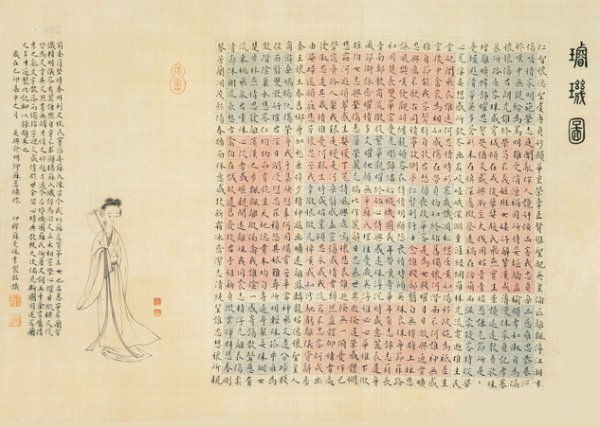
No set moves, no need to imitate — Chinese is just such a language of endless variation. Hence palindromic poems that read both ways, like the one at the start of this article: read forward, it means one thing; read backward, it has quite another flavor. The pinnacle of palindromic poetry is none other than Su Hui’s Xuanji Tu (“Armillary Sphere Chart”).
The Xuanji Tu, apart from the character 心 (xīn, “heart”) in the very center, which was added by later people, originally had 840 characters, 29 across and 29 down. The square can be read vertically, horizontally, diagonally, crosswise, forward or backward, or skipping a character or repeating a character, and still form poems, with three, four, five, six or seven characters to a line; by present count about 7,958 poems can be formed. For example, this one: “Grieved and pained, I long and yearn, my heart’s sorrow deepens; the hall is empty, I only think and chant harmonious tunes. Hidden and crushed, sad sounds issue in songs of Qin; the shang string stirs the Chu airs flowing from the clear zither.” (伤惨怀慕增忧心,堂空惟思咏和音。藏摧悲声发曲秦,商弦激楚流清琴。) When Su Hui wove the Xuanji Tu she was only twenty-three; for the height of her talent and the ingenuity of her mind, it can be called the unsurpassed song of the ages.
Modern joke-writers also often make fun of this “not playing by the rules.” For example, 东吴大胜魏国 (“Wu won a great victory over Wei”) and 东吴大败魏国 (“Wu greatly defeated Wei”) mean the same thing. And 我差点没死 (“I almost didn’t die”) means the same as 我差点死了 (“I almost died”).
The subtlety of Chinese lies in its emphasis on meaning
Qian Zhongshu writes in “On Chinese Poetry”: “One Chinese poet said: ‘The words come to an end, but the meaning is inexhaustible.’ Another poet said: ‘Depict a scene hard to describe as if it were before your eyes; contain an inexhaustible meaning that appears beyond the words.’ It uses the most precise and definite form to draw out a realm that cannot be named and is hard to grasp.”
This is just like the feeling an ink-wash painting gives. Ma Zhiyuan’s “Autumn Thoughts” to the tune Tian Jing Sha says: “Withered vines, old trees, crows at dusk; a small bridge, flowing water, a few homes.” A few strokes, yet they give one the feeling of looking at a painting. Wang Bo’s “Preface to the Pavilion of Prince Teng” says: “The sunset clouds fly together with a lone wild duck; the autumn waters share one color with the endless sky.” And Wang Wei’s line “In the vast desert a lone column of smoke rises straight; over the long river the setting sun is round” — every one of them makes us marvel at the realm where poetry and painting are one. That is why Su Dongpo said: “Savor Mojie’s poems, and there are paintings in them; look at Mojie’s paintings, and there are poems in them.” Capturing the spirit (xieyi) is the realm literati vied to attain.
When Westerners learn Chinese, what they complain about most is measure words. Chinese has a great many measure words: 一匹马 (a horse), 一头猪 (a pig), 一棵树 (a tree), 一朵花 (a flower), 一个人 (a person), 一支笔 (a pen), and so on and so forth. Yet without such measure words, one could not sketch the pictures of different things.
Of course, it is not only through simple description that a mood can be expressed. Here is another good example.
How do you describe time? “Do you not see, in the bright mirror of the high hall, the sorrow of white hair — black silk in the morning, turned to snow by evening!” Li Bai, the Immortal of Poetry, uses a head of black hair turning into a heap of white snow between morning and evening to lament the wasted years and the brevity of life. And Confucius sighs over time: “It passes on like this, never ceasing day or night!” Time truly slips away like flowing water!
The subtlety of Chinese also lies in concision
Who first said it, no one knows — “the concentrate is the essence” — and there is some truth to it. Classical Chinese mostly expresses precise meanings in concise words. So the poems and lyrics the ancients wrote all carry the charm that concision brings.
Du Mu’s “Qingming” reads: “At Qingming time the rain falls thick and fast; travelers on the road are near heartbreak. May I ask where a tavern can be found? The cowherd boy points far off to Apricot Blossom Village.” If changed to a five-character poem, it becomes: “Qingming, rain thick and fast; travelers near heartbreak. Where can a tavern be found? Pointing far to Apricot Blossom Village.”
Modern people are also tireless about concision, and play with translations from other languages.
A Book of Songs–style translation of “Scarborough Fair” once circulated online. Here are some excerpts:
Are you going to Scarborough Fair?
I ask where you are going — is it as you go?
Parsley sage rosemary and thyme.
Orchid and coriander, lush and fragrant angelica.
Remember me to one who lives there.
To the fair lady there, I ask you to send my words.
She once was a true love of mine.
She once was there, and knew me well.
Tell her to make me a cambric shirt.
Ask that fine lady to prepare my black garment.
Parsley sage rosemary and thyme.
Orchid and coriander, lush and fragrant angelica.
The ancients also invented homophonic texts (one-syllable texts), the most famous of which is none other than “The Story of Mr. Shi Eating Lions.” The full text is as follows:
石室诗士施氏,嗜狮,誓食十狮。施氏时时适市视狮。十时,适十狮适市。是时,适施氏适市。氏视是十狮,恃矢势,使是十狮逝世。氏拾是十狮尸,适石室。石室湿,氏使侍拭石室。石室拭,氏始试食是十狮。食时,始识是十狮,实十石狮尸。试释是事。 (In a stone den lived a poet, Mr. Shi, who loved lions and vowed to eat ten lions. Mr. Shi often went to the market to look for lions. At ten o’clock, ten lions happened to come to the market. At that time, Mr. Shi happened to come to the market. He looked at these ten lions and, relying on his arrows, caused these ten lions to die. He picked up the ten lion corpses and went to the stone den. The stone den was damp; he had his servant wipe the stone den. The stone den wiped, he began to try to eat these ten lions. When he ate, he first realized that these ten lions were in fact ten stone lion corpses. Try to explain this matter.)
If you want to concentrate it further, concentrate it into a single character. For example, 尖 (jiān, “pointed”): small 小 above and big 大 below makes “pointed.” Sun 日 and moon 月 bring light — 明 (míng, “bright”).
The subtlety of Chinese also lies in meaning beyond the words and the beauty of the unspoken
As for what meaning beyond the words is, I believe every speaker of Chinese understands its deeper sense in their heart. The Chinese people have been deeply influenced by the Confucian thought of the Doctrine of the Mean and are naturally accustomed to a reserved manner of expression. The meaning hidden beyond the words often reflects the habits and character of a people.
Keats’s famous line: “Heard melodies are sweet, but those unheard are sweeter.” A Chinese poet said, “At this moment silence speaks louder than sound”; and also, “Understanding the wonder of the stringless zither’s fingers.” Sometimes they also say: “In this there is a true meaning; I wish to explain it but have already forgotten the words,” and “Calmly leaving speech behind, the joy of awakening suffices the heart.”
A few years ago, the thing the National Palace Museum in Taipei made a huge stir over was none other than the Kangxi Emperor’s “朕知道了” (“We are aware”). “知道了” (“aware”) was the phrase emperors commonly used when reviewing their ministers’ memorials, meaning that “We” are aware of the matter reported. Since ancient times the reports ministers presented to the emperor had many names — zhang, zou, biao, yi, shu, qi, shu, ji, zhuang, zha, jie, fengshi and so on; the name zouzhe (palace memorial) began in the Kangxi reign of the Qing. Four simple characters — surely everyone knows the subtle meaning they contain. In modern business management, subordinates are always reporting matters to superiors; how should one reply? Superiors probably find it a headache at times — yet the Kangxi Emperor’s few characters gave the best answer long ago.
The Battle of Red Cliffs in the Three Kingdoms period is a famous battle in history. Before the Battle of Red Cliffs began, Cao Cao wrote a letter to Sun Quan of Eastern Wu. Thirty characters in all, the letter read:
“Recently, bearing the imperial command to punish the guilty, my banners pointed south, and Liu Cong surrendered with hands bound. Now I command a navy of eight hundred thousand, and wish to join the general in a hunt in Wu.”
Though only thirty characters, Cao Cao conveyed three layers of meaning. The first layer says “I am punishing the guilty on the emperor’s orders” — the implication being that Cao Cao is politically in the right. The second layer tells Sun Quan directly that he has a navy of 800,000, while Eastern Wu’s navy at the time numbered only a few tens of thousands — meaning that he had absolute military superiority. The third layer mentions that Liu Cong surrendered without a fight — the implication being that he hoped Eastern Wu would surrender like Liu Cong, which would be the wise choice.
Thirty characters, each weighing a thousand jun. After reading this declaration of war, the ministers of Eastern Wu turned pale with fright; the senior civil officials led by Zhang Zhao lost confidence in resistance and urged surrender to Cao Cao. This is the power of writing — and even more, the killing intent hidden behind the writing.
The subtlety of Chinese comes from cultural accumulation and transmission
Chinese is subtle because its users are so many and its years so long. As time has flowed by, the different elements culture has infused into the written and spoken language have brought Chinese so much splendor.
The two characters 江南 (Jiangnan, “south of the river”) are not only a place name; they also hold stories of enduring fame hidden in misty rain. 光阴, 岁月, 年华 (all words for “time, the years”) contain the accumulation behind Chinese civilization. Goujian slept on brushwood and tasted gall and in the end avenged his state, teaching us that “tasting gall” carries a meaning of such steadfast determination; Zhuge Liang attended to every matter great and small yet still could not save Shu from destruction, and we see the will to give one’s all until death; Xiang Yu cut his own throat at the Wu River — the helplessness of having no face to see the elders east of the river. And in the story of Yue Fei, wronged by treacherous men, we feel the deep meaning of serving the country with utmost loyalty.
For thousands of years, Chinese civilization has relied on the Chinese language to record, tell and transmit its culture. There are so many literary masterpieces, so many literary techniques, so many stories. Perhaps the breadth and depth of the Chinese language is in fact the long and far-reaching history of Chinese culture.
