

This English version was translated from the Chinese original with AI assistance. The Chinese text is authoritative.
Methods for explaining characters:
- Same sound, same meaning; same sound, opposite or related meaning: there is a pattern among Chinese characters whereby characters with the same sound often have the same, opposite or related meanings, so these homophonous characters form a group of characters whose meanings are closely linked;
- Yin and yang in opposition, interchange and mutual generation: one is yang and two is yin; the left-falling stroke is yang and the right-falling stroke is yin; the form of a character is yang and its sound is yin. The strokes, side components and radicals of Chinese characters, as well as their sound, form and meaning, all divide into yin and yang, and when these elements make up a character they are combined according to the patterns of yin and yang, the Four Images and the Eight Trigrams;
- Cultural transmission and moral instruction: the structure of Chinese characters carries strong cultural transmission and moral instruction; while expressing a certain meaning, a character also carries the sense of enlightening the people;
- In the evolution of Chinese characters, only those that conform to the laws of the universe and all things survive. Therefore, even later changes in pronunciation and form must also accord with the principles of character formation above.
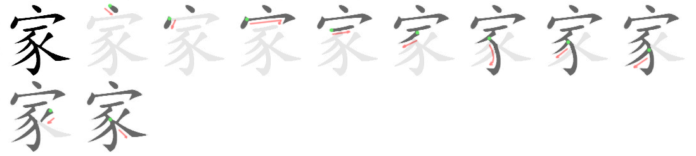
家 (jiā, “home, family”): its sound is the same as 佳 (jiā, “good”), 加 (jiā, “add”) and 甲 (jiǎ, “first”), meaning that for people it is the most important good place. It also indicates that the family should help people develop in a good direction. The family should make people willing to join (加入) it and should add to (增加) people’s happiness, and so on.
The roof component 宀 on top of 家 has a dot and a horizontal stroke, making two, which is yin. Home is where people rest, so it needs to be quiet and peaceful. In addition, the dot on top is a “little extra” (添头), expressing goodwill. In ancient times, anyone doing business would always give customers a little “extra,” a sign of the merchant’s goodwill toward the buyer. Even when it was done to attract repeat customers, it was done in a kindly way. When the family is harmonious, all things prosper; only when family members treat one another with harmony and kindness is it what a home should be.
The 豕 below the roof component is a pig (猪, zhū), which sounds like 住 (zhù, “to live”), indicating that home is where people live. Moreover, in houses of the past people lived upstairs and raised pigs downstairs, which is a vivid portrait of a family dwelling.
Ancient explanations of 家 include:
“家 means dwelling. It takes 宀 as its form, with the phonetic 豭 abbreviated.” (Shuowen)
“家人 (the Family hexagram) is about the inner.” (Book of Changes, “Miscellaneous Notes on the Hexagrams”)
“On superior land, a household of seven people.” (Rites of Zhou, “Xiao Situ”). Commentary: “Only when there is a husband and a wife is there a household.”
“Day and night diligent and clear-minded, he will keep his house.” (Book of Documents, “Gao Mo”)
“Founding states and continuing houses.” (Book of Changes, “Shi” hexagram)
“室 is where husband and wife dwell; 家 means everything within one gate.” (Commentary on Book of Songs, “Zhou Nan, Tao Yao”)
