

This English version was translated from the Chinese original with AI assistance. The Chinese text is authoritative.
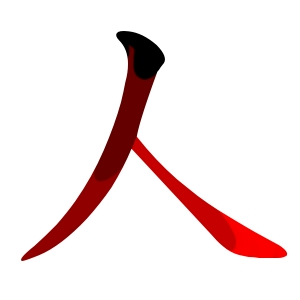
The character 人 explained in detail
At 6:05 a.m. on April 10, 2017, it was showering in Longshan Town, Cixi City, Zhejiang. In her sleep Ms. Long faintly heard a strange noise from the roof. At first she paid no attention, turned over and went back to sleep; but unexpectedly, a few minutes later, the whole roof collapsed, and thick roof beams came crashing down together with a mass of tiles and rubble. The room spun around her, and Ms. Long, terrified, burrowed under the quilt. Her husband was also frightened, but instinctively turned on his side to shield his wife. Just a few seconds later this couple in their thirties or forties were buried under the rubble with only the quilt between them.
The husband’s body not only bore the weight of hundreds of tiles but his legs were pinned under a roof beam, and he could not move; yet he shielded his wife with all his might, and in the limited space her husband held up, Ms. Long called the police on her mobile phone. At 6:59 a.m., Ms. Long, shielded by her husband, was rescued first; she had only had a fright and was not seriously hurt, and was even able to walk out of the rubble herself with the support of the firefighters. At 7:09, as the firefighters lifted off the whole bedful of rubble along with the quilt, Ms. Long’s husband was also successfully rescued.
This news story vividly reveals the origin and meaning of the character 人 (rén, “person”). The character 人 is made up of a left-falling stroke and a right-falling stroke. In ancient China it was always said that man is on the left and woman on the right, the left being yang and the right yin; so the left-falling stroke on the left stands for the man, and the right-falling stroke on the right for the woman. The man is above the woman, playing a protective role; the woman does her work in the space the man holds up. This very vividly expresses the relationship between man and woman established in traditional Chinese ethics and morality.
The construction and grammar of Chinese are self-defining. This character 人 also defines the meaning of the left-falling and right-falling strokes in character construction: the left-falling stroke represents development from neutrality toward yang, and the right-falling stroke development from neutrality toward yin. From birth, as an infant, a person has no sense of gender; as one gradually grows up and the mind awakens, male and female become distinct — this forms the basic description of human growth.
人 is pronounced the same as 仁 (rén, “benevolence”), 忍 (rěn, “forbearance”) and 认 (rèn, “to recognize”). At the beginning of life, human nature is fundamentally good. People should uphold benevolence, righteousness and morality, and be tolerant and courteous. This is the basic principle of being a person.
The methods of explicating characters used in this series of articles are as follows:
- Same sound, same meaning; same sound, opposite or related meaning: there is a pattern in Chinese characters whereby characters with the same sound often have the same, opposite or related meanings, so that these homophonous characters form a group of characters closely linked in meaning;
- Yin and yang in opposition, interchange and mutual generation: one is yang, two is yin; the left-falling stroke is yang, the right-falling stroke is yin; the form of a character is yang, its pronunciation is yin. The strokes, side components and radicals, and the sound, form and meaning of Chinese characters all have yin and yang aspects, and when these elements make up a character, they are combined according to the laws of yin and yang, the Four Images and the Eight Trigrams;
- Cultural transmission and moral education: the construction of Chinese characters carries strong cultural transmission and moral education; while expressing a certain meaning, it also carries the sense of enlightening the people’s minds;
- In the evolution of Chinese characters, only those that accord with the laws of the universe and all things survive. Therefore, even the changes in pronunciation and form of later ages must accord with the above principles of character construction.
