

This English version was translated from the Chinese original with AI assistance. The Chinese text is authoritative.
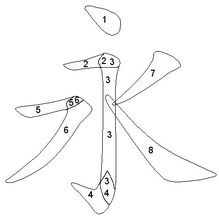
The Eight Principles of 永 (yǒng, “eternal”) use the way the dots and strokes of 永 are written as an example to explain the brushwork and composition of regular script. Tradition attributes them to Zhiyong of the Sui dynasty, or to Wang Xizhi of the Eastern Jin, or to Zhang Xu of the Tang. Because they are the basic rules for writing regular script, later generations also used “the Eight Principles” as another name for calligraphy. The ancients summed up the basic strokes of regular script and their methods of writing as eight: ce 侧 (dot), le 勒 (horizontal), nu 努 (vertical), ti 趯 (), ce 策 (rising horizontal), lüe 掠 (long left-falling), zhuo 啄 (short left-falling) and zhe 磔 (right-falling). These eight strokes and brush methods can conveniently be shown together in the single character 永, and so are called “the Eight Principles of 永.”
The ancients believed that 永 not only covers all the brush methods of regular script, but also that from the start of the first stroke to the finish of the last, there is an implicit, interconnected and mutually responsive path between one stroke and the next; that is, between the dots and strokes there is a momentum in which the form breaks but the intent does not, so that the veins of the whole character, though hidden and curving, flow freely. Every arrival and departure, gathering and dispersing, opening and closing of the dots and strokes is bound up with the others and focused on one point. That is why, according to tradition, many people who practiced calligraphy wrote 永 dozens of times almost every day.
Legend has it that the great Eastern Jin calligrapher Wang Xizhi spent several years writing nothing but 永. He believed that this character contained the eight principles of regular script, and that if one could write 永 well, one could write every character well. Later, Wang Xizhi’s grandson Zhiyong passed these “Eight Principles of 永” on to Yu Shinan, and after that they were handed down by many calligraphers. Legend also says that Wang Xizhi once went to Mount Tiantai and was so deeply captivated by the scenery that he settled on the summit, spending his days enjoying the wondrous sunrise and the seas of cloud and mist, and drawing inspiration for his calligraphy from them. He practiced writing tirelessly every day, constantly washing his brushes and inkstone, until he had actually turned a clear, limpid pool black, which shows how obsessed he was with the study of calligraphy. One night, late, Wang Xizhi was still practicing, writing sheet after sheet of white paper and spreading them all over the floor, yet he was still not satisfied. At last, utterly exhausted, he fell asleep slumped over the desk. Just then a fresh breeze suddenly blew in and a white cloud drifted up; on the cloud was an old man with crane-white hair and a silver beard, who looked at him with a smile and said: “I see you devote yourself to the study of calligraphy every day and work very hard. Now I will teach you a secret of the brush to grasp, which will be of use to you later. Hold out your hand.” Hearing this, Wang Xizhi held out his hand, half believing and half doubting. The old man wrote a character on his palm, then nodded and said: “Your calligraphic skill will become higher and higher.” With that he vanished into the sky. Wang Xizhi hurriedly called out: “Sir, where is your home?” He heard only a faint voice from the sky: “Tiantai, White Cloud…” After the old man had gone, Wang Xizhi looked at his palm and saw it was the character 永. He pondered it all night and at last understood: horizontal, vertical and hook, dot, left-falling and right-falling: the secrets of the strokes and structure of square characters are all embodied in this 永. What a fine secret of the brush Master White Cloud had taught him! From then on Wang Xizhi practiced even more diligently, and his calligraphy became ever freer and more superb. Later, on one occasion when Wang Xizhi gathered happily with friends at the Orchid Pavilion, he took up his brush and wrote the Preface to the Orchid Pavilion Collection, a calligraphic treasure handed down through the ages and praised by all.
