

This English version was translated from the Chinese original with AI assistance. The Chinese text is authoritative.
(Reprinted from the web) (Image source: the web)
In Chinese history there are four famous miswritten characters: the number one miswritten character under heaven, “避”; the most brilliant miswritten character, “富”; the miswritten character with the most to tell, “鱼”; and the most philosophical miswritten character, “流”.
1. The number one miswritten character under heaven: “避” (bì, “to avoid”)
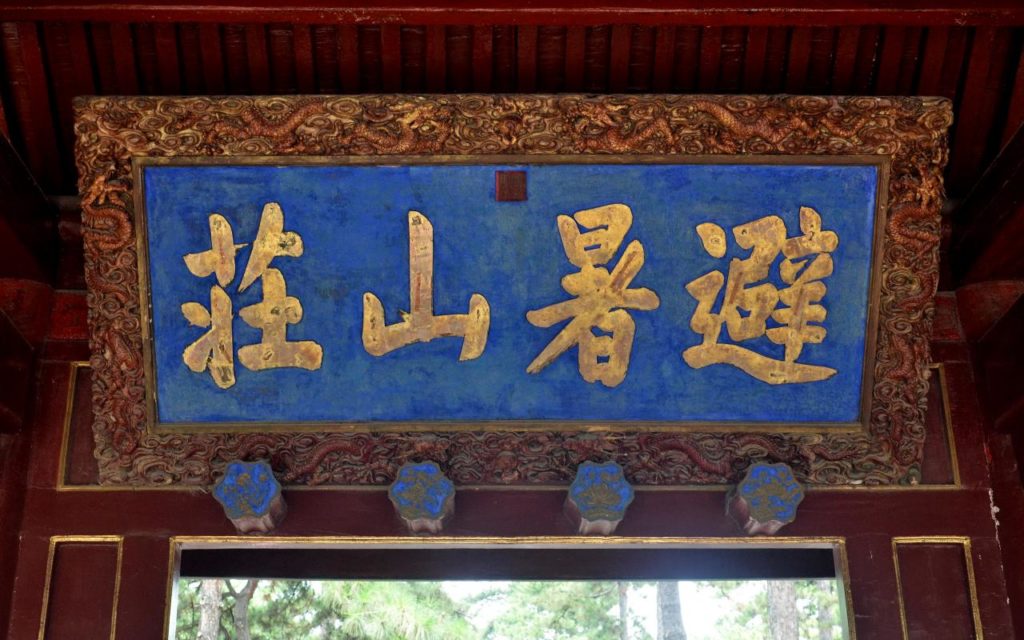
Mountain Resort for Escaping the Heat (inscription by Kangxi)
The four characters “避暑山庄” (Mountain Resort for Escaping the Heat), written by Kangxi’s own imperial hand, still hang at the Chengde Mountain Resort. At a glance one can see that the “辛” on the right of “避” has an extra horizontal stroke at the bottom. Everyone noticed it, but nobody dared say so, because the emperor’s words are golden and jade-like: even if he wrote it wrong, it was right. Thus was born the number one miswritten character under heaven, “避”.
2. The most brilliant miswritten character: “富” (fù, “wealth”)
(Image source: image from the web)
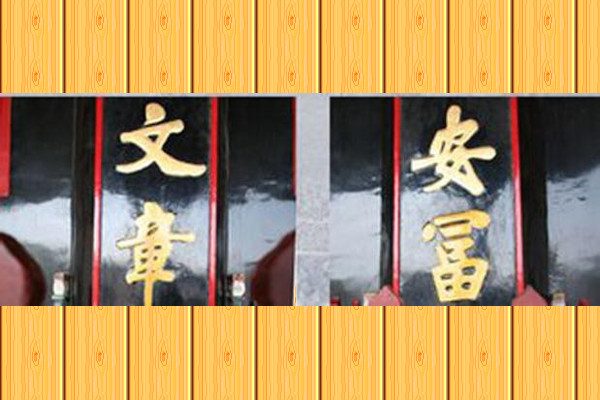
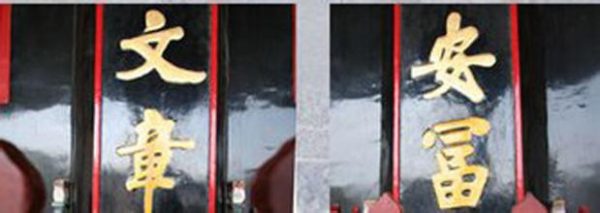
The Kong Family Mansion in Qufu, Shandong, can be called the most cultured place under heaven, yet visitors to the mansion can see conspicuous miswritten characters before they even enter the gate. On either side of the mansion gate hangs a couplet that reads: “Sharing peace with the state, wealthy, honoured and glorious: the mansion of the Duke; growing old together with heaven, in letters and virtue: the family of the Sage.” In the first line, the character “富” lacks the dot on top, so the roof component 宀 has become the bald-roof component 冖. In the second line, the vertical stroke at the bottom of “章” runs all the way through to the top.
This couplet is said to have been written by the Qing grand secretary Ji Xiaolan. Would Ji Xiaolan, the illustrious “Talent of Hejian” and chief compiler of the Complete Library of the Four Treasuries, write characters wrongly? And on the gate pillars of the mansion of the Duke Yansheng, “the first family under heaven,” at that? So some people believe that Ji Xiaolan miswrote the characters on purpose. Why miswrite them? Because there is a hidden meaning.
They interpret it like this: the roof on “富” in the first line lacks a dot, meaning “wealth and honour without a ceiling”; in the second line the vertical stroke of “章” breaks out through 日 (the sun), meaning “writings that reach heaven.” And they crowned the two characters “the most cultured miswritten characters.”
In fact, in ancient times both these ways of writing “富” and “章” were standard; they were widely used as popular or accepted variants of the two characters, and were only eliminated later in the process of simplifying Chinese characters.
3. The miswritten character with the most to tell: “鱼” (yú, “fish”)
(Image source: the web)
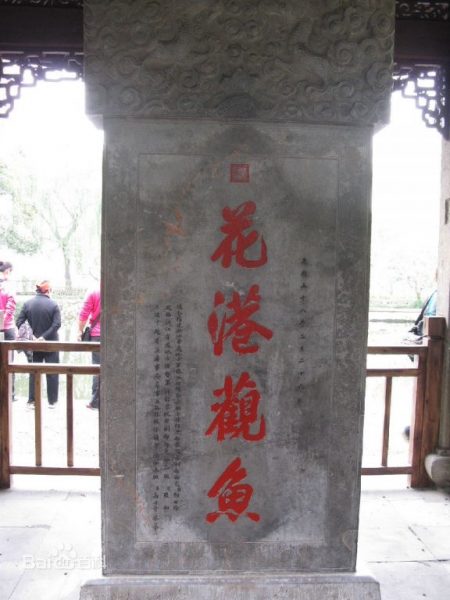
This too was inscribed by Kangxi. “Viewing Fish at Flower Harbour” is one of the Ten Scenes of West Lake, and the stele “花港观鱼” is also in Kangxi’s imperial hand. On the stele, the four dots at the bottom of the character “鱼” have become three dots, one dot short. There is a legend about this: it was not that Kangxi couldn’t write the character, but that he “miswrote it on purpose.”
Kangxi believed in Buddhism and had the virtue of cherishing life. When writing the inscription, he thought the four dots under “鱼” were not good, because four dots represent “火” (fire). With the fish roasting over a fire, how could it live? That would be killing a living creature, so he deliberately wrote one dot fewer.
4. The most philosophical miswritten character: “流” (liú, “to flow”)
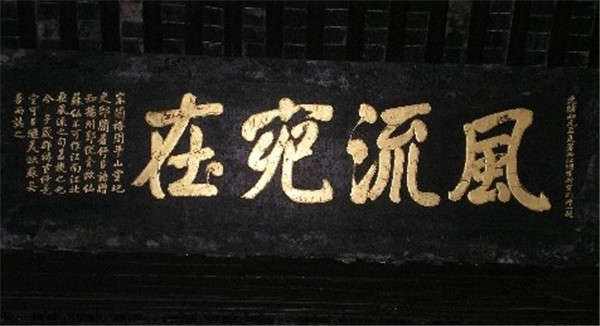
Pingshan Hall at Daming Temple (Image source: the web)
In Pingshan Hall at Daming Temple in Yangzhou, Jiangsu, the plaque “风流宛在” (“his elegant charm seems still present”) on the left of the main hall was written by Liu Kunyi, Viceroy of Liangjiang under the Guangxu Emperor of the Qing. It is said Liu Kunyi wrote it in memory of Ouyang Xiu, who had once governed Yangzhou. There are two miswritten characters among the four characters “风流宛在”: “流” is missing a dot, and “在” has an extra dot.
It turns out that the great historical figure Ouyang Xiu was a “romantic prefect” while in Yangzhou, and had quite a few amorous affairs at the feet of the beauties of Yangzhou, peerless in looks and talent. Liu Kunyi deliberately wrote the “流” of “风流宛在” with one dot fewer and “在” with one dot more. The meaning goes without saying: he hoped for a little less romance (风流) and a little more substance (实在). It is full of philosophy.
From the four famous miswritten characters above, we can see that the ancients really were very witty. Whether intentional or not, the “mistake” was made, and it even became a celebrated tale.
