

This English version was translated from the Chinese original with AI assistance. The Chinese text is authoritative.
Forty or fifty years ago, one Asian country after another abolished Chinese characters; now they all deeply regret it.
The Korean Institute of Chinese Art recently announced that a national-treasure-level artifact plundered by Japan in the Goryeo period (about a thousand years ago), Lotus Sutra, Scroll One, will soon be returned to South Korea.
The Sutra of the Lotus of the Wonderful Law, known for short as the Lotus Sutra, contains the teachings of the Buddha Shakyamuni in his later years. Its content is supreme; it makes clear that all people, regardless of wealth or rank, can attain Buddhahood, and it is one of the early scriptures of Mahayana Buddhism. The Lotus Sutra is a Mahayana scripture of far-reaching influence in the history of Buddhism. Because its translation is fluent, its language beautiful, its parables vivid and its doctrine complete, reading and reciting this sutra is the most common practice among Buddhists.
Korea is also one of the countries deeply influenced by Chinese Buddhism, so the Lotus Sutra was transmitted from China to Korea very early.
The Lotus Sutra, Scroll One that Japan intends to return to South Korea is 12.7 cm long and 34.5 cm wide, a folded book printed on both sides. Its cover is made of gold and silver leaf, and its illustration, the ” frontispiece picture “, is pressed in pure gold. The Goryeo strongman Choe U ordered it carved and printed in 1240. The Lotus Sutra has 7 scrolls in all; the scrolls preserved in South Korea have been designated National Treasures No. 692 and No. 977.
Experts say this scroll of the Lotus Sutra is very well preserved, excellent in both clarity and condition; few of the scrolls held in South Korea can match it.
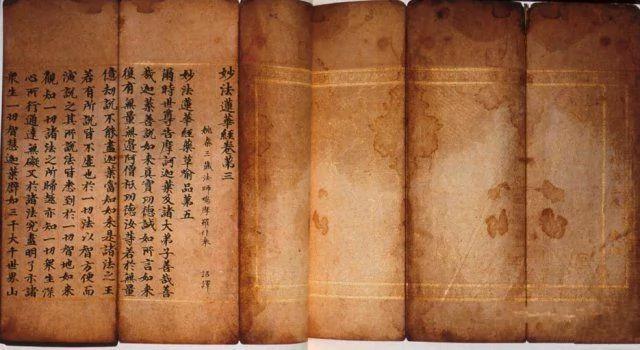
A Lotus Sutra held in South Korea’s own collection
Awkwardly, however, even if this thousand-year-old sutra returns to South Korea, most South Koreans will be unable to read or appreciate it, because the entire scripture is printed in Chinese characters, and South Korea abolished Chinese characters more than 40 years ago. Now, facing a national-treasure-level piece, they can only sigh at the “script” they cannot read. Their regret comes too late!
In fact, the countries of East and Southeast Asia have throughout history had countless ties with China. They were either China’s own territory or its vassal states, and in language and culture they held Chinese in the highest esteem. Traces of Chinese characters can still be seen everywhere in places such as Japan and South Korea today. South Korea had always used Chinese characters; only in 1970 did then-President Park Chung-hee order a full switch to Korean-script education, completely erasing Chinese characters from educational institutions and official documents.
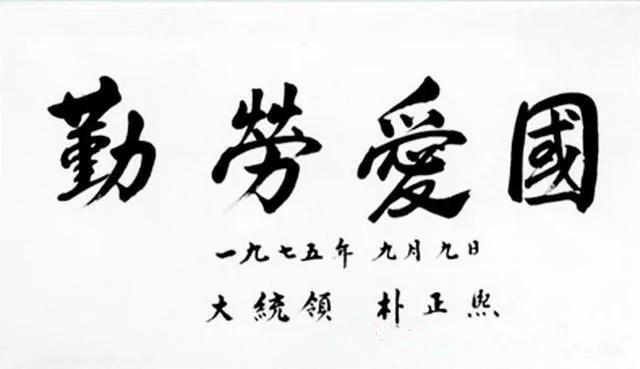
Calligraphy by Park Chung-hee
When the abolition of Chinese characters began, it enjoyed broad public support, because people felt that by abolishing Chinese characters the Korean nation would become one of the great peoples of the world. But Chinese characters, as a tool for expressing feelings and meaning, had long permeated every aspect of Korean life, and it was very difficult to purge them from people’s lives all at once. For Korean script is itself an immature writing system: it is merely phonetic, with many homophones, which leads to confusion of meaning in communication. For precisely this reason, South Korean identity cards still retain the corresponding Chinese characters, to avoid misunderstandings.
When Park Chung-hee introduced the policy of abolishing Chinese characters, he did not foresee that it would bring so many inconvenient consequences, so many South Koreans now regret that rash and impulsive decision.
More importantly, South Korea’s classic ancient books, its history and so on were all written in Chinese characters. Once the characters were abolished, the transmission of Korea’s history was forcibly severed.
In addition, many of South Korea’s historical sites are inscribed in Chinese characters. A few generations from now, will Korean children walking past their own front doors feel as if they were in China? If so, it would be truly absurd.
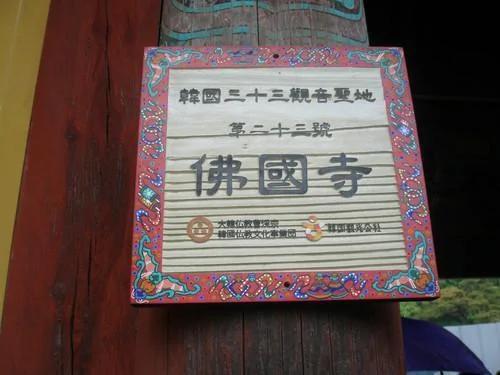
A historic site in South Korea
Having suffered enough, South Koreans already regret their willfulness and arrogance, and calls to restore Chinese characters are growing louder. South Korea’s Ministry of Education has announced that from 2019, textbooks for fifth and sixth grades in primary schools nationwide will be annotated with Chinese characters along with their pronunciations and meanings. And some South Korean parents are already teaching their children Chinese characters in advance.
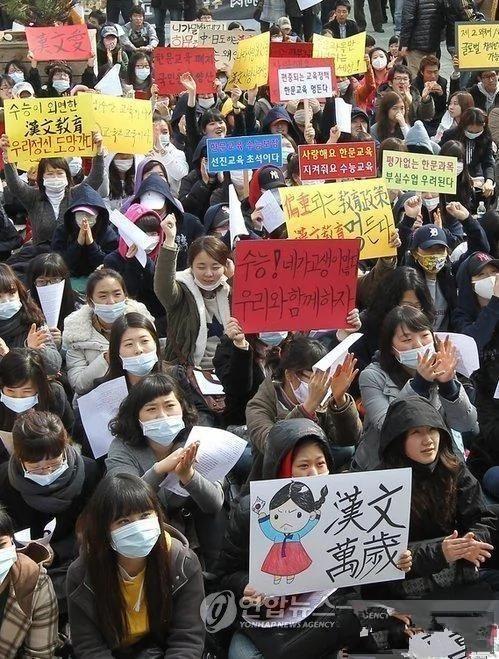
Have the regretful South Koreans ”awakened“?
Similarly to South Korea, Japan after the Second World War also tried to abolish Chinese characters, but soon discovered that abolishing them was not as simple as imagined. Since Chinese characters were introduced to Japan from China, they have deeply permeated the daily life of the Japanese. Rejecting the Chinese characters in Japanese would be no different from rejecting the country’s own culture and history. On this point, the Japanese have shown more good sense than the Koreans.
