

This English version was translated from the Chinese original with AI assistance. The Chinese text is authoritative.
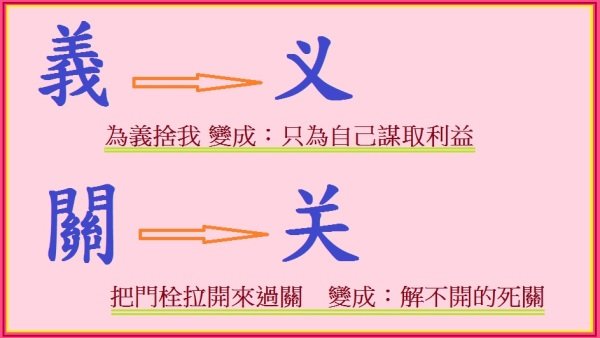
Chinese characters, the divinely imparted script of Chinese culture, display a vast inner meaning and profound principles! Chinese characters have spirit, and they all carry omens. But after the characters were simplified, the results have all come true in real life.
Below is a compilation by netizens showing that Chinese characters have spirit and carry omens. After reading it, you are guaranteed to break out in a cold sweat.
When 親 (qīn, “kin”) is simplified to 亲, kin no longer see (見): you can hardly see your parents once a year. Sowing seeds carelessly wherever one strays, one rarely has one’s children nearby.
When 產 (chǎn, “to produce”) is simplified to 产, production no longer gives birth (生): abortions are seen everywhere. Good farmland lies abandoned everywhere; people want no grain, only money.
When 鄉 (xiāng, “village”) is simplified to 乡, the village has no young men (郎): every one of them rushes off to the city. Young faces are rarely seen in the village; only the old, the weak, the sick and the disabled remain.
When 愛 (ài, “love”) is simplified to 爱, love has no heart (心): ask how many people are sincere. Casual flings are everywhere; as long as there is money, you are “dear.”
When 備 (bèi, “to prepare”) is simplified to 备, preparation has no person (人): are reserves to depend on the gods of heaven? Resources are exhausted and farmland all taken over; people give no thought to their descendants, only to themselves.
When 廠 (chǎng, “factory”) is simplified to 厂, the factory is empty: enterprise funds are poured into buildings. With exorbitant taxes and arbitrary fees, people leave, the buildings stand empty, and poverty naturally follows.
When 麵 (miàn, “flour”) is simplified to 面, flour has no wheat (麥): guess the reason for yourself. Flour has no fragrance of wheat; in fact it is adulterated with rongalite.
When 進 (jìn, “to advance”) is simplified to 进, advancing goes badly (no longer 隹, but a well 井): walk into a well and become fish and shrimp. A career is like the moon in the water; seeking wealth is like flowers in a mirror.
When 應 (yīng, “should; to respond”) is simplified to 应, response has no heart (心): verbal promises rarely come true. Scheming and shameless, no wonder there is no good faith left in the world.
When 衛 (wèi, “to defend”) is simplified to 卫, defense has no marching (行): how can one go on a distant campaign? If one cannot even protect one’s own home, how can all under heaven enjoy peace?
When 聽 (tīng, “to listen”) is simplified to 听, listening lacks the ear (耳): don’t laugh at this claim. Go and look at a big meeting: how many are not asleep?
When 導 (dǎo, “to guide”) is simplified to 导, guidance has no Dao (道): how can teaching use such a trick? Talking off the top of one’s head as one pleases, self-righteous and shameless.
When 優 (yōu, “excellent”) is simplified to 优, the excellent should be worried (憂): of all people, those who worry for the world are the hardest to find. Copying another’s faults is an even greater offense (尤); such people make one sad.
When 採 (cǎi, “to pick”) is simplified to 采, picking has no hand (扌): where can such gain be had? Everyone wants something for nothing, and everyone seeks to get ahead by trickery.
When 嘗 (cháng, “to taste”) is simplified to 尝, tasting has no mouth (口): good or bad, everything just follows feeling. Don’t dream of delicacies from land and sea; firewood, rice, oil and salt are worry enough.
When 孫 (sūn, “grandson”), made of 子 and 系 (“lineage”), is simplified to 孙: 子+小 and 子+系 are very different. 子+小 (a small son) is, after all, still a son; could the daughter-in-law have stolen the father-in-law?
When 實 (shí, “solid; real”) is simplified to 实, substance has no strings of cash (貫): there is no money stored at home. With only heads and no money to spend, such “prosperity” is truly pitiful.
When 質 (zhì, “quality”) is simplified to 质, quality goes bad: everyone is harmed. Food laced with poison and faked: this is the greatest sorrow of China!
When 敵 (dí, “enemy”) is simplified to 敌, the tongue (舌) becomes the enemy: be careful with your words and speeches. “A hundred schools contending” is mere decoration; you must speak in the same tone as me.
When 舘 (guǎn, “hall”) is simplified to 馆, the lodging (舍) is pushed aside: everything puts food (饣) first. Schools and martial-arts halls are rice buckets; the story of wine sacks and rice bags continues.
When 恥 (chǐ, “shame”) is simplified to 耻, shame has no heart (心): conscience is utterly lost and hard to restrain. Instead of helping the weak, one encroaches on them.
When 歷 (lì, “to pass through; history”) is simplified to 历, history has no sun (日): if I did not say it, you would not know. Without the sun there is endless night; in hard days, do not be extravagant.
When 寧 (níng, “peace”) is simplified to 宁, peace has no heart (心): put this way, no one believes it. Disaster strikes while sitting at home: forced demolitions, officials harassing the people.
When 勝 (shèng, “victory”) is simplified to 胜, victory has no token (券): one can only drag out an ignoble existence. Facing the powerful, one wears a servile face; meeting the weak, a ferocious one.
When 傑 (jié, “hero”) is simplified to 杰, heroes have no person (亻): how can great deeds be achieved? Names that don’t match reality are everywhere; inferior goods pass as good, the fake confounds the real.
When 歡 (huān, “joy”) is simplified to 欢, it becomes 又 (again) and 欠 (owe): everyone borrows money and doesn’t want to repay. When the banks press, they run off; they have homes abroad anyway.
When 難 (nán, “difficult”) is simplified to 难, it becomes 又 plus 隹: such simplification is truly absurd. Extreme joy may turn to sorrow, nothing is certain; one sudden change and disaster strikes.
When 邊 (biān, “border”) is simplified to 边, the border has nothing at its side: walking takes effort and looks bad (力). Mongolia was originally Chinese land; does it still count as a frontier pass?
When 癡 (chī, “foolish”) is simplified to 痴, doubt (疑) turns into knowing (知): to know while sick, you call that foolish. Lies upon lies cannot be exposed; is only muddle-headedness wise?
When 筆 (bǐ, “pen”) is simplified to 笔, the pen is no longer straight (聿): history is often written with a crooked pen. Writing history straight has always existed, but nowadays that tradition has long been lost.
When 樂 (yuè/lè, “music; joy”) is simplified to 乐, music has no silk strings (絲): whether you are joyful, you know yourself. Only a wooden frame with silk and bamboo can be called music; being told you are happy is hard to believe.
When 驚 (jīng, “alarm”) is simplified to 惊, the heart (心) harbors the capital (京): can it be that the officials harm the common people? Since ancient times only horses (馬) took fright; now it is people who are alarmed.
When 賓 (bīn, “guest”) is simplified to 宾, soldiers (兵) come into the house: since ancient times this has been called a sign of troubled times. When an honored guest comes and the cowrie (貝) is missing, sincere feasting and hospitality are gone.
When 慄 (lì, “to tremble”) is simplified to 栗, trembling has no heart (心): no one believes in fear of the law. Corruption is everywhere; power replacing law is the reality.
When 懷 (huái, “to cherish”) is simplified to 怀, the heart says no (不): if the heart is unwilling, how can it be called cherishing? With hearts unreconciled and people unhappy, few faces break into smiles.
When 豐 (fēng, “abundant”) is simplified to 丰, abundance is rotten through: the ears of wheat have no enclosure, and the vessel (豆) is missing too. Harvest figures are fabricated; every year output is said to be high.
When 窮 (qióng, “poor”) is simplified to 穷, the poor are not poor: rich men live in subsidized housing. Insatiably greedy, only regretting they have too little: such a world is truly unjust.
When 達 (dá, “to reach”) is simplified to 达, reaching may not reach: all depends on one word from the official. If you say go down, down it must go; if you say it reaches up, up it reaches.
When 礎 (chǔ, “foundation”) is simplified to 础, stone (石) and out (出) make the foundation: no wonder foundations are not solid. Broken roads, collapsed bridges, flimsy buildings; people submit in word but not in heart.
When 矇 (méng, “blind”) is simplified to 蒙, blindness has no eye (目): self-immolations are turned a blind eye to. Everyone says that only with a settled home can one work happily, yet to grab money they harm the innocent.
When 廟 (miào, “temple”) is simplified to 庙, the temple no longer has the court of worship (朝): atheism is the creed. If one fears neither ghosts nor gods, one naturally schemes boldly.
When 網 (wǎng, “net”) is simplified to 网, the net has no silk (糸): truly many fish slip through the net. The law is like silk thread; when power replaces law, there are no rules.
When 後 (hòu, “after; descendants”) is simplified to 后, “after” changes into 后: descendants were originally all handsome. This change is too heartless: descendants can have only one mouth (口).
